Owners have filed 1,667 complaints
about the 2015 Hyundai Sonata with NHTSA between 2015 and 2026.
The largest single group is the engine & cooling.
Across this model's run it ranks 2 of 32 worst.
The letter says how bad. This says what kind — whether this year drew
an unusual number of complaints, unusually dangerous
ones, or failures that arrived unusually early.
The dashed ring is 50 — the national norm. Further out is worse.
Complaint volume — 100
Against the median year of the Hyundai Sonata. 50 means typical for this
model; 100 means roughly double.
Severity — 58
11.3% of these complaints
involved a crash, fire, injury or death, against a national rate of
9.7%.
Early failure — 63
37% of failures with a mileage on record happened under
36,000 miles, against a national rate of
29%.
NHTSA files every complaint against a named sub-assembly, not just a
system. This is the difference between knowing it was "the engine" and
knowing which part of it — the list to hand a mechanic.
Body
4756.6%
Sun/Moon Roof Assembly
1012.0%
Automatic Emergency Braking
67.2%
Warnings
67.2%
Adaptive Cruise Control
44.8%
Blind Spot Detection
44.8%
Fuel Pump
44.8%
Accelerator Pedal
22.4%
When it fails
Odometer readings owners gave when they filed. About half of all
complaints include one.
Under 1,000 miles
445.1%
1,000 – 9,999 miles
859.9%
10,000 – 24,999 miles
11112.9%
25,000 – 49,999 miles
14917.4%
50,000 – 74,999 miles
18121.1%
75,000 – 99,999 miles
14917.4%
100,000 – 149,999 miles
10712.5%
150,000+ miles
323.7%
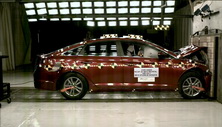
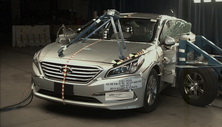
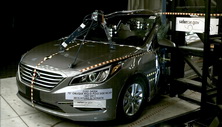
NHTSA crash tests
The agency crash-tested this model year itself. These are its own
photographs and star ratings.
Frontal crash test
Side barrier crash test
Side pole crash test
Photographs taken by NHTSA during its own New Car Assessment Program crash
tests of this model year. Public domain.
Configuration
Overall
Front
Side
Rollover
2015 Hyundai Sonata 4 DR FWD
10.5% risk
When owners complained
A spike years after the car went on sale usually means a part wearing
out on schedule across the whole fleet — the kind of pattern no single
owner can see from inside their own car.
Jan 2015peak 30Sep 2026
NHTSA investigations into the 2015 Hyundai Sonata
An investigation is the step before a recall: the agency has seen enough
complaints to look into a pattern itself. An open one means it thinks
something may be wrong and nothing has been fixed yet.
DP22003Opened 12 Sep 2022Closed 12 Dec 2023ENGINE
Loss of Motive Power
The National Highway Traffic Safety Administration (NHTSA) received a letter dated July 13, 2022, petitioning the Agency to initiate a safety defect investigation into loss of motive power allegations attributed to oil drain pan assembly failures on certain Hyundai Motor America, Inc. and Kia America, Inc. vehicles spanning Model Years (MY) 2005-2021. The Petitioners cited examples of complaints indicating that the subject vehicles were experiencing rapid loss of engine oil due to oil drain plug back outs, resulting in loss of motive power and/or catastrophic engine damage. Additional complain...
EA21003Opened 22 Dec 2021Closed 5 Feb 2024ENGINE
Engine Fires
On March 29, 2019, the Office of Defects Investigation (ODI) opened two Preliminary Evaluations (PE19-003 on Hyundai and PE19-004 on Kia) to broadly investigate incidents of non-crash fires (regardless of origin or operational status of the vehicle) on various model year Hyundai and Kia vehicles. During the PE investigations, Hyundai and Kia issued several recalls to address vehicle fires, including those due to engine failures involving various engine types. The remedies for the engine failure recalls typically involve engine inspection (to detect existing damage), and if necessary, engine...
DP21003Opened 12 Nov 2021Closed 20 Jun 2023VEHICLE SPEED CONTROL:THROTTLE
Throttle control system vulnerabilities
The Office of Defects Investigation (ODI) of the National Highway Traffic Safety Administration (NHTSA) received a petition letter dated October 10, 2021, requesting an investigation of possible defects in the electronic throttle control (ETC) system on certain Kia vehicles resulting in the opening of DP21-003. Accordingly, Model Year (MY) 2005-2016 Kia Optima/K5, MY 2006-2015 Kia Sorento, MY 2007-2016 Hyundai Elantra, MY 2007-2016 Hyundai Santa Fe, MY 2006-2015 Hyundai Sonatas are all part of the subject population. The petition was originally filed as a Vehicle Owner Questionnaire that can b...
EA19001Opened 19 Apr 2019Closed 19 Sep 2024AIR BAGS: AIR BAG/RESTRAINT CONTROL MODULE
Electrical overstress
The Office of Defects Investigation (ODI) opened this investigation to determine if the failure of airbags to deploy during severe crashes, in certain vehicles, was the result of a safety related defect. During the investigation a complex failure was studied that can result in non-deployment of subject vehicle air bags and other restraint system devices in severe crash events. The subject vehicles may be equipped with an airbag control unit (ACU) for the supplemental restraint system (SRS) Electronic Control Unit (ECU) manufactured by ZF-TRW. The ECU receives signals from crash sensors mount...
Recalls on the 2015 Hyundai Sonata
A complaint is one owner's allegation. A recall is the point at which
the manufacturer or a regulator agreed the defect is real and dangerous
enough to fix for free — however old the car is.
United States — NHTSA
21V749000
EXTERIOR LIGHTING:TURN SIGNAL
Hyundai Motor America (Hyundai) is recalling certain 2015-2017 Sonata, 2016-2017 Sonata Hybrid, and Sonata Plug-In Hybrid vehicles. The Smart Junction Box (SJB) software logic may not properly interpret the signals received from the multifunction switch, which could cause the turn signal to activate in the opposite direction of what the driver intended.
Risk: A turn signal that activates in the opposite direction of what was intended by the driver increases the risk of a crash.
17V359000
PARKING BRAKE:INDICATOR LIGHT
Hyundai Motor America (Hyundai) is recalling certain 2015-2016 Sonata and Genesis vehicles. In the affected vehicles, the warning light to indicate that the parking brake is applied may intermittently not illuminate in the dash due to corrosion in the switch.
Risk: If the parking brake indicator is not illuminated when the parking brake is applied, the driver may operate the vehicle with the parking brake partially engaged, increasing the risk of a crash.
16V726000
VISIBILITY:SUN/MOON ROOF ASSEMBLY
Hyundai Motor America (Hyundai) is recalling certain model year 2015-2016 Sonata Hybrid vehicles manufactured December 8, 2014, to August 18, 2015, and Hyundai Sonata vehicles manufactured May 28, 2014, to March 18, 2016, equipped with the panoramic sunroof option. Due to a bonding issue with the sunroof wind deflector, the sunroof panel on the affected vehicles may detach while driving.
Risk: If the sunroof detaches from the vehicle it could become a road hazard, increasing the risk of a crash.
16V232000
AIR BAGS:FRONTAL
Hyundai Motor Company (Hyundai) is recalling certain model year 2015-2016 Sonata vehicles manufactured May 29, 2014 to February 11, 2016, 2017 Elantra vehicles manufactured January 12, 2016 to February 22, 2016, and one 2016 Sonata Hybrid vehicle manufactured October 15, 2015. In these vehicles, the driver's frontal air bag may be missing a chemical enhancer required for the second stage air bag deployment, resulting in the second stage not deploying in certain crashes. The primary stage will deploy as intended.
Risk: An air bag that does not inflate increases the risk of injury.
15V678000
ELECTRICAL SYSTEM: INSTRUMENT CLUSTER/PANEL
Hyundai Motor America (Hyundai) is recalling certain model year 2015-2016 Sonata vehicles manufactured May 28, 2014, to August 21, 2015. The affected vehicles are equipped with an Antilock Braking System (ABS) warning light intended to warn the driver if there is an ABS malfunction. In the event of an ABS malfunction, the Brake System warning light will illuminate, but the ABS warning light will not illuminate. Since the vehicles have ABS malfunction lights that do not illuminate, these vehicles fail to comply with the requirements of Federal Motor Vehicle Safety Standard (FMVSS) number 135, "Light Vehicle Brake Systems."
Risk: If the driver is alerted there is a brake system malfunction, but not specifically with the ABS system, the driver may operate the vehicle unaware that the vehicle's brakes may lock up during hard braking, increasing the risk of a crash.
15V414000
SEAT BELTS:FRONT:BUCKLE ASSEMBLY
Hyundai Motor America (Hyundai) is recalling certain model year 2015 Sonata vehicles manufactured April 25, 2014, to December 4, 2014. The affected vehicles have a front passenger seat belt whose buckle latch assembly may prevent the front passenger from fastening the seat belt.
Risk: If the front passenger seat belt cannot be latched, an occupant sitting in the front passenger seat has an increased risk of injury in the event of a crash.
14V784000
POWER TRAIN:AXLE ASSEMBLY:AXLE SHAFT
Hyundai Motor America (Hyundai) is recalling certain 1.6 liter model year 2015 Sonata vehicles manufactured August 29, 2014, to October 28, 2014. The affected vehicles may have been assembled with an incorrect left axle shaft which may result in the shaft separating from the transaxle differential.
Risk: If the left axle shaft separates from the transaxle, the vehicle may stop moving, increasing the risk of a crash. Additionally, a separated axle shaft may allow the vehicle to roll away as the driver and other occupants exit the vehicle or anytime thereafter. A vehicle rollaway increases the risk of injury to exiting occupants and bystanders.
14V368000
SERVICE BRAKES, HYDRAULIC:FOUNDATION COMPONENTS:DISC:CALIPER
Hyundai Motor Company (Hyundai) is recalling certain model year 2015 Sonata vehicles manufactured April 25, 2014, through June 16, 2014. Due to a manufacturing error, one or both of the front brake calipers may fracture.
Risk: If a brake caliper fractures, brake effectiveness would be reduced, lengthening to distance required to stop the vehicle, increasing the risk of a crash.
Canada — Transport Canada
Canada runs its own recall programme, and its campaigns do not
always mirror the American ones.
Recall 2024080353,849 units in Canada
Brakes
Issue: On certain vehicles, brake fluid could leak into the control module for the antilock brake system (ABS) and cause it to short circuit. Note: This recall replaces recall R0246 (Transport Canada recall number 2023-527). For the Sonata model, only the Sonata Hybrid model is affected by this recall. Safety Risk: A short circuit could create a fire risk, even while the vehicle is parked and turned off. Corrective Actions: Hyundai will notify owners by mail and advise you to take your vehicle to a dealership to replace the fuse for the ABS module. Hyundai recommends that you should park your vehicle outdoors and away from other vehicles or structures until the recall repairs have been completed.
Recall 20231043,494 units in Canada
Electrical
Issue: Hyundai is conducting a special service campaign to upgrade the safety plug fuse. On certain Sonata Hybrid (HEV) models, the safety plug fuse in the power relay assembly could blow and cause a sudden loss of hybrid system power. Safety Risk: A loss of hybrid system power may increase the risk of a crash. Corrective Actions: Hyundai will notify owners by mail and instruct you to take your vehicle to a dealership to replace the 125-A safety plug with one that has a 150-A rating.
Recall 202161251,508 units in Canada
Engine
Issue: Hyundai Auto Canada is conducting a Product Improvement Campaign that provides an update to the engine control module to detect potential problems before an engine fails. An engine failure would cause a sudden loss of power with an inability to restart. Note: This only affects vehicles equipped with a 2.4 L MPI engine. For the Sonata model, only the Sonata Hybrid is affected by this campaign. All vehicles previously included in TC # 2021-033 are now part of this new campaign. Vehicles that were previously repaired under campaign R0181 (Transport Canada #2021-033) do not require this software update. Safety Risk: A sudden loss of engine power could increase the risk of an accident. An engine failure could also create the risk of a fire. Corrective Actions: The company will notify owners by mail. Owners will be instructed to take their vehicle to a dealer to update the software for the engine control module. Note: Hyundai recommends that you should always follow the correct vehicle maintenance schedule, which is printed in the Owner's Manual. If you experience unusual engine noise, reduced power, or a check engine/oil warning light, Hyundai advises you to immediately visit a Hyundai dealership to have your vehicle diagnosed.
Recall 202158930,525 units in Canada
Lights And Instruments
Issue: On certain vehicles, an intermittent problem could cause the turn signals to activate in the opposite direction from what a driver intends. For example, when the driver uses the right turn signal, the left signal could turn on. Note: For 2016 and 2017 models, the Sonata Hybrid and Sonata Plug-In Hybrid (PHEV) models are also affected by this recall. Safety Risk: Turn signals that do not work properly may cause confusion and could increase the risk of a crash. Corrective Action: Hyundai will notify owners by mail and instruct you to bring your vehicle to a dealer to update the Smart Junction Box software.
Recall 2019640275,533 units in Canada
Engine
Issue: Hyundai Auto Canada is conducting a Product Improvement Campaign that provides an update to the engine control module to detect potential problems before an engine fails. An engine failure would cause a sudden loss of power with an inability to restart. Note: This affects Sonata and Santa Fe Sport equipped with a 2.4 L GDI or 2.0 L Turbo GDI engine, as well as Tucson equipped with a 2.4 L GDI engine. Safety Risk: A sudden loss of engine power could increase the risk of an accident. Corrective Actions: The company will notify owners by mail. Owners will be instructed to take their vehicle to a dealer to update the software for the engine control module. Note: Vehicles previously repaired under Product Improvement Campaign R0153 (TC # 2019-130) do not require this software update. Owners can find additional information at <a href="http://www.hyundaiengineinfo.ca">www.hyundaiengineinfo.ca</a>.
Recall 2019130255,370 units in Canada
Engine
Issue: Hyundai Auto Canada is conducting a Product Improvement Campaign that provides an update to the engine control module to detect potential problems before an engine fails. An engine failure would cause a sudden loss of power with an inability to restart. Note: This affects Sonata and Santa Fe Sport equipped with a 2.4 L GDI or 2.0 L Turbo GDI engine, as well as Tucson equipped with a 2.4 L GDI engine. Safety Risk: A sudden loss of engine power could increase the risk of an accident. Corrective Actions: The company will notify owners by mail. Owners will be instructed to take their vehicle to a dealer to update the software for the engine control module. Note: Vehicles repaired under Service Campaigns, C0336, C0344, or C0347, already have this software update. Owners can find additional information at <a href="http://www.hyundaiengineinfo.ca">www.hyundaiengineinfo.ca</a>.
Recall 20190127,027 units in Canada
Engine
Issue: When repairs were completed under recall campaign 2015-428 (Hyundai #R0101) or 2017197 (Hyundai #R0130), the high pressure fuel pipe may not have been properly installed on the fuel pump outlet. A fuel leak could occur if the pipe was damaged, misaligned or improperly torqued during the recall repair. Safety Risk: Leaking fuel in the presence of an ignition source could increase the risk of a fire causing injury and/or property damage. Corrective Actions: The company will notify owners by mail. Owners will be instructed to take their vehicle to a dealer for an inspection. If fuel leakage is detected, the fuel pipe will be replaced with a new one.
Recall 201723556 units in Canada
Lights And Instruments
Certain vehicles may fail to comply with the requirements of Canada Motor Vehicle Safety Standard 108 - Lighting System and Retroreflective Devices. The headlamp bulb type markings do not comply with the requirements of the standard. Correction: A manufacturing change has been undertaken to prevent this non-compliance condition from continuing. No corrective recall action is required as the non-compliance condition is deemed to be non-safety related.
Reports where the owner recorded a crash, a fire, an injury or a death.
Winter Park FL, FLFire
ENGINE
Vehicle: 2015 Hyundai Sonata VIN: [XXX] Mileage: ~85,000 Description of the Problem: While driving, the vehicle suddenly began producing thick smoke from under the hood without warning. I safely maneuvered to the shoulder to avoid an accident. The engine subsequently seized completely and became inoperable. My mechanic diagnosed this as a known internal manufacturing defect in the Theta II engine (connecting rod bearing failure), a widely documented issue for this model and production year. Oil and coolant levels were confirmed normal with no leaks, ruling out maintenance neglect. I initially paid for an unnecessary starter replacement before this diagnosis was confirmed. This is a serious safety hazard that could cause loss of engine power and control while driving, posing a risk to myself and other drivers on the road. INFORMATION REDACTED PURSUANT TO THE FREEDOM OF INFORMATION ACT (FOIA), 5 U.S.C. 552(B)(6)
NHTSA complaint #11755594 — an unverified report by a vehicle owner.
Pearland, TXCrash
ENGINE
I will take 10k$ for the car or a new engine and steering, damages fixed. . I also need a rental by April 10th and $300 for inconvenience thus far. The engine stalled twice when driving over 2 months! The lawyer won't be forgiving.
NHTSA complaint #11729990 — an unverified report by a vehicle owner.
Branford, CTFire
ELECTRICAL SYSTEM
I was driving on the highway and the engine shut off but everything else remained on. I drifted to the breakdown lane and turned the car off. It would not start again and the car began acting up by turning lights on and off, telling me to check the tire pressure, and not unlocking the doors. I then saw some very light smoke from the engine compartment. I popped the hood and looked and saw a glow on the bottom side of the engine area. Then the car just went up in flames.
NHTSA complaint #11721923 — an unverified report by a vehicle owner.
Branford, CTFire
ENGINE
I was driving on the highway and the engine shut off but everything else remained on. I drifted to the breakdown lane and turned the car off. It would not start again and the car began acting up by turning lights on and off, telling me to check the tire pressure, and not unlocking the doors. I then saw some very light smoke from the engine compartment. I popped the hood and looked and saw a glow on the bottom side of the engine area. Then the car just went up in flames.
NHTSA complaint #11721923 — an unverified report by a vehicle owner.
Alexandria, VACrash
SERVICE BRAKES
I was turning into a parking spot and the car accelerated unexpectedly. I slammed into a snow bank and my front bumper was damaged.
NHTSA complaint #11720509 — an unverified report by a vehicle owner.
Guntown, MS1 injured
ELECTRICAL SYSTEM
My 2015 Sonata will stall out dropping speeds to 12-24 when i slightly merge, when I turn ect. Then it won’t accelerate for what seems like 10 minutes realistically 2 minutes maybe 3 Then will slowly regain speed. I’ve almost wrecked twice Share care with daughter and she’s been victim to it way way more. This is scary and Hyundai won’t stay behind their product Local dealership won’t fix recalls so we have to go over 120 miles for repairs. The recall isn’t even for transmission engine
NHTSA complaint #11711848 — an unverified report by a vehicle owner.
The most recent complaints
In the owners' own words, exactly as filed with NHTSA.
Chesapeake, VA
ENGINE
After receiving the Hyundai Service Campaign 9C2 update on my 2015 Hyundai Sonata on XXX, I have started having jerky acceleration when the car is first started and am driving. Also, while driving at highway speed (~65 mph)) and I take my foot off the accelerator to coast, the engine RPM drops suddenly, anywhere from 250 rpm to 750 rpm, then recovers abruptly to where it was at prior to the drop (typically around 2000 rpm). The engine rpm also drops while driving at slower speeds and recovers but is not as noticeable as it is at highway speeds. It was not doing this prior to the Service Campaign. There are no check engine lights or pending codes. I brought it back to the Hyundai dealer and discussed the issue with them on XXX. They acknowledged it was likely due to the Service Campaign and they did not want to keep the car to look at it and said no damage was being done and it was safe to drive. They said a fix was in the works but did not know how long until it was released and I should receive information in the mail on it. Video link [XXX] INFORMATION REDACTED PURSUANT TO THE FREEDOM OF INFORMATION ACT (FOIA), 5 U.S.C. 552(B)(6)
NHTSA complaint #11763571 — an unverified report by a vehicle owner.
Chesapeake, VA
FUEL/PROPULSION SYSTEM
After receiving the Hyundai Service Campaign 9C2 update on my 2015 Hyundai Sonata on XXX, I have started having jerky acceleration when the car is first started and am driving. Also, while driving at highway speed (~65 mph)) and I take my foot off the accelerator to coast, the engine RPM drops suddenly, anywhere from 250 rpm to 750 rpm, then recovers abruptly to where it was at prior to the drop (typically around 2000 rpm). The engine rpm also drops while driving at slower speeds and recovers but is not as noticeable as it is at highway speeds. It was not doing this prior to the Service Campaign. There are no check engine lights or pending codes. I brought it back to the Hyundai dealer and discussed the issue with them on XXX. They acknowledged it was likely due to the Service Campaign and they did not want to keep the car to look at it and said no damage was being done and it was safe to drive. They said a fix was in the works but did not know how long until it was released and I should receive information in the mail on it. Video link [XXX] INFORMATION REDACTED PURSUANT TO THE FREEDOM OF INFORMATION ACT (FOIA), 5 U.S.C. 552(B)(6)
NHTSA complaint #11763571 — an unverified report by a vehicle owner.
Mineral, VA
POWER TRAIN
In March 2026 Hyundai did an emissions update Campaign 9C2. Since that update my 2015 Hyundai Sonata SE has run rough and shifted hard. Hyundai stopped doing the update in May 2026. Hyundai has not provided any update to fix the problem they created. I am worried the update is damaging the motor and transmission of a car that was running just fine prior to the update.
NHTSA complaint #11763289 — an unverified report by a vehicle owner.
Mineral, VA
ENGINE
In March 2026 Hyundai did an emissions update Campaign 9C2. Since that update my 2015 Hyundai Sonata SE has run rough and shifted hard. Hyundai stopped doing the update in May 2026. Hyundai has not provided any update to fix the problem they created. I am worried the update is damaging the motor and transmission of a car that was running just fine prior to the update.
NHTSA complaint #11763289 — an unverified report by a vehicle owner.
Fairfax, VA
ENGINE
The engine failed due to the known recall defect, dealer confirmed loss of compression in cylinders 2 & 4. I am a federal employee stationed overseas on official duty orders, and Hyundai Motor America is delaying safety recall remedies and buyback negotiations since June 9th.
NHTSA complaint #11761235 — an unverified report by a vehicle owner.
Pottsboro, TX
ENGINE
Engine locked up, crank bearing failure, found out there is known failures with this problem and Hyundai had a class action suit against them in the past and issued lifetime warranty for this engine due to this problem. Took car to local dealer, Clay Cooley in Sherman TX, they have been great but Hyundai corporate has denied the claim stating lack of maintenance records. Car has 175,000 miles on it, I have only owned it for about 5-6,000 miles. I have changed the oil in it twice myself I was able to prove one of those with a receipt but I don't have the other receipt and have been unable to get it. The dealer has records of oil changes up to 150k miles then I was able to find additional proof of other oil changes through car fax at smaller lube shops. The previous owner before me changed their own oil also and did not keep receipts I reached out to them with no luck. Ultimately there is only about a 10k mile gap of unprovable maintenance, this engine model has a known issue, it did not make it to 175k miles without proper maintenance, I can't control what previous owners did with their receipts but lifetime warranty should be lifetime not only if you can prove every detail from people you can't control.
NHTSA complaint #11759964 — an unverified report by a vehicle owner.
Florence, AL
ENGINE
I bought this car new in 2015, when I was at 97000 miles they had to replace the motor and turbo, I am now at 155844 and they are telling me that basically all 4 cylinders have low compression, cylinder 3 is the worst. They are telling me that this car has to have a new motor. I have not done anything to this vehicle to cause no compression. They want me to pay around 8800.00 to get this fixed.
NHTSA complaint #11759071 — an unverified report by a vehicle owner.
San tan Valley, AZ
FUEL/PROPULSION SYSTEM
Issue- fuel pump/supply line causing fuel to leak and fuel smell around the outside of the car. This can cause a major fire, explosion, death for myself and others around me. Problem has been confirmed by auto repair shop. No warning messages on car dash board, just strong smell of gas. Replaced gas cap and smell is still there.
NHTSA complaint #11757985 — an unverified report by a vehicle owner.
Dallas, TX
SERVICE BRAKES
Brake lights not working properly.
NHTSA complaint #11757315 — an unverified report by a vehicle owner.
at 88,000 milesSouthfield, MI
ENGINE
The contact owns a 2015 Hyundai Sonata. The contact stated that while driving on several occasions at various speeds, the vehicle lost power, and the check engine warning light was illuminated. The vehicle was taken to a dealer where it was diagnosed that the engine had failed and needed to be replaced. The vehicle was repaired, but the failure reoccurred within a year. The vehicle was taken back to the same dealer where it was diagnosed and determined that a software update was needed. The vehicle was repaired, but the failure persisted. The vehicle was then taken back to the same dealer, and there was oil on the pistons and a tune-up was needed. The vehicle was repaired, but the failure persisted. The vehicle was taken back to the dealer, where it was advised that an oil consumption test could not be provided until the pistons had failed. The manufacturer was notified of the failure, and a complaint was filed. The failure mileage was approximately 88,000.
NHTSA complaint #11755866 — an unverified report by a vehicle owner.
Menominee, MI
ENGINE
My Hyundai Sonata engine stalled out while driving on the highway. I had it towed to a dealership with the hope they would fix the issue because it was supposed to be covered under warranty from a recall. The dealership said the engine replacement would be covered as long as they got approval from Hyundai. Hyundai apparently only asked that specific dealership for the service records that they had, didn’t even reach out to me or try to find any other service records on the vehicle and denied the claim for “neglect of maintenance” because that dealership only had records from 0-90,000 miles. The dealership got back to me and told me the news and I told them that I will get all service records from 0 miles to current. I got all those records together and sent them to the dealer. A week later they called and said Hyundai was again going to deny my request because of the same “neglect of maintenance” which isn’t true based on the records I have and they have. I have driven the vehicle less than 10,000 miles and there has been nothing wrong with it. No check engine lights ever and regular oil changes.
NHTSA complaint #11756074 — an unverified report by a vehicle owner.
Winter Park FL, FLFire
ENGINE
Vehicle: 2015 Hyundai Sonata VIN: [XXX] Mileage: ~85,000 Description of the Problem: While driving, the vehicle suddenly began producing thick smoke from under the hood without warning. I safely maneuvered to the shoulder to avoid an accident. The engine subsequently seized completely and became inoperable. My mechanic diagnosed this as a known internal manufacturing defect in the Theta II engine (connecting rod bearing failure), a widely documented issue for this model and production year. Oil and coolant levels were confirmed normal with no leaks, ruling out maintenance neglect. I initially paid for an unnecessary starter replacement before this diagnosis was confirmed. This is a serious safety hazard that could cause loss of engine power and control while driving, posing a risk to myself and other drivers on the road. INFORMATION REDACTED PURSUANT TO THE FREEDOM OF INFORMATION ACT (FOIA), 5 U.S.C. 552(B)(6)
NHTSA complaint #11755594 — an unverified report by a vehicle owner.
Greenfield, MA
UNKNOWN OR OTHER
1.) Following Hyundai's 9C2 Campaign update for the ECU that was completed back on May 27th, 2026, my 2015 Sonata went into limp mode [solid check engine light present] while I was accelerating up an on-ramp on the 2nd drive cycle since the update was performed. I was already far away from the dealership so I was forced to limp it to my local shop that I regularly use to have it checked out. It was confirmed that the code on the vehicle was P200A for intake manifold runners. Since the update was for smog regulation, the code was cleared in order to see if it would come back. Since then, it has not, however the vehicle continues to have one persistent problem. The RPMs will dramatically dip and then surge back upwards while the car is coasting (no gas and no brake applied). 70% of the time, you can feel the car violently jerk as it appears to try and correct itself. 2.) I've brought this car to multiple dealerships, have a case open with corporate and have also found that this is a systemic issue with this specific update in these cars. All and all, nothing has been done. I'm repeatedly turned away over and over again because their techs are only permitted to look into it once they have hard evidence of a fault. In this case, that would be a dashboard light. I'm told that I may only return if the check engine light comes back, which as I mentioned previously, posed a HUGE safety risk to myself the first time it appeared. If I can only go 55mph down the highway, I am at risk of being rear-ended or struck in some way. 3.) The problem has not been reproduced by the dealer as they will not test drive it to see the dip and spike. However, the code was still pending for awhile in the vehicle before it cleared it on its own, so that was acknowledged by at least one place. 4.) Vehicle has not been inspected by anyone but a dealership and local mechanic. 5.) No other signs prior to the vehicle limping out on me other than some acceleration concerns on May 27th, 2026.
NHTSA complaint #11755317 — an unverified report by a vehicle owner.
Greenfield, MA
ELECTRICAL SYSTEM
1.) Following Hyundai's 9C2 Campaign update for the ECU that was completed back on May 27th, 2026, my 2015 Sonata went into limp mode [solid check engine light present] while I was accelerating up an on-ramp on the 2nd drive cycle since the update was performed. I was already far away from the dealership so I was forced to limp it to my local shop that I regularly use to have it checked out. It was confirmed that the code on the vehicle was P200A for intake manifold runners. Since the update was for smog regulation, the code was cleared in order to see if it would come back. Since then, it has not, however the vehicle continues to have one persistent problem. The RPMs will dramatically dip and then surge back upwards while the car is coasting (no gas and no brake applied). 70% of the time, you can feel the car violently jerk as it appears to try and correct itself. 2.) I've brought this car to multiple dealerships, have a case open with corporate and have also found that this is a systemic issue with this specific update in these cars. All and all, nothing has been done. I'm repeatedly turned away over and over again because their techs are only permitted to look into it once they have hard evidence of a fault. In this case, that would be a dashboard light. I'm told that I may only return if the check engine light comes back, which as I mentioned previously, posed a HUGE safety risk to myself the first time it appeared. If I can only go 55mph down the highway, I am at risk of being rear-ended or struck in some way. 3.) The problem has not been reproduced by the dealer as they will not test drive it to see the dip and spike. However, the code was still pending for awhile in the vehicle before it cleared it on its own, so that was acknowledged by at least one place. 4.) Vehicle has not been inspected by anyone but a dealership and local mechanic. 5.) No other signs prior to the vehicle limping out on me other than some acceleration concerns on May 27th, 2026.
NHTSA complaint #11755317 — an unverified report by a vehicle owner.
Arnold, MD
ENGINE
Since the 9C2 update on June 24, 2026, my vehicle has not driven the same. I'm experiencing clunky or harsh gear changes at low speeds, especially during stop-and-go driving. When I slow down and then accelerate again, the vehicle sputters or hesitates before responding. While driving at lower speeds, I also feel intermittent skips or small surges, almost like bubbles or brief misfires. These symptoms were not present before the 9C2 update, and they have noticeably affected the drivability of the vehicle. It was suggested the transmission needed time to "relearn" driving patterns, but it has been several weeks with no change
NHTSA complaint #11755188 — an unverified report by a vehicle owner.
Greenfield, MA
FUEL/PROPULSION SYSTEM
1.) Following Hyundai's 9C2 Campaign update for the ECU that was completed back on May 27th, 2026, my 2015 Sonata went into limp mode [solid check engine light present] while I was accelerating up an on-ramp on the 2nd drive cycle since the update was performed. I was already far away from the dealership so I was forced to limp it to my local shop that I regularly use to have it checked out. It was confirmed that the code on the vehicle was P200A for intake manifold runners. Since the update was for smog regulation, the code was cleared in order to see if it would come back. Since then, it has not, however the vehicle continues to have one persistent problem. The RPMs will dramatically dip and then surge back upwards while the car is coasting (no gas and no brake applied). 70% of the time, you can feel the car violently jerk as it appears to try and correct itself. 2.) I've brought this car to multiple dealerships, have a case open with corporate and have also found that this is a systemic issue with this specific update in these cars. All and all, nothing has been done. I'm repeatedly turned away over and over again because their techs are only permitted to look into it once they have hard evidence of a fault. In this case, that would be a dashboard light. I'm told that I may only return if the check engine light comes back, which as I mentioned previously, posed a HUGE safety risk to myself the first time it appeared. If I can only go 55mph down the highway, I am at risk of being rear-ended or struck in some way. 3.) The problem has not been reproduced by the dealer as they will not test drive it to see the dip and spike. However, the code was still pending for awhile in the vehicle before it cleared it on its own, so that was acknowledged by at least one place. 4.) Vehicle has not been inspected by anyone but a dealership and local mechanic. 5.) No other signs prior to the vehicle limping out on me other than some acceleration concerns on May 27th, 2026.
NHTSA complaint #11755317 — an unverified report by a vehicle owner.
Weaverville, CA
ENGINE
Engine / Short block assembly / Connecting rod bearing seizure. The engine suffered a sudden, catastrophic seizure while I was actively driving on a steep incline mountain road with a cliff on one side and forest on other. The vehicle experienced an immediate, total loss of motive power, forcing an emergency maneuver onto the shoulder in 5 seconds with no power steering or power brakes, creating an extreme collision hazard on a high-speed incline. The rod bearing melted due to a manufacture defect and could have also possible caught fire in heavy fire country. The fuel pump was also leaking recently and just replaced. They are nearly $1800 for a new pump because of price gauging because they are in "high demand". The Check Engine Light was solid (not flashing) for a thermostat code (P0128) due to extreme internal friction/heat from the failing bearings. There were no flashing KSDS warnings or physical signs of engine overheating. My car was denied a new engine under a Federally Mandated Warranty explicitly stating the exact symptoms of internal engine defect that happened in my car under "owner neglect" even though I have changed my oil regularly and even before the manufacture recommended time frames to do so. I've changed the valve covers, 02 sensors, thermostats, and plenty more on this car than any other car I have ever owned proving I'm actually an exceptional owner. I remained nice to all corporate staff during this process while they denied my car proper care under a Federal Mandate. I bought this car to believe that Hyundai was a superior company in regards to warranties, price, and function as opposed to the more expensive counterparts of the same class. Which in the end has cost me way more, and almost my life. This car is dangerous and the company has done everything in their power to try to cover it up while placing blame on the very consumers that are believing in them to do better.
NHTSA complaint #11755077 — an unverified report by a vehicle owner.
Morton, IL
ENGINE
Driving vehicle at slow speed crossing an intersection and engine completely shut down. The engine has completely seized and needs replaced due to a known recall. I have only owned the vehicle for 7 months. Hyundai is refusing to pay for engine replacement claiming a previous recall prior to me owning the vehicle should have been completed. I only drove the vehicle 1,000 miles in that time at nothing over 50 mph. There was no notification to me about this recall.
NHTSA complaint #11754029 — an unverified report by a vehicle owner.
Naples, FL
UNKNOWN OR OTHER
I was driving my 2015 Hyundai Sonata approximately 35 mph after leaving the Hyundai dealership following an engine replacement when the hood unexpectedly flew completely open without warning. The hood struck the windshield, completely obstructing my forward visibility and creating an extremely dangerous situation. I was able to safely pull over without causing a collision, but the vehicle sustained extensive damage and was declared a total loss by my insurance company. During the same service visit in which the engine was replaced, the dealership recommended replacing the hood latches, but I declined that repair. Hyundai later informed me that the hood latching system was functioning properly after the engine replacement and that the vehicle passed its post-repair inspection and road test. Approximately one mile after leaving the dealership following the engine replacement, the hood unexpectedly opened while I was driving. There were no hood-ajar warnings, warning lights, or other indications that the hood was not properly secured before the incident. The sudden loss of visibility created a serious risk of a crash that could have resulted in severe injury or death. I am submitting this complaint because I believe this incident represents a significant vehicle safety issue that should be investigated.
NHTSA complaint #11753510 — an unverified report by a vehicle owner.
Naples, FL
STRUCTURE:BODY
I was driving my 2015 Hyundai Sonata approximately 35 mph after leaving the Hyundai dealership following an engine replacement when the hood unexpectedly flew completely open without warning. The hood struck the windshield, completely obstructing my forward visibility and creating an extremely dangerous situation. I was able to safely pull over without causing a collision, but the vehicle sustained extensive damage and was declared a total loss by my insurance company. During the same service visit in which the engine was replaced, the dealership recommended replacing the hood latches, but I declined that repair. Hyundai later informed me that the hood latching system was functioning properly after the engine replacement and that the vehicle passed its post-repair inspection and road test. Approximately one mile after leaving the dealership following the engine replacement, the hood unexpectedly opened while I was driving. There were no hood-ajar warnings, warning lights, or other indications that the hood was not properly secured before the incident. The sudden loss of visibility created a serious risk of a crash that could have resulted in severe injury or death. I am submitting this complaint because I believe this incident represents a significant vehicle safety issue that should be investigated.
NHTSA complaint #11753510 — an unverified report by a vehicle owner.
Naples, FL
VISIBILITY/WIPER
I was driving my 2015 Hyundai Sonata approximately 35 mph after leaving the Hyundai dealership following an engine replacement when the hood unexpectedly flew completely open without warning. The hood struck the windshield, completely obstructing my forward visibility and creating an extremely dangerous situation. I was able to safely pull over without causing a collision, but the vehicle sustained extensive damage and was declared a total loss by my insurance company. During the same service visit in which the engine was replaced, the dealership recommended replacing the hood latches, but I declined that repair. Hyundai later informed me that the hood latching system was functioning properly after the engine replacement and that the vehicle passed its post-repair inspection and road test. Approximately one mile after leaving the dealership following the engine replacement, the hood unexpectedly opened while I was driving. There were no hood-ajar warnings, warning lights, or other indications that the hood was not properly secured before the incident. The sudden loss of visibility created a serious risk of a crash that could have resulted in severe injury or death. I am submitting this complaint because I believe this incident represents a significant vehicle safety issue that should be investigated.
NHTSA complaint #11753510 — an unverified report by a vehicle owner.
North Miami Beach, FL
AIR BAGS
We are the sole owners of the 2015 Hyundai Sonata. Over the years the dashboard has deteriorated and developed cracks along the entire length, including over the area of the passenger airbag. We are currently concerned as to what would happen in the event of an accident that would trigger the air bag causing the dashboard to explode and send splinters all over the place, possibly causing severe damage to the passenger. I took the vehicle to Lehman Hyundai and they could not give me a definitive answer as to whether this was a dangerous situation or not. They gave me an oral estimate of $3,500 just for the part, and who knows what the labor costs would be. Whether I end up donating, gifting or selling the car, I am truly concerned about the safety of this vehicle and the condition it is in.
NHTSA complaint #11753166 — an unverified report by a vehicle owner.
North Miami Beach, FL
UNKNOWN OR OTHER
We are the sole owners of the 2015 Hyundai Sonata. Over the years the dashboard has deteriorated and developed cracks along the entire length, including over the area of the passenger airbag. We are currently concerned as to what would happen in the event of an accident that would trigger the air bag causing the dashboard to explode and send splinters all over the place, possibly causing severe damage to the passenger. I took the vehicle to Lehman Hyundai and they could not give me a definitive answer as to whether this was a dangerous situation or not. They gave me an oral estimate of $3,500 just for the part, and who knows what the labor costs would be. Whether I end up donating, gifting or selling the car, I am truly concerned about the safety of this vehicle and the condition it is in.
NHTSA complaint #11753166 — an unverified report by a vehicle owner.
Dania Beach, FL
ELECTRICAL SYSTEM
This vehicle had a recall, 201, for the smart junction box. This was due to the blinkers not working properly. The software update was performed, however, the problem still exists. This was due to the smart junction box. Now, aside from the blinker issue, the ac stays on when the engine is turned off, lights come on by themselves, the media screen goes randomly into night mode, daylight running lights are constantly in night mode, smart junction box failure. I have not taken this to a mechanic as of yet, the dealership is aware, and I opened a case with Hyundai case #42940056, however, I have not received a call from my service advisor or Hyundai. They offered to do diagnostics, but, if these problems are not about the safety recall, I would have to pay $350 for diagnostics, unless I get the problem fixed by them. This car has 66k miles with a new engine installed at 59400 miles! At this point, I have the car parked, battery disconnected, and looking for the most efficient way to fix the problem, which must be performed by specialized equipment.
NHTSA complaint #11750940 — an unverified report by a vehicle owner.
Jacksonville, FL
ENGINE
On June 22, my 2015 Hyundai Sonata suddenly lost all electrical power without warning. The vehicle stalled and would not restart. There were no warning signs beforehand. After the incident, the car had no electrical power and was inoperable. Further inspection determined that the engine had failed and required replacement. I maintained the vehicle with regular oil changes and was unaware of Hyundai’s Service Campaign 953 (KSDS update). I was never notified that this campaign needed to be completed, and I believe that failure to receive notice contributed to Hyundai’s denial of my engine replacement claim. I purchased the vehicle December 19, 2019. I was never notified by the dealer or manufacturer
NHTSA complaint #11750143 — an unverified report by a vehicle owner.