Owners have filed 1,561 complaints
about the 2019 Honda Cr-V with NHTSA between 2018 and 2026.
The largest single group is the driver assist & collision avoidance.
Across this model's run it ranks 1 of 30 worst.
The letter says how bad. This says what kind — whether this year drew
an unusual number of complaints, unusually dangerous
ones, or failures that arrived unusually early.
The dashed ring is 50 — the national norm. Further out is worse.
Complaint volume — 100
Against the median year of the Honda Cr-V. 50 means typical for this
model; 100 means roughly double.
Severity — 34
6.5% of these complaints
involved a crash, fire, injury or death, against a national rate of
9.7%.
Early failure — 100
79% of failures with a mileage on record happened under
36,000 miles, against a national rate of
29%.
NHTSA files every complaint against a named sub-assembly, not just a
system. This is the difference between knowing it was "the engine" and
knowing which part of it — the list to hand a mechanic.
Automatic Emergency Braking
25866.2%
Warnings
6015.4%
Adaptive Cruise Control
235.9%
Body
174.4%
Warning
112.8%
Assist
92.3%
Blind Spot Detection
61.5%
Fuel Pump
61.5%
When it fails
Odometer readings owners gave when they filed. About half of all
complaints include one.
Under 1,000 miles
5413.1%
1,000 – 9,999 miles
15036.4%
10,000 – 24,999 miles
8119.7%
25,000 – 49,999 miles
7117.2%
50,000 – 74,999 miles
307.3%
75,000 – 99,999 miles
133.2%
100,000 – 149,999 miles
92.2%
150,000+ miles
41.0%
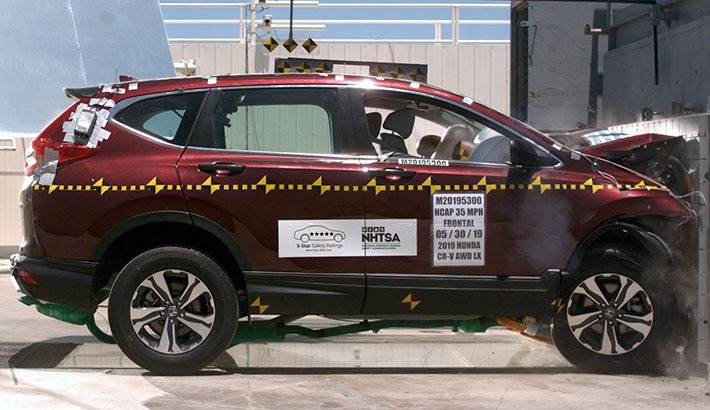
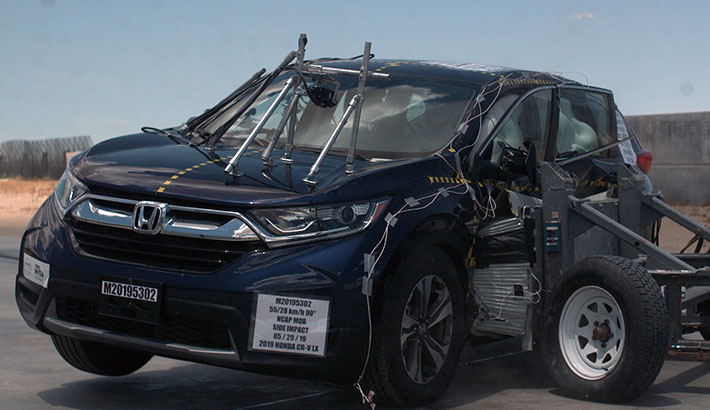
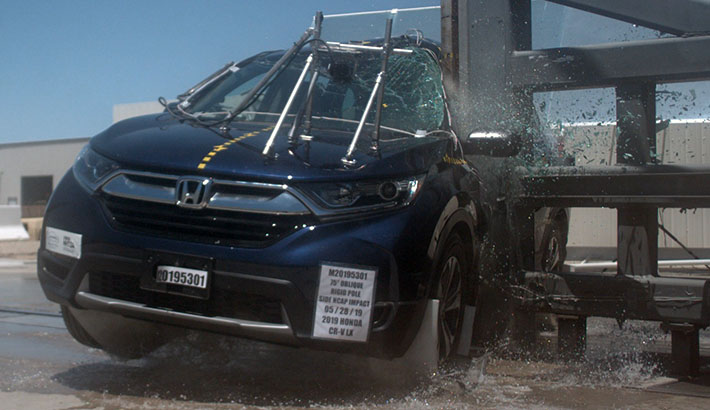
NHTSA crash tests
The agency crash-tested this model year itself. These are its own
photographs and star ratings.
Frontal crash test
Side barrier crash test
Side pole crash test
Photographs taken by NHTSA during its own New Car Assessment Program crash
tests of this model year. Public domain.
Configuration
Overall
Front
Side
Rollover
2019 Honda CR-V SUV AWD
16.4% risk
2019 Honda CR-V SUV FWD
16.4% risk
When owners complained
A spike years after the car went on sale usually means a part wearing
out on schedule across the whole fleet — the kind of pattern no single
owner can see from inside their own car.
Dec 2018peak 63Sep 2026
NHTSA investigations into the 2019 Honda Cr-V
An investigation is the step before a recall: the agency has seen enough
complaints to look into a pattern itself. An open one means it thinks
something may be wrong and nothing has been fixed yet.
On February 21, 2022, the Office of Defects Investigation (ODI) opened Preliminary Evaluation (PE22003) to assess reports of inadvertent activation of the Collision Mitigation Braking System (CMBS), an automatic emergency braking (AEB) system, in model year 2017-2019 Honda CR-V and 2018-2019 Honda Accord vehicles. The reports allege that activation of the AEB system occurs while driving with no apparent obstruction in the vehicle's forward path, resulting in sudden vehicle deceleration. Honda indicated that they were aware of a total of X,XXX reports that may relate to the alleged defect. Hon...
PE22011Opened 28 Nov 2022Closed 22 Jul 2024POWER TRAIN:AXLE ASSEMBLY:AXLE SHAFT
Rear Differential Seizure
On November 29, 2022, the Office of Defects Investigation (ODI) opened PE 22-011 after reviewing field reports alleging rear differential seizure in 2018-2022MY Honda CR-V and HR-V vehicles equipped with all wheel drive. To date, ODI has not received any consumer complaints. Some of the field reports received alleged the vehicle’s wheels locked up with no warning while the vehicle was in motion. These vehicles were towed to a dealership. Examination of these vehicles showed the driveshaft had broken and the differential unit was completely damaged. The field reports cited a lack of oil due to...
On February 21, 2022, the Office of Defects Investigation (ODI) opened Preliminary Evaluation (PE22003) to assess reports of inadvertent activation of the Collision Mitigation Braking System (CMBS), an automatic emergency braking (AEB) system, in model year 2017-2019 Honda CR-V and 2018-2019 Honda Accord vehicles. The reports allege that activation of the AEB system occurs while driving with no apparent obstruction in the vehicle's forward path, resulting in sudden vehicle deceleration. Honda indicated that they were aware of a total of X,XXX reports that may relate to the alleged defect. Hon...
Recalls on the 2019 Honda Cr-V
A complaint is one owner's allegation. A recall is the point at which
the manufacturer or a regulator agreed the defect is real and dangerous
enough to fix for free — however old the car is.
United States — NHTSA
26V332000
AIR BAGS:SENSOR:OCCUPANT CLASSIFICATION:FRONT PASSENGER
Honda (American Honda Motor Co.) is recalling certain 2018-2021, 2023 Acura TLX, 2019-2024 RDX, 2017-2020, 2022-2026 MDX, 2017-2021, 2023, 2025 Honda Ridgeline, 2017-2022 Pilot, 2019-2021 Passport, 2018-2026 Odyssey, 2019-2022 Insight, 2019-2021 HR-V, 2018-2020 Fit, 2020-2022 CR-V Hybrid, 2017-2022 CR-V, 2017-2018, 2021 Civic Type R, 2017-2021 Civic hatchback, 2016-2020 Civic coupe, 2016-2022 Civic, 2017-2022 Accord Hybrid, and 2016-2022 Accord vehicles. The front passenger seat weight sensor may crack and short circuit, which can cause the air bags to deploy unintentionally during a crash.
Risk: Air bags that deploy unintentionally during a crash increase the risk of injury.
23V858000
FUEL SYSTEM, GASOLINE:DELIVERY:FUEL PUMP
Honda (American Honda Motor Co.) is recalling certain 2013-2023 Honda Accord, Civic Coupe, Civic Sedan, Civic Hatchback, Civic Type R, CR-V, HR-V, Ridgeline, Odyssey, Acura ILX, MDX, MDX Hybrid, RDX, RLX, TLX, 2019-2022 Honda Insight, Passport, 2020 Honda CR-V Hybrid, 2018-2019 Honda Clarity PHEV, Fit, and 2015-2020 Honda Accord Hybrid, Pilot, Acura NSX vehicles. The fuel pump inside the fuel tank may fail.
Risk: Fuel pump failure can cause an engine stall while driving, increasing the risk of a crash.
23V158000
SEAT BELTS:FRONT:BUCKLE ASSEMBLY
Honda (American Honda Motor Co.) is recalling certain 2017-2020 CR-V, 2018-2019 Accord and Accord Hybrid, 2018-2020 Odyssey, 2019 Insight, and 2019-2020 Acura RDX vehicles. A manufacturing issue with the front seat belts may cause the seat belt buckle channel to interfere with the release button, preventing the seat belt buckle from latching.
Risk: An unlatched seat belt cannot properly restrain the seat occupant during a crash, increasing their risk of injury.
21V215000
FUEL SYSTEM, GASOLINE:DELIVERY:FUEL PUMP
Honda (American Honda Motor Co.) is recalling certain 2019-2020 Acura MDX, MDX Sport Hybrid, RDX, TLX, Honda Accord, Civic Hatchback, Insight, 2019 Acura ILX, Honda Accord Hybrid, Civic Coupe, Civic Coupe Si, Civic Sedan, Civic Sedan Si, Civic Type R, Fit, HR-V, Odyssey, Passport, Pilot and Ridgeline, and 2018-2019 CR-V vehicles. The low-pressure fuel pump inside the fuel tank may fail.
Risk: Fuel pump failure can cause an engine stall while driving, increasing the risk of a crash.
19V865000
STRUCTURE:FRAME AND MEMBERS
Honda (American Honda Motor Co.) is recalling certain 2019-2020 CR-V vehicles. The rear subframe bolts were improperly manufactured and may loosen, allowing the rear subframe to separate.
Risk: A separated rear subframe reduces vehicle handling and can suddenly disable the vehicle, increasing the risk of a crash.
19V694000
EQUIPMENT:OTHER:OWNERS/SERVICE/OTHER MANUAL
Honda (American Honda Motor Co.) is recalling certain 2019 CR-V vehicles. The owner's guide incorrectly describes when the "Passenger Airbag Off" indicator should illuminate. As such, these vehicles fail to comply with the requirements of Federal Motor Vehicle Safety Standard (FMVSS) number 208, "Occupant Crash Protection."
Risk: If the front passenger does not correctly understand how the airbag functions, they may be at an increased risk of personal injury in the event of a crash.
19V569000
FUEL SYSTEM, GASOLINE:STORAGE:TANK ASSEMBLY
Honda (American Honda Motor Co.) is recalling certain 2019 CR-V vehicles. The joint weld between the fuel tank and the vapor return line may have been insufficiently welded, causing the weld to fail.
Risk: The failed weld may allow fuel to leak, increasing the risk of a fire in the presence of an ignition source.
19V383000
AIR BAGS:FRONTAL:DRIVER CLOCKSPRING/SPIRAL CASSETTE
Honda (American Honda Motor Co.) is recalling certain 2019 CR-V vehicles. The metal core of the steering wheel may have burrs which can damage the harnesses routed within, potentially disabling the driver's air bag or causing it to deploy without warning.
Risk: In the event of a crash, a disabled air bag would increase the risk of injury. An uncommanded deployment of the driver's air bag also increases the risk of injury and a crash.
Canada — Transport Canada
Canada runs its own recall programme, and its campaigns do not
always mirror the American ones.
Recall 202625112,371 units in Canada
Seats And Restraints
Issue: On certain vehicles, the weight sensor for the front passenger seat may not have been manufactured properly. As a result, the passenger-front airbag and knee airbag could deploy in a crash that doesn't require them to. Note: This recall is an expansion of Transport Canada recall no. 2024-059. If the weight sensor fails, the SRS warning light would turn on in the instrument panel. Safety Risk: An airbag system that doesn't work properly could increase the risk of injury in a crash. Corrective Actions: The company will notify owners by mail and advise you to take your vehicle to a dealership to replace the passenger-front seat weight sensor.
Recall 2024262291,588 units in Canada
Fuel System
Issue: This recall is for low-pressure fuel pumps installed on certain vehicles or sold at dealerships as a replacement part. On certain vehicles, the low-pressure fuel pump could fail. If this happens, the engine may run rough or may not start and the check engine light may turn on. This could also result in a sudden loss of engine power while driving. Note: This recall replaces Transport Canada recall no. 2023-679. Vehicles that were repaired under that recall don't require this repair. Safety Risk: A sudden loss of engine power could increase the risk of a crash. Corrective Actions: The company will notify owners by mail and advise you to take your vehicle to a dealership to replace the fuel pump motor.
Recall 2023679285,461 units in Canada
Fuel System
This recall was replaced by Transport Canada recall no. 2024-262. Issue: This recall is for low-pressure fuel pumps installed on certain vehicles or sold at dealerships as a replacement part. On certain vehicles, the low-pressure fuel pump could fail. If this happens, the engine may run rough or may not start and the check engine light may turn on. This could also result in a sudden loss of engine power while driving. Note: This is an expansion of Transport Canada recall nos. 2020-236 and 2021-182. Safety Risk: A sudden loss of engine power could increase the risk of a crash. Corrective Actions: The company will notify owners by mail and advise you to take your vehicle to a dealership to replace the fuel pump motor.
Recall 202312752,196 units in Canada
Seats And Restraints
Issue: On certain vehicles, the seat belt buckles for the driver and front-passenger seats could wear over time and may not latch securely. If this happens, the seat belt could unlatch unexpectedly. Safety Risk: A seat belt that doesn't latch securely could create an increased risk of injury in a crash. Corrective Actions: Honda will notify owners by mail and instruct you to take your vehicle to a dealership to inspect the driver and front-passenger seat belt assemblies. In most cases, the seat belt buckle release buttons will be replaced. If the dealer determines that a buckle can't be repaired, it will be replaced with a new part.
Recall 202118280,176 units in Canada
Fuel System
Issue: On certain vehicles, the low-pressure fuel pump could fail. If this happens, then engine may run rough or may not start and the check engine light may turn on. This could also result in a sudden loss of engine power while driving. Note: This is an expansion of Transport Canada Recall No. 2020-236. Safety Risk: A sudden loss of engine power could increase the risk of a crash. Corrective Actions: The company will notify owners by mail and instruct you to take your vehicle to a dealer to replace the fuel pump motor.
Recall 201947155,604 units in Canada
Other
Issue: On certain vehicles, the owner's manual incorrectly describes when the “passenger airbag off” light should turn on. The manual states that if the front passenger seat is empty the indicator light will not turn on. It should instead state that if the seat is empty, the indicator light will turn on. This could cause a user to misunderstand how the passenger airbag system should work. Safety Risk: A user that does not understand how the airbag system operates may be at an increased risk of injury in a crash. Corrective Actions: Honda will mail a sticker to all current owners that has the correct description for the “passenger airbag off” indicator light. They will also provide the owner with instructions on where to place it in the owner's manual. Owners who would like help installing the label can contact a Honda dealer.
Recall 201937817 units in Canada
Fuel System
Issue: On certain vehicles, the connection between the fuel tank and the fuel vapour return line may not be properly welded. Over time, vibrations and heat cycling can cause the weld to separate, resulting in a fuel leak. Safety Risk: A fuel leak, in the presence of an ignition source, creates the risk of a fire. Corrective Actions: Honda will notify owners by mail and instruct them to take their vehicle to a dealer to replace the fuel tank.
Recall 201924023,849 units in Canada
Airbag
Issue: On certain vehicles, the wiring for the steering wheel-mounted airbag could be damaged by sharp metal edges that may be present on the steering wheel core. This could disconnect the airbag, causing it not to work and turning on the airbag (SRS) warning light. This problem could also cause the airbag to deploy suddenly without a crash. Safety Risk: A driver-front airbag that does not deploy properly in a crash could increase the risk of injuries. A sudden airbag deployment when there is no crash could also create a risk of injury. Corrective Actions: Honda will notify owners by mail and instruct them to take their vehicle to a dealer to replace the steering wheel wiring and install a protective cover over the steering wheel core.
Reports where the owner recorded a crash, a fire, an injury or a death.
at 98,000 milesSanta Maria, CACrash1 injured
AIR BAGS
The contact owns a 2019 Honda CR-V. The contact stated that while pulling into the street, the light was green, and she noticed a vehicle coming in fast into a turning light, and when he turned, she braced for impact. The contact stated she was in the left lane and got pushed all the way to the right lane during the crash. The air bags deployed, but upon impact to the head, the air bag exploded and instantly felt burning in her stomach, her hand, and all the way up to her shoulder. The vehicle was not drivable. The vehicle was towed to a local Bodyshop. A police report was filed. The driver was the only occupant. The injury sustained was a burn on the left arm and stomach, and pain in the neck and back. There was medical treatment for the injuries. The dealer was not notified. The vehicle was not repaired. The manufacturer was not notified of the failure. The failure mileage was 98,000.
NHTSA complaint #11729084 — an unverified report by a vehicle owner.
at 53,519 milesWichita Falls, TXCrash
AIR BAGS
The contact owned a 2019 Honda CR-V. The contact stated that while her husband was driving at approximately 15 MPH, and as he was making a left turn onto a side street, another vehicle ran a stop sign and crashed into the center of the vehicle on the driver's side. The contact stated that the side air bags did not deploy. The contact stated that the police were called and wrote a report. The contact stated that there were no injuries. The vehicle was towed to an impound lot. The manufacturer was not informed of the failure. The failure mileage was 53,519.
NHTSA complaint #11700273 — an unverified report by a vehicle owner.
Pittsburgh, PA1 injured
FORWARD COLLISION AVOIDANCE: WARNINGS
On October 7, 2025, I was driving to work. There was a steel metal plate of approximately 1 inch height lying flat on the roadway, presumably to cover up a pothole or other utility work. The steel metal plate was near an intersection where I was to be turning left. I was driving relatively slow as it was almost time to make the left turn, about 15-20 mph. When I was almost upon the steel metal plate my car braked to a complete stop because of the Collision Mitigation Braking System. The intense deceleration has had my back in pain all day, and my neck is slowly starting to hurt as well. I feel like I was in a car accident from how quickly my car came to a stop over what appeared to be the steel plate tripping the CMBS. My vehicle is available for inspection upon request. My safety was at risk due to the back and neck pain I am currently experiencing. If a car had been driving behind me, I would have almost certainly been rear ended which could have created further injury. This feature cannot be permanently disabled and needs to be able to be. It's an undue burden on the driver of the car to have to turn it off every time the car starts. I am concerned someone else will drive my car and not know to turn off that feature and they will be injured or in an accident.
NHTSA complaint #11691914 — an unverified report by a vehicle owner.
On October 7, 2025, I was driving to work. There was a steel metal plate of approximately 1 inch height lying flat on the roadway, presumably to cover up a pothole or other utility work. The steel metal plate was near an intersection where I was to be turning left. I was driving relatively slow as it was almost time to make the left turn, about 15-20 mph. When I was almost upon the steel metal plate my car braked to a complete stop because of the Collision Mitigation Braking System. The intense deceleration has had my back in pain all day, and my neck is slowly starting to hurt as well. I feel like I was in a car accident from how quickly my car came to a stop over what appeared to be the steel plate tripping the CMBS. My vehicle is available for inspection upon request. My safety was at risk due to the back and neck pain I am currently experiencing. If a car had been driving behind me, I would have almost certainly been rear ended which could have created further injury. This feature cannot be permanently disabled and needs to be able to be. It's an undue burden on the driver of the car to have to turn it off every time the car starts. I am concerned someone else will drive my car and not know to turn off that feature and they will be injured or in an accident.
NHTSA complaint #11691914 — an unverified report by a vehicle owner.
Mountain View, CA1 injured
ELECTRICAL SYSTEM
As I was cruising into a parking space with foot on break at about 1 mile per hour the car suddenly accelerated and hit he side walk. Foot still on break I put car in park and switched off engine. Total cost of repair $11,188.00
NHTSA complaint #11690656 — an unverified report by a vehicle owner.
The contact owned a 2019 Honda CR-V. The contact stated while driving approximately 48-50 MPH, the Collision Mitigation Braking System engaged while there was no other vehicles nearby and the contact sustained whiplash. The vehicle was taken to the dealer, where the contact was informed that the failure could be related to a crack on the passenger's side of the windshield. The vehicle was not repaired and was traded in. The manufacturer was notified of the failure, but no assistance was provided. The failure mileage was approximately 45,000.
NHTSA complaint #11673439 — an unverified report by a vehicle owner.
The most recent complaints
In the owners' own words, exactly as filed with NHTSA.
Loveland, CO
ENGINE
On March 13, 2026 the Honda CRV was being driven at approximately 65 mph when the check engine lights came on due to the low and high pressure fuel pumps failing simultaneously causing the CRV to slow suddenly to approximately 25 mph. The incident almost caused vehicles behind the CRV to collide with the rear of the CRV. The CRV was towed to a Honda dealership where it was diagnosed as the fuel pump issues. The fuel pumps were replaced and I paid the repair bill ($1,702.33). On March 21, 2026 the check engine lights came on again when the fuel injectors failed. The CRV was driven to the same Honda dealership where it was diagnosed as the fuel injector issue. The fuel injectors were replaced and Honda did not charge me for the repairs.
NHTSA complaint #11763892 — an unverified report by a vehicle owner.
Loveland, CO
FUEL/PROPULSION SYSTEM
On March 13, 2026 the Honda CRV was being driven at approximately 65 mph when the check engine lights came on due to the low and high pressure fuel pumps failing simultaneously causing the CRV to slow suddenly to approximately 25 mph. The incident almost caused vehicles behind the CRV to collide with the rear of the CRV. The CRV was towed to a Honda dealership where it was diagnosed as the fuel pump issues. The fuel pumps were replaced and I paid the repair bill ($1,702.33). On March 21, 2026 the check engine lights came on again when the fuel injectors failed. The CRV was driven to the same Honda dealership where it was diagnosed as the fuel injector issue. The fuel injectors were replaced and Honda did not charge me for the repairs.
NHTSA complaint #11763892 — an unverified report by a vehicle owner.
Louisville, KY
UNKNOWN OR OTHER
Mutiple times on highway driving of 2+ hours, the active grille shutter system appears to fail, causing the vehicle to lose the ability to accelerate at speeds needed for safe highway driving. This typically occurs after 2 hours of highway driving and remains in place for the duration of the drive. This does not occur during normal driving or even highway drives of less than 90 minutes. My mechanic has inspected and suspects this might be a computer programming issue because the grills appear to work correctly under normal condition. This has occured for a couple of years and creates acceleration difficulty on the highway (for passing or merging).
NHTSA complaint #11763797 — an unverified report by a vehicle owner.
Dallas, TX
SERVICE BRAKES
This emergency brake happened multiple times during crossing train tracks. I’m not sure if the sensor was capturing anything there but the car stopped immediately. Two incidents occurred in the same street and was after the traffic light turned green. Two times I had vehicles behind me but thankfully nothing happened. I monitored the incident then it happened again crossing another train tracks. One time just happened while driving, I didn’t have no cars around me but the car just started breaking on me.
NHTSA complaint #11763750 — an unverified report by a vehicle owner.
Midlothian, VA
FUEL/PROPULSION SYSTEM
three of the fuel injectors started misfiring
NHTSA complaint #11763535 — an unverified report by a vehicle owner.
This emergency brake happened multiple times during crossing train tracks. I’m not sure if the sensor was capturing anything there but the car stopped immediately. Two incidents occurred in the same street and was after the traffic light turned green. Two times I had vehicles behind me but thankfully nothing happened. I monitored the incident then it happened again crossing another train tracks. One time just happened while driving, I didn’t have no cars around me but the car just started breaking on me.
NHTSA complaint #11763750 — an unverified report by a vehicle owner.
Lansdale, PA
ELECTRICAL SYSTEM
2019 Honda CR-V, VIN [XXX], approximately 82,000 miles. Since new, the vehicle has intermittently displayed a "Christmas tree" warning — most or all dashboard warning lights illuminate simultaneously — with no consistent trigger (not tied to weather, cold starts, road type, or time of day). Over approximately the last two months this has escalated from occasional to daily, sometimes twice daily. On XXX at approximately 9:00 AM, while driving on [XXX] near [XXX] heading toward [XXX], the check engine light began flashing and the vehicle lost the ability to accelerate — it could only slow down. I activated my hazard/turn signals and slowly pulled over. I shut the engine off; restarting it resolved the issue and the vehicle drove normally afterward. Both an independent mechanic and a Honda dealer have inspected the vehicle multiple times and pulled diagnostic codes, and neither has identified a definitive cause; the independent mechanic has stated repeatedly that this requires Honda's direct involvement. I first contacted Honda corporate about this recurring issue in 2022. NHTSA's VIN lookup shows no unrepaired recalls on this VIN as of XXX. INFORMATION REDACTED PURSUANT TO THE FREEDOM OF INFORMATION ACT (FOIA), 5 U.S.C. 552(B)(6)
NHTSA complaint #11763145 — an unverified report by a vehicle owner.
Lansdale, PA
ENGINE
2019 Honda CR-V, VIN [XXX], approximately 82,000 miles. Since new, the vehicle has intermittently displayed a "Christmas tree" warning — most or all dashboard warning lights illuminate simultaneously — with no consistent trigger (not tied to weather, cold starts, road type, or time of day). Over approximately the last two months this has escalated from occasional to daily, sometimes twice daily. On XXX at approximately 9:00 AM, while driving on [XXX] near [XXX] heading toward [XXX], the check engine light began flashing and the vehicle lost the ability to accelerate — it could only slow down. I activated my hazard/turn signals and slowly pulled over. I shut the engine off; restarting it resolved the issue and the vehicle drove normally afterward. Both an independent mechanic and a Honda dealer have inspected the vehicle multiple times and pulled diagnostic codes, and neither has identified a definitive cause; the independent mechanic has stated repeatedly that this requires Honda's direct involvement. I first contacted Honda corporate about this recurring issue in 2022. NHTSA's VIN lookup shows no unrepaired recalls on this VIN as of XXX. INFORMATION REDACTED PURSUANT TO THE FREEDOM OF INFORMATION ACT (FOIA), 5 U.S.C. 552(B)(6)
NHTSA complaint #11763145 — an unverified report by a vehicle owner.
Lansdale, PA
FUEL/PROPULSION SYSTEM
2019 Honda CR-V, VIN [XXX], approximately 82,000 miles. Since new, the vehicle has intermittently displayed a "Christmas tree" warning — most or all dashboard warning lights illuminate simultaneously — with no consistent trigger (not tied to weather, cold starts, road type, or time of day). Over approximately the last two months this has escalated from occasional to daily, sometimes twice daily. On XXX at approximately 9:00 AM, while driving on [XXX] near [XXX] heading toward [XXX], the check engine light began flashing and the vehicle lost the ability to accelerate — it could only slow down. I activated my hazard/turn signals and slowly pulled over. I shut the engine off; restarting it resolved the issue and the vehicle drove normally afterward. Both an independent mechanic and a Honda dealer have inspected the vehicle multiple times and pulled diagnostic codes, and neither has identified a definitive cause; the independent mechanic has stated repeatedly that this requires Honda's direct involvement. I first contacted Honda corporate about this recurring issue in 2022. NHTSA's VIN lookup shows no unrepaired recalls on this VIN as of XXX. INFORMATION REDACTED PURSUANT TO THE FREEDOM OF INFORMATION ACT (FOIA), 5 U.S.C. 552(B)(6)
NHTSA complaint #11763145 — an unverified report by a vehicle owner.
Simpsonville, SC
STEERING
The steering on my 2019 Honda CRV is sticking at highway speeds. When making micro corrections to stay in my lane I experienced resistance or sticking of the steering wheel causing me to use a slight force to overpower the wheel, which then causes jerking of the wheel and vehicle. This could cause an increase in the likelihood of a crash and causing injury. This started happening in XXX and XXX while traveling from [XXX] to [XXX] and back, for a total of 3000 miles. There were no warning lights. The car only has 52,600 miles on it. My car is at the Honda dealership in [XXX] today, XXX. They are trying to replicate the issue. There is a recall on the 2023-2025 Honda CRV for this issue, but not for the 2019, although this same problem has been and is being reported across other years. INFORMATION REDACTED PURSUANT TO THE FREEDOM OF INFORMATION ACT (FOIA), 5 U.S.C. 552(B)(6)
NHTSA complaint #11762879 — an unverified report by a vehicle owner.
Garden Valley, CA
FUEL/PROPULSION SYSTEM
While driving on a winding, two-lane rural mountain highway, I came up behind a slower vehicle. When a designated passing lane opened up, I pulled out to overtake them. The driver ahead safely slowed way down to let me pass, so I applied normal, moderate acceleration to complete the maneuver.Mid-way through the pass, the vehicle suddenly suffered a catastrophic loss of motive power and entered "Limp Mode." Simultaneously, the entire dashboard lit up frantically with warning alerts indicating that virtually every Advanced Driver Assistance System (ADAS) had failed.The vehicle lost nearly all forward momentum and would barely move. Because of the immediate power loss, I spent a grueling half-mile struggling to find a safe place to pull off the roadway. I was forced to come to a stop on a highly dangerous, blind mountain corner. On a highway where traffic routinely travels at 55 mph or faster, being stranded at a dead stop around a blind curve placed me in imminent danger of a severe, high-speed rear-end collision. Safety Concern & Product Defect:While the vehicle's programming forces "Limp Mode" to protect the mechanical components of the engine, the real-world execution of this feature creates an extreme, life-threatening hazard. Cutting power entirely during routine highway maneuvers—such as passing or merging onto a 65+ mph freeway—renders the driver helpless. Rather than preventing damage, this defect actively creates a high-probability scenario for a fatal high-speed accident. Honda's safety systems should not prioritize engine preservation over human life. After thoroughly researching this specific failure pattern, the evidence strongly indicates that the root cause is premature fuel injector failure—an issue that is heavily documented as a common defect in this specific engine layout.This component should not be failing at this stage in the vehicle's lifespan. My husband is a certified mechanic and meticulously maintains all of our personal vehicles!
NHTSA complaint #11762554 — an unverified report by a vehicle owner.
Round Mountain, NV
ENGINE
While driving with my 3yr old in the car multiple dashboard warning lights suddenly illuminated simultaneously (including the Check Engine light, Emissions system warning, and various safety sensor alerts). The vehicle experienced a sudden loss of engine power, rough idling, and hesitation upon acceleration, which created an immediate traffic hazard. I took the vehicle to an authorized Honda dealership service center. The diagnostic scan revealed a failure of the fuel injectors (with diagnostic trouble codes indicating a system too rich and cylinder misfires). The dealership service advisor informed me that this premature fuel injector failure is a highly common and widespread systemic defect with Honda’s 1.5L Turbo direct-injection engines, stating that their shop actively stocks these parts because they perform at least one of these replacements every week. This premature component failure at mileage (105,136 miles) is a severe safety risk that causes unexpected engine stalling or power loss while driving.
NHTSA complaint #11761684 — an unverified report by a vehicle owner.
Round Mountain, NV
SERVICE BRAKES
While driving with my 3yr old in the car multiple dashboard warning lights suddenly illuminated simultaneously (including the Check Engine light, Emissions system warning, and various safety sensor alerts). The vehicle experienced a sudden loss of engine power, rough idling, and hesitation upon acceleration, which created an immediate traffic hazard. I took the vehicle to an authorized Honda dealership service center. The diagnostic scan revealed a failure of the fuel injectors (with diagnostic trouble codes indicating a system too rich and cylinder misfires). The dealership service advisor informed me that this premature fuel injector failure is a highly common and widespread systemic defect with Honda’s 1.5L Turbo direct-injection engines, stating that their shop actively stocks these parts because they perform at least one of these replacements every week. This premature component failure at mileage (105,136 miles) is a severe safety risk that causes unexpected engine stalling or power loss while driving.
NHTSA complaint #11761684 — an unverified report by a vehicle owner.
Round Mountain, NV
FUEL/PROPULSION SYSTEM
While driving with my 3yr old in the car multiple dashboard warning lights suddenly illuminated simultaneously (including the Check Engine light, Emissions system warning, and various safety sensor alerts). The vehicle experienced a sudden loss of engine power, rough idling, and hesitation upon acceleration, which created an immediate traffic hazard. I took the vehicle to an authorized Honda dealership service center. The diagnostic scan revealed a failure of the fuel injectors (with diagnostic trouble codes indicating a system too rich and cylinder misfires). The dealership service advisor informed me that this premature fuel injector failure is a highly common and widespread systemic defect with Honda’s 1.5L Turbo direct-injection engines, stating that their shop actively stocks these parts because they perform at least one of these replacements every week. This premature component failure at mileage (105,136 miles) is a severe safety risk that causes unexpected engine stalling or power loss while driving.
NHTSA complaint #11761684 — an unverified report by a vehicle owner.
Newburgh, ME
STEERING
The steering wheel sticks. Used to be very smooth but the last few months it stick in one place and often makes a clicking sound when stopped.
NHTSA complaint #11761456 — an unverified report by a vehicle owner.
Apex, NC
SERVICE BRAKES
Car automatically hit the brakes for no apparent reason while going at 45 mph. There was no vehicle or any kind of obstacle ahead of behind. Also resulted in tightening of driver seat belt. No injuries. Vehicle was being operated by an authorized and licensed driver.
NHTSA complaint #11761346 — an unverified report by a vehicle owner.
Car automatically hit the brakes for no apparent reason while going at 45 mph. There was no vehicle or any kind of obstacle ahead of behind. Also resulted in tightening of driver seat belt. No injuries. Vehicle was being operated by an authorized and licensed driver.
NHTSA complaint #11761346 — an unverified report by a vehicle owner.
Alexandria, LA
SERVICE BRAKES
While driving my 2019 Honda CR-V across railroad tracks, the vehicle displayed a BRAKE warning and automatically applied the brakes even though there was no vehicle, person, train, or other obstruction in front of me. The braking occurred while I was crossing the railroad tracks and caused the vehicle to slow unexpectedly. I did not intentionally apply the brakes. I am concerned that the Collision Mitigation Braking System/automatic emergency braking activated falsely and could create a safety hazard, especially at a railroad crossing.
NHTSA complaint #11760594 — an unverified report by a vehicle owner.
Alexandria, LA
FORWARD COLLISION AVOIDANCE: WARNINGS
While driving my 2019 Honda CR-V across railroad tracks, the vehicle displayed a BRAKE warning and automatically applied the brakes even though there was no vehicle, person, train, or other obstruction in front of me. The braking occurred while I was crossing the railroad tracks and caused the vehicle to slow unexpectedly. I did not intentionally apply the brakes. I am concerned that the Collision Mitigation Braking System/automatic emergency braking activated falsely and could create a safety hazard, especially at a railroad crossing.
NHTSA complaint #11760594 — an unverified report by a vehicle owner.
While driving my 2019 Honda CR-V across railroad tracks, the vehicle displayed a BRAKE warning and automatically applied the brakes even though there was no vehicle, person, train, or other obstruction in front of me. The braking occurred while I was crossing the railroad tracks and caused the vehicle to slow unexpectedly. I did not intentionally apply the brakes. I am concerned that the Collision Mitigation Braking System/automatic emergency braking activated falsely and could create a safety hazard, especially at a railroad crossing.
NHTSA complaint #11760594 — an unverified report by a vehicle owner.
Aurora, CO
ELECTRICAL SYSTEM
My car dilutes oil or burns it up and I constantly have to put oil in. Its been like that since year 4 of my owning my brand new car. The oil can be completely gone and it doesnt tell me. My warning lights have never worked to tell me its empty or low. There was a noise coming from my glove box and my ac stopped working. There a recall for it but they told me im not a part of it except the part they told me is broken is the same part for the recall and my car is the same year, just my Vin doesnt count. They want me to pay over 1000 to fix but I refuse to. Passenger window has been messed up and freezes goes up a little then stops over amd over til.its up since I bought the car
NHTSA complaint #11760488 — an unverified report by a vehicle owner.
Aurora, CO
ENGINE
My car dilutes oil or burns it up and I constantly have to put oil in. Its been like that since year 4 of my owning my brand new car. The oil can be completely gone and it doesnt tell me. My warning lights have never worked to tell me its empty or low. There was a noise coming from my glove box and my ac stopped working. There a recall for it but they told me im not a part of it except the part they told me is broken is the same part for the recall and my car is the same year, just my Vin doesnt count. They want me to pay over 1000 to fix but I refuse to. Passenger window has been messed up and freezes goes up a little then stops over amd over til.its up since I bought the car
NHTSA complaint #11760488 — an unverified report by a vehicle owner.
at 105,000 milesSan Bernardino, CA
AIR BAGS
The contact owns a 2019 Honda CR-V. The contact stated that vehicle was displaying the warning message "Airbag System SRS Problem". The contact associated the failure with NHTSA Campaign Number: 26V332000 (Air Bags); however, VIN number was not included. The dealer was contacted; however vehicle was not diagnosed or repaired. The manufacturer was not made aware of the failure. The failure mileage was approximately 105,000.
NHTSA complaint #11760112 — an unverified report by a vehicle owner.
Raleigh, NC
ENGINE
The vehicle developed an intermittent crank/no-start condition and later stalled after being driven home. An independent repair facility diagnosed the vehicle before it was taken to Honda and documented no fuel pressure at the fuel rail and diagnostic trouble code P0087 for low fuel pressure. The shop advised that Honda has a known fuel-pump issue and recommended that the vehicle be taken to a Honda dealer for recall-related repair. The vehicle was then towed to a Honda dealer. The dealer also determined that the fuel pump requires replacement. The dealer advised that the fuel pump had previously been replaced under Honda's 2021 fuel-pump recall. Honda has now denied another recall-related repair based on the dealer's claim that water is present in the fuel. I requested objective testing to document the alleged water contamination and its relationship to the pump failure. The dealer provided a photograph of cloudy fuel but did not provide a quantitative water-content test. I was told that the dealership's master technician determined that the sample contained water. The vehicle has approximately 53,700 miles. The replacement fuel pump has failed with symptoms consistent with loss of fuel pressure, including intermittent no-start and vehicle stalling. The independent shop's P0087/no-fuel-pressure diagnosis was made before the vehicle was taken to Honda. I am concerned that replacement fuel pumps installed during Honda's prior fuel-pump recall may be experiencing subsequent failures that can cause engine stalling or prevent vehicles from starting.
NHTSA complaint #11759481 — an unverified report by a vehicle owner.
Raleigh, NC
FUEL/PROPULSION SYSTEM
The vehicle developed an intermittent crank/no-start condition and later stalled after being driven home. An independent repair facility diagnosed the vehicle before it was taken to Honda and documented no fuel pressure at the fuel rail and diagnostic trouble code P0087 for low fuel pressure. The shop advised that Honda has a known fuel-pump issue and recommended that the vehicle be taken to a Honda dealer for recall-related repair. The vehicle was then towed to a Honda dealer. The dealer also determined that the fuel pump requires replacement. The dealer advised that the fuel pump had previously been replaced under Honda's 2021 fuel-pump recall. Honda has now denied another recall-related repair based on the dealer's claim that water is present in the fuel. I requested objective testing to document the alleged water contamination and its relationship to the pump failure. The dealer provided a photograph of cloudy fuel but did not provide a quantitative water-content test. I was told that the dealership's master technician determined that the sample contained water. The vehicle has approximately 53,700 miles. The replacement fuel pump has failed with symptoms consistent with loss of fuel pressure, including intermittent no-start and vehicle stalling. The independent shop's P0087/no-fuel-pressure diagnosis was made before the vehicle was taken to Honda. I am concerned that replacement fuel pumps installed during Honda's prior fuel-pump recall may be experiencing subsequent failures that can cause engine stalling or prevent vehicles from starting.
NHTSA complaint #11759481 — an unverified report by a vehicle owner.