Owners have filed 603 complaints
about the 2004 Honda Cr-V with NHTSA between 2003 and 2026.
The largest single group is the engine & cooling.
Across this model's run it ranks 12 of 30 worst.
The letter says how bad. This says what kind — whether this year drew
an unusual number of complaints, unusually dangerous
ones, or failures that arrived unusually early.
The dashed ring is 50 — the national norm. Further out is worse.
Complaint volume — 42
Against the median year of the Honda Cr-V. 50 means typical for this
model; 100 means roughly double.
Severity — 98
18.9% of these complaints
involved a crash, fire, injury or death, against a national rate of
9.7%.
Early failure — 39
23% of failures with a mileage on record happened under
36,000 miles, against a national rate of
29%.
NHTSA files every complaint against a named sub-assembly, not just a
system. This is the difference between knowing it was "the engine" and
knowing which part of it — the list to hand a mechanic.
Cooling System
5139.5%
Engine
2720.9%
AIR Conditioner
2217.1%
Front Underhood
75.4%
Power Window Devices AND Controls
64.7%
Frontal
64.7%
Filler Pipe AND CAP
53.9%
Accelerator Pedal
53.9%
When it fails
Odometer readings owners gave when they filed. About half of all
complaints include one.
Under 1,000 miles
112.6%
1,000 – 9,999 miles
5412.7%
10,000 – 24,999 miles
204.7%
25,000 – 49,999 miles
419.6%
50,000 – 74,999 miles
9121.4%
75,000 – 99,999 miles
7216.9%
100,000 – 149,999 miles
8920.9%
150,000+ miles
4811.3%
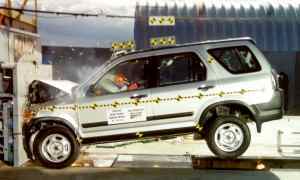
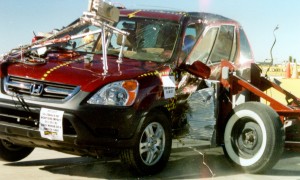
NHTSA crash tests
The agency crash-tested this model year itself. These are its own
photographs and star ratings.
These stars come from the pre-2011 crash test programme. NHTSA
rebuilt the programme for the 2011 model year and states that
ratings either side of that change are not comparable — so do
not read these against a 2011-or-newer car's stars.
Frontal crash test
Side barrier crash test
Frontal crash test
Photographs taken by NHTSA during its own New Car Assessment Program crash
tests of this model year. Public domain.
Configuration
Overall
Front
Side
Rollover
2004 Honda CR-V w/SAB
—
—
—
—
2004 Honda CR-V
—
—
—
—
When owners complained
A spike years after the car went on sale usually means a part wearing
out on schedule across the whole fleet — the kind of pattern no single
owner can see from inside their own car.
Oct 2003peak 22Apr 2026
NHTSA investigations into the 2004 Honda Cr-V
An investigation is the step before a recall: the agency has seen enough
complaints to look into a pattern itself. An open one means it thinks
something may be wrong and nothing has been fixed yet.
From 2000 through 2017, Takata produced millions of air bag inflators using two types of phase-stabilized ammonium nitrate ("PSAN") propellant -- propellant 2004 and propellant 2004L. After prolonged exposure to high temperature cycles and humidity, inflators using propellant 2004 can degrade, causing the propellant to burn too quickly when ignited. The rapid burning can cause the inflator to rupture during deployment, potentially causing serious or even fatal injury to vehicle occupants. See 2016 Blomquist Report at www.nhtsa.gov/sites/nhtsa.gov/files/documents/expert_report-hrblomquist.pdf.C...
EA15001Opened 24 Feb 2015Still openAIR BAGS:FRONTAL
Air Bag Inflator Rupture
The Office of Defects Investigation (ODI) opened PE14-016 in June 2014 based on six inflator rupture incidents involving consumer owned vehicles produced by five vehicle manufacturers.All six vehicles were operated in Florida or Puerto Rico at the time of the rupture and for the majority of their service life, and were equipped with inflators produced by Takata, a tier-one supplier of automotive air bag systems.During the course of PE14-016, ODI determined that five additional vehicle manufacturers used inflators of a similar design and vintage also supplied by Takata. No evidence of field fai...
PE14016Opened 11 Jun 2014Closed 2 Mar 2015AIR BAGS:FRONTAL
Air Bag Inflator Rupture
The Office of Defects Investigation (ODI) opened PE14-016 in June 2014 based on six inflator rupture incidents involving consumer owned vehicles produced by five vehicle manufacturers.All six vehicles were operated in Florida or Puerto Rico at the time of the rupture and for the majority of their service life, and were equipped with inflators produced by Takata, a tier-one supplier of automotive air bag systems.During the course of PE14-016, ODI determined that five additional vehicle manufacturers used inflators of a similar design and vintage also supplied by Takata. No evidence of field fai...
This investigation was prompted by Preliminary Evaluation (PE) 11-017, and was based on reports from consumers alleging that both low beam headlights stopped illuminating simultaneously.Some complainants also reported that the combination switch (switch) that controls the headlights and turn signals, and/or its electrical wiring harness connector were damaged by overheating.ODI's PE information request letter asked Honda for certain data on model years (MY) 2002-2006 CR-V, 2003-2008 Pilot, 2003-2008 Element, 2001-2005 Civic, and 2000-2001 S 2000 vehicles.Analysis of complaint and Honda data sh...
The Office of Defects Investigation (ODI) opened this investigation based on 12 reports from consumers alleging the low beam headlights stopped working simultaneously.Several of the complainants reported that the headlight switch and/or its wiring harness connector required replacement to repair the low beam headlight circuit, and also reported that the switch and/or the wire harness connector were damaged from overheating.Based on information provided by Honda in response to ODI's Preliminary Evaluation information request, ODI is upgrading the investigation to EA11-012.
EA11004Opened 11 Apr 2011Closed 24 Oct 2012ELECTRICAL SYSTEM
Driver's Power Window Master Switch
This investigation was prompted by Preliminary Evaluation (PE) 10-047 and was based on reports from consumers alleging that smoke and/or fire, as defined in 49 CFR ? 579.4, had occurred inside of the driver's door.The subject vehicles, model year (MY) 2006 CR-V, were manufactured at two different assembly plants.The vehicles manufactured in Japan (Sayama plant) were produced with a power window master switch (PWMS) supplied by the Thai Toyo Denso Company, Ltd. (Denso).The vehicles manufactured in the United Kingdom (UK, Swindon, England plant) were produced with a PWMS supplied by the Omron Co...
EA04027Opened 9 Sep 2004Closed 19 Jan 2005ENGINE AND ENGINE COOLING
UNDERHOOD FIRES
IN DOCUMENTS PROVIDED DURING EA04-027, HONDA IDENTIFIED A MECHANISM WHICH CAUSES THE RUBBER SEAL (GASKET) OF THE ORIGINAL EQUIPMENT (OE) OIL FILTER TO ADHERE TO THE ENGINE BLOCK OF THE SUBJECT VEHICLES.IF AN ADHERED SEAL REMAINS WHEN THE OE FILTER IS REMOVED AND A NEW FILTER IS INSTALLED, A DOUBLE GASKET CONDITION RESULTS.A SUBSEQUENT RUPTURE OF THE EXTRANEOUS SEAL CAN RESULT IN OIL CONTACTING NEARBY EXHAUST SYSTEM SURFACES AND A FIRE MAY OCCUR.THROUGHOUT ITS DISCUSSIONS WITH ODI, HONDA HAS MAINTAINED THAT IT IS THE SERVICING TECHNICIAN?S RESPONSIBILITY TO INSPECT FOR AND REMOVE THE SEAL PRIOR...
Recalls on the 2004 Honda Cr-V
A complaint is one owner's allegation. A recall is the point at which
the manufacturer or a regulator agreed the defect is real and dangerous
enough to fix for free — however old the car is.
United States — NHTSA
20V768000
VISIBILITY:POWER WINDOW DEVICES AND CONTROLS
Honda (American Honda Motor Co.) is recalling certain 2002-2006 CR-V vehicles. Moisture may enter the driver side power window master switch, causing the switch to fail or melt.
Risk: If the switch fails, it could overheat and smoke, increasing the risk of a fire.
19V501000
AIR BAGS:FRONTAL:PASSENGER SIDE:INFLATOR MODULE
Honda (American Honda Motor Co.) is recalling certain 2003-2006 Acura MDX, 2005-2012 RL, 2003-2007 Honda Accord, 2001-2005 Civic, 2003-2005 Civic Hybrid, 2001-2005 Civic GX NGV, 2002-2006 CR-V, 2003-2011 Element, 2007-2008 Fit, 2002-2004 Odyssey, 2003-2008 Pilot, and 2006-2014 Ridgeline vehicles. The vehicles are equipped with passenger frontal air bag inflators assembled as a recall remedy part or replacement service part, that may explode due to propellant degradation occurring after long-term exposure to high absolute humidity, temperature and temperature cycling.
Risk: An inflator explosion may result in sharp metal fragments striking the driver or other occupants resulting in serious injury or death.
19V499000
AIR BAGS:FRONTAL:DRIVER SIDE:INFLATOR MODULE
Honda (American Honda Motor Co.) is recalling certain 2003 Acura 3.2CL, 2002-2003 3.2TL, 2003-2006 MDX, 2001-2007 Honda Accord, 2001-2005 Civic, 2003-2005 Civic Hybrid, 2001-2005 Civic GX NGV, 2002-2006 CR-V, 2003-2011 Element, 2002-2004 Odyssey, 2003-2008 Pilot and 2006 Ridgeline vehicles. These vehicles are equipped with driver frontal air bag inflators assembled as a recall remedy part or replacement service part, that may explode due to propellant degradation occurring after long-term exposure to high absolute humidity, temperature and temperature cycling.
Risk: An inflator explosion may result in sharp metal fragments striking the driver or other occupants resulting in serious injury or death.
19V182000
AIR BAGS:FRONTAL:DRIVER SIDE:INFLATOR MODULE
Honda (American Honda Motor Co.) is recalling specific 2003 Acura 3.2CL, 2013-2016 ILX, 2013-2014 ILX Hybrid, 2003-2006 MDX, 2007-2016 RDX, 2002-2003 3.2TL, 2004-2006, and 2009-2014 TL, 2010-2013 ZDX and 2001-2007 and 2009 Honda Accord, 2001-2005 Civic, 2003-2005 Civic Hybrid, 2001-2005 Civic GX NGV, 2002-2007 and 2010-2011 CR-V, 2003-2011 Element, 2007 Fit, 2002-2004 Odyssey, 2003-2008 Pilot, and 2006-2014 Ridgeline vehicles. The affected vehicles received a replacement driver air bag inflator as part of a previous Takata inflator recall remedy or a replacement driver air bag module containing the same inflator type as a service part. Due to a manufacturing error, in the event of a crash necessitating deployment of the driver frontal air bag, these inflators may explode.
Risk: An explosion of an inflator within the driver frontal air bag module may result in sharp metal fragments striking the driver, front seat passenger or other occupants resulting in serious injury or death.
18V268000
AIR BAGS:FRONTAL:PASSENGER SIDE:INFLATOR MODULE
Honda (American Honda Motor Co.) is recalling certain 2003-2012 Honda Accord and Pilot, 2010 Accord Crosstour, 2001-2011 Civic, 2002-2011 CR-V, 2003-2004, 2006-2008 and 2011 Element, 2007 and 2009-2013 Fit, 2010-2012 Insight, 2002-2004 Odyssey, and 2012 Ridgeline vehicles. The front passenger air bag may have been installed incorrectly during replacement.
Risk: An incorrectly installed air bag may deploy improperly in the event of a crash, increasing the risk of injury.
15V370000
AIR BAGS:FRONTAL:PASSENGER SIDE:INFLATOR MODULE
Honda (American Honda Motor Co.) is recalling certain model year 2001-2005 Honda Civic vehicles manufactured March 21, 2000, to January 20, 2005, 2001-2004 Honda Civic GX vehicles manufactured June 14, 2000, to August 19, 2004, 2003-2005 Honda Civic Hybrid vehicles manufactured February 24, 2002, to January 18, 2005, 2003-2007 Honda Accord vehicles manufactured February 21, 2002, to August 28, 2007, 2002-2004 Honda CR-V vehicles, 2002-2003 Honda Odyssey vehicles manufactured June 19, 2001, to July 12, 2003, 2003 Acura MDX vehicles manufactured September 19, 2002, to June 19, 2003, 2003 Honda Element vehicles manufactured June 25, 2002, to July 31, 2003, and 2003 Honda Pilot vehicles manufactured November 26, 2001, to August 21, 2003. The affected vehicles have a passenger side frontal air bag that may be susceptible to moisture intrusion which, over time, could cause the inflator to rupture upon its deployment.
Risk: In the event of a crash necessitating deployment of the passenger's frontal air bag, the inflator could rupture with metal fragments striking the passenger seat occupant or other occupants possibly causing serious injury or death.
15V320000
AIR BAGS:FRONTAL:DRIVER SIDE:INFLATOR MODULE
Honda (American Honda Motor Co.) is recalling certain model year 2001-2007 Accord, 2001-2005 Civic, 2001-2004 Honda Civic GX, 2003-2005 Honda Civic Hybrid, 2002-2006 CR-V, 2003-2011 Element, 2002-2004 Odyssey, 2003-2008 Pilot, 2006 Ridgeline, 2003 Acura 3.2CL, 2003-2006 Acura MDX, and 2002-2003 Acura 3.2TL vehicles. The affected vehicles are equipped with a dual-stage driver frontal air bag that may be susceptible to moisture intrusion and other factors, including manufacturing variability that, over time, could cause the inflator to rupture.
Risk: In the event of a crash necessitating deployment of the driver's frontal air bag, the inflator could rupture with metal fragments striking the driver or other occupants resulting in serious injury or death.
14V700000
AIR BAGS
American Honda Motor Co. (Honda) is recalling certain model year 2001-2005 Honda Civic, 2003-2004 Civic CNG and Element, 2002-2005 CR-V, 2002-2004 Odyssey, 2003-2005 Accord, Pilot, Civic Hybrid, and Acura MDX, 2005 Acura RL and 2006 Honda Ridgeline vehicles originally sold, or ever registered, in geographic locations associated with high absolute humidity. Specifically, vehicles sold, or ever registered, in Alabama, Florida, Georgia, Hawaii, Louisiana, Mississippi, South Carolina, Texas, Puerto Rico, U.S. Virgin Islands, Saipan, Guam, and American Samoa are addressed by this recall. Upon deployment of the passenger side frontal air bag, excessive internal pressure may cause the inflator to rupture.
Risk: In the event of a crash necessitating deployment of the passengers frontal air bag, the inflator could rupture with metal fragments striking the vehicle occupants potentially resulting in serious injury or death.
Canada — Transport Canada
Canada runs its own recall programme, and its campaigns do not
always mirror the American ones.
Recall 2019323222,662 units in Canada
Airbag
Issue: On certain vehicles, long-term exposure to high absolute humidity and temperature, combined with high temperature cycling, may eventually degrade the propellant contained in the airbag. This could cause the airbag to deploy with more force than normal. If the airbag inflator ruptures, fragments could be propelled toward vehicle occupants or cause damage to the airbag assembly, preventing its proper function. Note: This is a new recall campaign that includes vehicles that had an airbag inflator replaced under a previous recall or had a replacement airbag installed. The previous recall provided an interim (short-term) repair. Interim repair parts must be replaced with the final repair parts provided in this recall. Safety Risk: If the vehicle is involved in a crash requiring an airbag deployment, the airbag inflator could rupture and create a risk of injury. Corrective Action: Owners will be notified by mail and instructed to take their vehicle to a dealer to replace the driver and/or passenger-front airbag inflator. Note: The Canadian climate results in the propellant degrading slowly. This recall is being conducted as a precaution to address future risk. It is expected that all airbag inflators will be replaced before their function would be affected.
Recall 201911783,977 units in Canada
Airbag
Issue: On certain vehicles, there could be a problem with the driver-front airbag inflator. This could cause the airbag to deploy with more force than normal. If the airbag inflator ruptures, pieces could be propelled toward the occupants. This could also cause damage to the airbag assembly and prevent it from inflating properly. Note: This recall only affects certain vehicles that had a Takata airbag inflator installed during a previous airbag recall or collision repair. Safety Risk: In a crash where the airbag deploys, there could be an increased risk of injury. Corrective Action: The company will notify owners by mail. Owners will be instructed to take their vehicle to a dealer to have the driver-front airbag inflator replaced.
Recall 201560217,990 units in Canada
Airbag
On certain vehicles, the passenger frontal airbag inflator could produce excessive internal pressure during airbag deployment. Increased pressure may cause the inflator to rupture, which could allow fragments to be propelled toward vehicle occupants, increasing the risk of injury. This could also damage the airbag module, which could prevent proper deployment. Failure of the passenger airbag to fully deploy during a crash (where deployment is warranted) could increase the risk of personal injury to the seat occupant. Correction: Dealers will replace airbag inflator. Note: Note: This is an expansion of recall 2015-261. Honda Canada has created a special Airbag Inflator Hotline for immediate assistance. For more information, please contact: For Honda Owners: 1-877-445-7754 For Acura Owners: 1-877-445-9844
Recall 2015225704,770 units in Canada
Airbag
On certain vehicles, the driver frontal airbag inflator could produce excessive internal pressure during airbag deployment. Increased pressure may cause the inflator to rupture, which could allow fragments to be propelled toward vehicle occupants, increasing the risk of injury. This could also damage the airbag module, which could prevent proper deployment. Failure of the airbag to fully deploy during a crash (where deployment is warranted) could increase the risk of personal injury to the seat occupant. Note: This recall supersedes special service campaign 2014567. Correction: Dealers will inspect/replace the driver's frontal airbag inflator. All vehicles having received a replacement inflator as part of any previous driver's inflator campaign will have a replacement inflator installed. Note: Honda Canada has created a special Airbag Inflator Hotline for immediate assistance. For more information, please contact: For Honda Owners: 1-877-445-7754 For Acura Owners: 1-877-445-9844
Recall 2014567704,770 units in Canada
Airbag
Honda Canada is conducting a voluntary Safety Improvement Campaign concerning the driver's airbag inflator on certain vehicles equipped with Takata airbags. Honda will replace the driver's inflator on affected vehicles. This action is not being conducted under the requirements of the Motor Vehicle Safety Act. Note: This special service campaign was replaced by recall 2015225. Please see recall 2015225 for more information: <a href="http://wwwapps.tc.gc.ca/Saf-Sec-Sur/7/VRDB-BDRV/search-recherche/detail.aspx?lang=eng&&rn=2015225">Click here for more information</a>
Reports where the owner recorded a crash, a fire, an injury or a death.
at 198,000 milesST. Paul, MNFire
ENGINE
TL* THE CONTACT OWNED A 2004 HONDA CR-V. THE CONTACT STATED THAT WHILE HER SON WAS DRIVING APPROXIMATELY 70 MPH, SMOKE WAS SUDDENLY SEEN COMING FROM UNDER THE HOOD. AFTER STOPPING THE HOOD WAS OPENED AND FLAMES WERE PRESENT COMING FROM THE ENGINE COMPARTMENT. THE FIRE DEPARTMENT WAS CALLED TO THE SCENE AND EXTINGUISHED THE FLAMES. AN UNKNOWN REPORT WAS FILED. THE CONTACT WAS UNSURE IF IT WAS THE FIRE DEPARTMENT OR POLICE DEPARTMENT. THE CONTACT MENTIONED THE VEHICLE WAS SERVICED AT INVER GROVE HONDA (4605 S. ROBERT TRL, INVER GROVE HEIGHTS, MN 55077) WEEKS BEFORE THE FAILURE. THE CAUSE OF THE FAILURE WAS NOT DETERMINED. THE CONTACT STATED THAT THE VEHICLE WAS DEEMED A TOTAL LOSS. THE DEALER WAS NOTIFIED OF THE FAILURE HOWEVER, NO ASSISTANCE WAS OFFERED. THE MANUFACTURER WAS NOT CONTACTED. THE FAILURE MILEAGE WAS 198,000. *LN
NHTSA complaint #11330616 — an unverified report by a vehicle owner.
at 160,000 milesAlameda, CACrash1 injured
AIR BAGS
I WAS INVOLVED IN A HIGH SPEED MOTOR VEHICLE ACCIDENT ON CA980. THE AIRBAGS DID NOT DEPLOY. I BROUGHT MY HONDA CRV IN FOR RECALL FOR THE AIRBAGS IN ~JAN 2020 TO GET THIS RECALL FIXED, SO I DO NOT KNOW WHAT HAPPENED.
NHTSA complaint #11319670 — an unverified report by a vehicle owner.
at 144,000 milesPort Washington, WICrash2 injured
AIR BAGS
TL* THE CONTACT OWNS A 2004 HONDA CR-V.THE CONTACT STATED THAT WHILE DRIVING AT 40 MPH, A DEER WALKED IN FRONT OF HER VEHICLE WITHOUT WARNING. WHILE TRYING TO AVOID THE DEER, THE VEHICLE VEERED DOWN TWO EMBANKMENTS, HIT SEVERAL TREES, AND ROLLED OVER. THE AIR BAGS FAILED TO DEPLOY DURING THE INCIDENT. THE CONTACT SUSTAINED MINOR INJURIES AND A FEW ABRASIONS. THE PASSENGER SUSTAINED SEVERE CUTS TO THE RIGHT SIDE OF HIS BODY AND HAD TO BE AIR LIFTED TO A LOCAL HOSPITAL. THE PASSENGER WAS TAKEN TO FROEDTERT HOSPITAL 9200 W WISCONSIN AVE, MILWAUKEE, WI 53226 414-805-3000 WHERE HE WAS TREATED FOR CUTS TO THE RIGHT FORE ARM AND UPPER ARM, FOREHEAD AND SHOULDER. THE CONTACT ALSO SOUGHT MEDICAL ATTENTION FOR HER INJURIES AT AURORA MEDICAL CENTER GRAFTON 975 PORT WASHINGTON RD, GRAFTON WI 53024 262-329-1000, WHERE SHE TREATED FOR THE REMOVAL OF GLASS FROM HER LEGS AND SCALP. A POLICE REPORT WAS FILED. THE VEHICLE WAS TOWED TO AN INDEPENDENT MECHANIC AND THE VEHICLE WAS DESTROYED. THE MANUFACTURER WAS NOT NOTIFIED OF THE FAILURE. THE FAILURE MILEAGE WAS 144,000. JO
NHTSA complaint #11246546 — an unverified report by a vehicle owner.
at 250,000 milesClaremont, CACrash1 injured
AIR BAGS
TL* THE CONTACT OWNED A 2004 HONDA CR-V. THE CONTACT STATED THAT THE VEHICLE WAS INVOLVED IN A REAR END COLLISION WITH A SEMI-TRUCK. THE AIR BAGS DID NOT DEPLOY. A POLICE REPORT WAS FILED. THE VEHICLE WAS TOWED TO A SALVAGE YARD AND DEEMED DESTROYED. THE CONTACT SUFFERED A CONTUSION AND MODERATE HEADACHES, WHICH REQUIRED MEDICAL ATTENTION. THE MANUFACTURER WAS NOTIFIED OF THE FAILURE. THE FAILURE MILEAGE WAS APPROXIMATELY 250,000.
NHTSA complaint #11080952 — an unverified report by a vehicle owner.
at 193,000 milesGranite BAY, CAFire
ELECTRICAL SYSTEM
WE WERE LEAVING A PARKING LOT WHEN WE HAD TO PULL OVER AND GET OUT OF THE CAR. A VERY STRONG ELECTRIC SMELL AND SMOKE WAS COMING FROM DRIVERS SIDE WINDOW AREA. WE WERE ALL OUTSIDE THE CAR ON A VERY BUSY CITY STREET BECAUSE OF THIS INCIDENT. AFTER A WHILE THE SMOKE CLEARED AND I WENT BACK INTO THE VEHICLE TO SEE IF IT WOULD FUNCTION. THE REAR WINDOWS WERE NO LONGER FUNCTIONING. HAD A FRIEND TAKE THE FAMILY HOME AND DROVE THE CAR MYSELF HOME AND PARKED IT AWAY FROM THE HOUSE. LOOKED IT UP ON THE INTERNET AND FOUND THAT A RECALL FOR THE DRIVERS SIDE POWER WINDOW SWITCH ( 12V486000 10/05/2012 2002 TO 2005 CRV )WAS MADE INCLUDING 2004 CRV MODELS FOR THIS VERY ISSUE. CONTACTED HONDA SUPPORT TO FIND OUT WHY WE WERE NOT NOTIFIED. ACCORDING TO HONDA SUPPORT, OUR MODEL IS NOT COVERED BECAUSE WE HAVE A DIFFERENT VIN THAN THE SAME YEAR MODELS THAT WERE RECALLED FOR THE VERY SAME ISSUE. THIS IS A SERIOUS DRIVING AND FIRE HAZZARD!. I AM VERY DISSAPOINTED THIS IS NOT SOMETHING THEY TAKE SERIOUS. WE ARE ORIGINAL OWNERS AND HAVE NEVER RECEIVED NOTICE OF THIS ISSUE. THEY SAY IT IS MY EXPENSE BECAUSE MY VIN IS NOT ONE INCLUDED IN THE RECALL FOR THIS VERY SAME ISSUE OF THE VERY SAME YEAR AND MODEL. HAD TO PAY THOUSANDS FOR OUR AIR CONDITIONER TO BE COMPLETELY REPLACED SHORTLY AFTER WE BOUGHT THE CAR BECAUSE OF A LATER RECALLED ISSUE WITH IT THAT ALSO WAS NOT COVERED AT THE TIME. USED TO BE HONDA BELIEVERS, BUT THIS KIND OF TREATMENT IS NOT SITTING WELL.
NHTSA complaint #11043805 — an unverified report by a vehicle owner.
at 145,000 milesErial, NJCrash1 injured
SEAT BELTS
NO " TAKATA RECALL?" FOR MY 2004 HONDA CRV W/ FAULTY DRIVER + PASSENGER AIRBAGS?! THIS CAR SHOULD DEFINATELY BE ON THAT RECALL LIST BUT IS NOT!! WHY? ! I PURCHASED MY 2004 ONLY 9 MONTHS AGO FROM A DEALER. I WAS TRAVELING ON A HIGHWAY APPROACHING A RED LIGHT GOING APPROX 35- 40 MPH WHEN MY 2004 HONDA CRV HIT THE REAR OF ANOTHER CAR. MY DRIVER AIRBAG NEVER OPENED TO PROTECT ME YET MY PASSENGER AIRBAG INFLATED!? IRONICALLY, I WAS ALONE WITH NO PASSENGERS! BOTH FRONT AIRBAGS FAILED ME & WERE FAULTY! I FEEL THIS IS A MAJOR SAFETY HAZARD AND I WAS LUCKY TO GET OUT OF MY CAR ALIVE! I DON'T KNOW IF FAULT LIES WHOLLY WITH HONDA AND/OR TAKAKA OR W/ THE DEALER WHO SOLD ME THIS CAR? UNFORTUNATELY, I NOW OWN AN $8000 "TOTALED" CRV SITTING IN A JUNKYARD AND I'M W/O TRANSPORTATION TO MY JOB!
NHTSA complaint #11022449 — an unverified report by a vehicle owner.
The most recent complaints
In the owners' own words, exactly as filed with NHTSA.
at 125,077 milesLos Angeles, CA
ELECTRICAL SYSTEM
The contact owns a 2004 Honda CR-V. The contact stated that while seated in the vehicle, there was smoke coming from the driver’s side door and the power window master switch was melted. The contact refenced NHTSA Campaign Number: 20V768000 (VISIBILITY, ELECTRICAL SYSTEM); however, the VIN was not included in the recall repair. The dealer was notified of the failure. The vehicle was not repaired. The manufacturer was not notified of the failure. The failure mileage was 125,077.
NHTSA complaint #11731479 — an unverified report by a vehicle owner.
at 125,077 milesLos Angeles, CA
VISIBILITY
The contact owns a 2004 Honda CR-V. The contact stated that while seated in the vehicle, there was smoke coming from the driver’s side door and the power window master switch was melted. The contact refenced NHTSA Campaign Number: 20V768000 (VISIBILITY, ELECTRICAL SYSTEM); however, the VIN was not included in the recall repair. The dealer was notified of the failure. The vehicle was not repaired. The manufacturer was not notified of the failure. The failure mileage was 125,077.
NHTSA complaint #11731479 — an unverified report by a vehicle owner.
at 156,000 milesSan Diego, CA
AIR BAGS:SRS MALFUNCTION WARNING LAMP/LIGHT
The contact owns a 2004 Honda CR-V. The contact stated that while driving at an undisclosed speed, the SRS warning light was illuminated. The vehicle was taken to the dealer; however, the vehicle was not inspected, diagnosed, or repaired. The contact stated that the SRS warning light remained illuminated. The manufacturer was not made aware of the failure. The failure mileage was approximately 156,000.
NHTSA complaint #11723392 — an unverified report by a vehicle owner.
The contact purchased a 2004 Honda CR-V. The vehicle was a private sale on July 17, 2025. The contact stated that after obtaining the Carfax Report, the contact noticed that the previous odometer reading indicated that the mileage was 300,000. The contact stated that the seller's advertisement indicated that the vehicle had low mileage. In addition, the contact stated that when the vehicle was purchased, the odometer indicated the mileage was 124,000. The seller was not made aware of the issue.
NHTSA complaint #11683249 — an unverified report by a vehicle owner.
Middletown, MD
ENGINE
I own a 2004 Honda CR-V, a vehicle that has served me well over the years, but I recently faced a harrowing experience that left me quite shaken. While cruising along the highway, I was startled when the engine abruptly shut down. The ominous P1349 code indicated an issue with the Variable Timing Control (VTC) actuator, a crucial component for maintaining optimal engine performance. Just two years ago, I replaced the VVT solenoid, investing time and resources to ensure my vehicle’s reliability. Yet, here I was again, grappling with the same frustrating problem that, in a split second, nearly caused a catastrophic accident with a speeding truck tailing closely behind me. With my heart pounding and adrenaline surging, I managed to steer my CR-V into the emergency lane, narrowly avoiding disaster. In my quest for answers, I discovered that I’m not alone in this struggle; many other Honda CR-V owners have reported similar incidents of sudden engine shutdowns while driving on the highway. This alarming trend raises serious safety concerns, highlighting the urgent need for a major recall to address the underlying issues with the software and the VVT solenoid assembly. I find myself pondering whether Honda made significant redesigns to the VVT system in models post-2006 to rectify the issues faced by earlier versions, all without triggering the need for a recall. It’s a troubling thought, but one that underscores the importance of safety in our vehicles as we navigate the roads.
NHTSA complaint #11675206 — an unverified report by a vehicle owner.
Los Angeles, CA
EXTERIOR LIGHTING
The headlights on both sides, specifically the low beams, will almost randomly turn off for up to 30 seconds. I used to drive about 90 miles at night, and on the highway this is dangerous since the speed limit is 65mph. It’s a danger to other people on the road since it’s incredibly difficult to see with the headlights turn off like that. It’s happened multiple times on my ~90 mile trips but have not taken it to a dealer for it to be checked. After the headlights come back on, it’s rare that it happens again but has happened multiple times within a quick span of each other. I’m quick to turn the high beams on, since they are still functional during this time. I don’t want to blind the vehicle in front of me by potentially shining the high beams through their rear view mirror. There were no warning lamps or messages prior to the problem occurring nor after. The vehicle is available to be inspected.
NHTSA complaint #11613134 — an unverified report by a vehicle owner.
Los Angeles, CA
ELECTRICAL SYSTEM
The headlights on both sides, specifically the low beams, will almost randomly turn off for up to 30 seconds. I used to drive about 90 miles at night, and on the highway this is dangerous since the speed limit is 65mph. It’s a danger to other people on the road since it’s incredibly difficult to see with the headlights turn off like that. It’s happened multiple times on my ~90 mile trips but have not taken it to a dealer for it to be checked. After the headlights come back on, it’s rare that it happens again but has happened multiple times within a quick span of each other. I’m quick to turn the high beams on, since they are still functional during this time. I don’t want to blind the vehicle in front of me by potentially shining the high beams through their rear view mirror. There were no warning lamps or messages prior to the problem occurring nor after. The vehicle is available to be inspected.
NHTSA complaint #11613134 — an unverified report by a vehicle owner.
at 195,000 milesHolliston, MA
ELECTRICAL SYSTEM
The contact owns a 2004 Honda CR-V. The contact stated that while rolling down the driver's side window, smoke briefly emanated from the window switch, prompting the contact to roll up the window, after which the window switch lost functionality. No warning lights were illuminated. The vehicle was not taken to the dealer or an independent mechanic. The vehicle was not repaired. After investigating the failure, the contact related the failure to NHTSA Campaign Number: 20V768000 (Visibility, Electrical System) but the VIN was not included. The manufacturer was notified of the failure and referred the contact to the NHTSA Hotline for assistance. The failure mileage was 195,000.
NHTSA complaint #11597285 — an unverified report by a vehicle owner.
at 195,000 milesHolliston, MA
VISIBILITY
The contact owns a 2004 Honda CR-V. The contact stated that while rolling down the driver's side window, smoke briefly emanated from the window switch, prompting the contact to roll up the window, after which the window switch lost functionality. No warning lights were illuminated. The vehicle was not taken to the dealer or an independent mechanic. The vehicle was not repaired. After investigating the failure, the contact related the failure to NHTSA Campaign Number: 20V768000 (Visibility, Electrical System) but the VIN was not included. The manufacturer was notified of the failure and referred the contact to the NHTSA Hotline for assistance. The failure mileage was 195,000.
NHTSA complaint #11597285 — an unverified report by a vehicle owner.
Springfield, MO
AIR BAGS
While cruising down a standard roadway around 40 mph, the passenger side/seat airbag randomly deployed for no apparent reason. The sound and shock of the airbag deployment nearly caused me to lose control the vehicle because it was so loud and unexpected.
NHTSA complaint #11592363 — an unverified report by a vehicle owner.
Centralia, WA
EXTERIOR LIGHTING
While driving down the freeway at 6:00 AM in the morning, the headlights flashed on and then off intermittently. I thought nothing of it and then they went out completely and would not come back on right away. I was driving in complete darkness and thankfully the bright headlights still worked. After this incident, my left headlight completely stopped working and the right-side low beam will come on intermittently. The bulb in the left side appears to be working and I replaced it and it still doesn't come on.
NHTSA complaint #11545456 — an unverified report by a vehicle owner.
Ithaca, NY
SUSPENSION
The rear trailing arm broke loose from the frame causing the wheel to twist back into the wheel well. It is now at my garage and could be inspected. This happened at about 45 miles per hour causing me to take evasive action so as not to cause an accident. There was no warning lamps affiliated with the suspension system.
NHTSA complaint #11541374 — an unverified report by a vehicle owner.
at 318,370 milesRichmond, VA
ELECTRICAL SYSTEM
The contact owns a 2004 Honda CR-V. The contact stated that while attempting to restart the vehicle, the vehicle failed to start. The vehicle was towed to the residence. The contact related the failure to NHTSA Campaign Number: 12V573000 (Electrical System) however, neither the VIN nor the year, make, or model was included. The vehicle was not diagnosed or repaired by an independent mechanic or dealer. The manufacturer was not made aware of the failure. The failure mileage was approximately 318,370.
NHTSA complaint #11538948 — an unverified report by a vehicle owner.
Spring Hill, TN
ELECTRICAL SYSTEM
The locking actuator gradually started going, where the locking knob would go down or up slowly as if it was stuck. Then one day the rear doors stopped working, then the front doors started to go. I have to unlock by key or manually inside the vehicle. Not only that though, I started having a weird not start situation. I tested the alternator and starter and were in good margin so I replaced the battery and it worked for a day then wouldn't start up the next day. All the interior lights are off just in case there was some sort of parasitic outlet that is constantly draining the battery. Ive gone through 3 batteries and was about to replace the starter in case there was a bad cell until I found out that the 2004 honda crv community has 600+ complaints for the door actuators draining the battery for this vehicle. There should be a recall and this should be covered at 100% or at least a percentage.
NHTSA complaint #11537035 — an unverified report by a vehicle owner.
at 80,000 milesFairfield, OH
LATCHES/LOCKS/LINKAGES
The contact owns a 2004 Honda CR-V. The contact stated that after entering the vehicle, the power lock would not engage on the passenger’s side front door. The contact stated that the failure was intermittent however, had gradually become constant and all the door locks failed to operate as needed. The contact stated that the battery would be drained by the door lock actuators and had to be replaced. Additionally, the contact stated that the liftgate warning light would be illuminated with the liftgate closed. The contact had taken the vehicle to a local dealer, where it was diagnosed and determined that all the door lock actuators needed to be replaced. The vehicle had not been repaired. The manufacturer had not been informed of the failure. The contact researched online and related the failure to Technical Service Bulletin: 14-083 and 14-084 Door Actuators (Latches, Locks, and Linkages). The failure mileage was approximately 80,000.
NHTSA complaint #11522830 — an unverified report by a vehicle owner.
Springfield, MO
ELECTRICAL SYSTEM
Front and rear driver side windows stop working after heavy rain. There was a safety recall for this, however my VIN is not included but I believe it should be.
NHTSA complaint #11521816 — an unverified report by a vehicle owner.
Birchwood, WI
SUSPENSION
The rear trailing arm became detached from the unibody due to rust/rot. This caused the rear tire to shoot sideways and backwards causing the vehicle to no longer be drivable. The vehicle has spent its life in Wisconsin, New York, and Vermont. As it happened on the road close to my house it was not assessed by any service center, but it is very obvious what happened. I pulled the vehicle back to my house myself. I can provide pictures as proof and I still have the vehicle in my possession (it has obviously been taken off the road). My problem is exactly what is described in the most recent Honda CRV recall NHTSA#23V228 or Honda #XDZ. Since my CRV is a 2004 it apparently does not qualify for the above recall... but it very obviously is the same thing and really should be covered by Honda. If they issue a recall on a certain year range but that same issue happens on a different year are we just supposed to sit back and say "oh well"? My family could have been very hurt if that component broke while the vehicle was on the highway. There has to be someone who can help with this. All that I've gotten from Honda is "your vin doesn't match the recall". I realize this... but the SAME EXACT ISSUE happened to my 2004 CRV. Now I have a vehicle that should be worth $4,000+ worth absolutely nothing unless I scrap it out... This is a known design flaw
NHTSA complaint #11516868 — an unverified report by a vehicle owner.
at 160,000 milesWinchester, VA
ELECTRICAL SYSTEM
The contact owns 2004 Honda CR-V. The contact stated that after entering the vehicle, a spark emitted from the driver’s side master switch as he attempted to roll down the window. Since the failure, the front passenger’s window had failed to operate as needed. The contact then received notification of NHTSA Campaign Number: 20V768000 (Visibility, Electrical System) however, the recall was for the same model vehicle that he previously owned. The contact called the dealer and the manufacturer who confirmed that the vehicle was not included in the recall. The vehicle was not repaired. The failure mileage was approximately 160,000.
NHTSA complaint #11480146 — an unverified report by a vehicle owner.
at 160,000 milesWinchester, VA
VISIBILITY
The contact owns 2004 Honda CR-V. The contact stated that after entering the vehicle, a spark emitted from the driver’s side master switch as he attempted to roll down the window. Since the failure, the front passenger’s window had failed to operate as needed. The contact then received notification of NHTSA Campaign Number: 20V768000 (Visibility, Electrical System) however, the recall was for the same model vehicle that he previously owned. The contact called the dealer and the manufacturer who confirmed that the vehicle was not included in the recall. The vehicle was not repaired. The failure mileage was approximately 160,000.
NHTSA complaint #11480146 — an unverified report by a vehicle owner.
Oxnard, CA
ENGINE
My vehicle is been consuming very large amounts of oil, every 450-500 miles I have to add a quart of motor oil.
NHTSA complaint #11425734 — an unverified report by a vehicle owner.
East Elmhurst, NY
AIR BAGS
Honda is not honoring their commitment to make service available for the recalls on this vehicle, which includes the Takata airbag. I am attempting to make an appointment at my local Honda Dealer Paragon Honda in Woodside, NY on 6/28. There are no service appointments available through the end of December. I had the same problem about two years ago when I attempted to speak to a person at the dealership. They have made this impossible. Because I live in NYC it is not reasonable to commute to the next closest dealer because that would require bridges and tolls. This is unaccaptable.
NHTSA complaint #11422696 — an unverified report by a vehicle owner.
Anza, CA
UNKNOWN OR OTHER
I just saw a recall on some 2004 honda crv models about the window switch. Mine went faulty a couple years ago and I cannot use 1 window. The dealer said it was the switch then, but it was somewhere around $1000 to fix so I decided to just not use the window. I just saw the recall and checked my VIN which says itsnot affected. How do I get this fixed? Thank you.
NHTSA complaint #11419856 — an unverified report by a vehicle owner.
Orlando, FL
UNKNOWN OR OTHER
The Air Conditioner began making a loud noise under the hood then it began making a rattling noise. When I turned it on it blew warm air. Now I don’t get the noise only warm air. I took 2004 Honda CR-V to the shop to get checked out. I rec’d an estimate of $1,800. This vehicle’s A/C compressor motor is directly under the motor making it difficult to remove/repair/replace. The clutch engaging the compressor is not working ** due to the heat of the motor. Honda: This is a very poor placement for an A/C compressor.
NHTSA complaint #11419280 — an unverified report by a vehicle owner.
NYA, MN
ELECTRICAL SYSTEM
POWER WINDOWS DO NOT WORK
NHTSA complaint #11399516 — an unverified report by a vehicle owner.
Granda Hills, CA
ELECTRICAL SYSTEM
WELL MY KEY IS IN THE IGNITION I CANNOT LIFT OR LOWER THE PASSENGER OR REAR PASSENGER WINDOWS WITHOUT BLOWING FUSES. I HAVE TRIED REPLACING FUSES COUNTLESS TIMES THE SAME ISSUE HAPPENS. I HAVE READ AND TALK TO MECHANICS THAT IT IS A MASTER SWITCH ISSUE. A RECALL FROM HONDA IS OUT FOR THIS CURRENT ISSUE OF THE MASTER SWITCH: NHTSA # 20V-768. BUT FOR SOME REASON MY VIN NUMBER IS NOT ASSOCIATED WITH THIS RECALL. IF YOU CAN PLEASE REVIEW THIS AND GET BACK TO ME BECAUSE I NEED THIS ISSUE FIXED I CANNOT ROLL ANY OF MY WINDOWS DOWN WITHOUT BLOWING FUSES I'M AFRAID IT CAN CAUSE OVERHEATING OR FIRE I NEED THIS FIXED. ALSO THE CAR CAN BE STATIONARY IN MOTION ON THE HIGHWAY AS LONG AS THE KEY IS IN THE IGNITION ON RUN THE FUSES WILL BLOW. THANK YOU
NHTSA complaint #11399146 — an unverified report by a vehicle owner.