Owners have filed 1,568 complaints
about the 2019 Chevrolet Silverado 1500 with NHTSA between 2019 and 2026.
The largest single group is the engine & cooling.
Across this model's run it ranks 1 of 32 worst.
The letter says how bad. This says what kind — whether this year drew
an unusual number of complaints, unusually dangerous
ones, or failures that arrived unusually early.
The dashed ring is 50 — the national norm. Further out is worse.
Complaint volume — 100
Against the median year of the Chevrolet Silverado 1500. 50 means typical for this
model; 100 means roughly double.
Severity — 26
5% of these complaints
involved a crash, fire, injury or death, against a national rate of
9.7%.
Early failure — 100
66% of failures with a mileage on record happened under
36,000 miles, against a national rate of
29%.
How 2019 compares with every other Chevrolet Silverado 1500
NHTSA files every complaint against a named sub-assembly, not just a
system. This is the difference between knowing it was "the engine" and
knowing which part of it — the list to hand a mechanic.
Body
2141.2%
Camera
713.7%
Automatic Emergency Braking
611.8%
Rearview System Braking
47.8%
Automatic Transmission
47.8%
Warnings
35.9%
OIL Cooler
35.9%
Hoses/Lines/Piping/Fittings
35.9%
When it fails
Odometer readings owners gave when they filed. About half of all
complaints include one.
Under 1,000 miles
10716.3%
1,000 – 9,999 miles
18327.9%
10,000 – 24,999 miles
9514.5%
25,000 – 49,999 miles
9013.7%
50,000 – 74,999 miles
7511.5%
75,000 – 99,999 miles
304.6%
100,000 – 149,999 miles
629.5%
150,000+ miles
132.0%
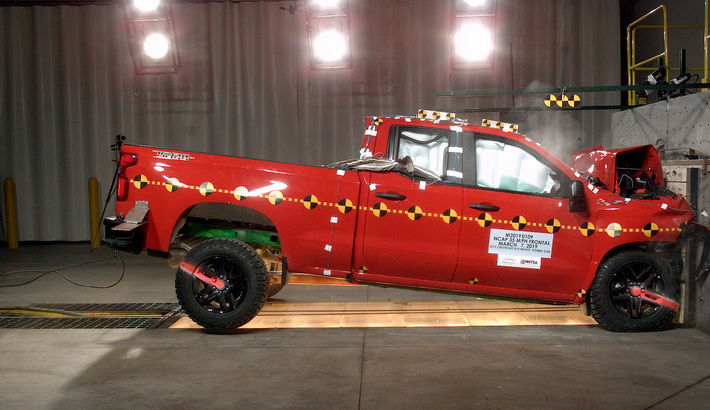
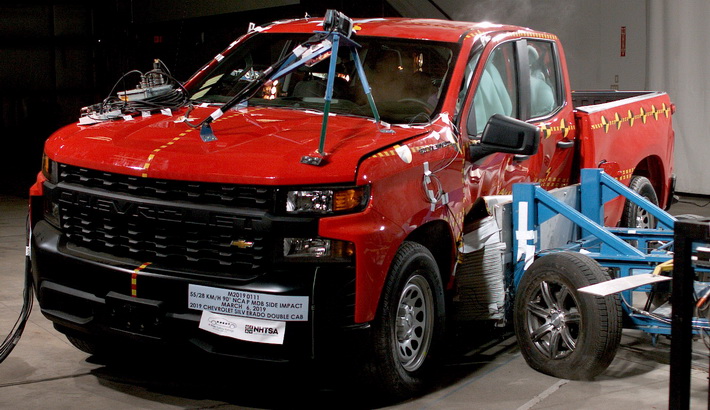
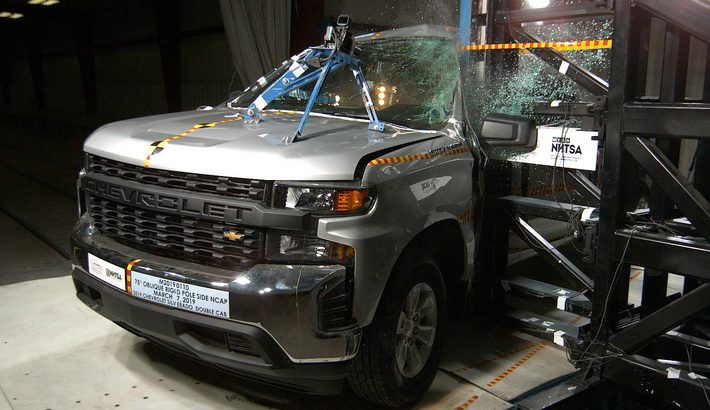
NHTSA crash tests
The agency crash-tested this model year itself. These are its own
photographs and star ratings.
Frontal crash test
Side barrier crash test
Side pole crash test
Photographs taken by NHTSA during its own New Car Assessment Program crash
tests of this model year. Public domain.
Configuration
Overall
Front
Side
Rollover
2019 Chevrolet Silverado 1500 PU/EC RWD
19.1% risk
2019 Chevrolet Silverado 1500 PU/EC 4WD
19.8% risk
2019 Chevrolet Silverado 1500 PU/RC RWD
19.1% risk
2019 Chevrolet Silverado 1500 PU/RC 4WD
19.8% risk
2019 Chevrolet Silverado 1500 PU/CC 4WD
19.8% risk
2019 Chevrolet Silverado 1500 PU/CC RWD
19.1% risk
When owners complained
A spike years after the car went on sale usually means a part wearing
out on schedule across the whole fleet — the kind of pattern no single
owner can see from inside their own car.
Jan 2019peak 90Sep 2026
NHTSA investigations into the 2019 Chevrolet Silverado 1500
An investigation is the step before a recall: the agency has seen enough
complaints to look into a pattern itself. An open one means it thinks
something may be wrong and nothing has been fixed yet.
1
investigation is
still open.
EA25007Opened 23 Oct 2025Still openENGINE AND ENGINE COOLING:ENGINE:HARD PARTS INTERNAL/MECHANICAL
Loss of motive power due to engine failure
The Office of Defects Investigation (ODI) has received 1,157 reports of engine bearing failure failures in the L87 6.2L engine produced by General Motors (GM). Of the 1,157 reports received, 173 are outside of the scope of recall 25V-274. These engines are installed in Model Years (MY) 2019–2024 Chevrolet Silverado 1500 and GMC Sierra 1500, and 2021-2024MY Chevrolet Suburban and Tahoe, GMC Yukon/Yukon XL, and Cadillac Escalade/Escalade ESV vehicles. The subject engine failures were investigated as part of a Preliminary Evaluation (PE25001). GM determined that these engine failures were due to...
PE25001Opened 16 Jan 2025Closed 23 Oct 2025ENGINE AND ENGINE COOLING:ENGINE:HARD PARTS INTERNAL/MECHANICAL
Loss of motive power due to engine failure
On January 16, 2025, the Office of Defects Investigation (ODI) opened Preliminary Evaluation PE25001 after receiving complaints and field reports concerning engine failures in MY2019-2024 GM’s full-size truck and SUV T1XX platform equipped with the L87 6.2L V8 engine. These complainants alleged engine bearing failures resulting in knocking and growling noises from the engine’s bottom end and in some cases more severe consequences such as broken connecting rods leading to engine damage, or engine failure. If the engine fails during vehicle operation, the vehicle will lose propulsion, increasing...
Recalls on the 2019 Chevrolet Silverado 1500
A complaint is one owner's allegation. A recall is the point at which
the manufacturer or a regulator agreed the defect is real and dangerous
enough to fix for free — however old the car is.
United States — NHTSA
21V985000
TIRES:TEMPORARY/EMERGENCY SPARE TIRE
General Motors (GM) is recalling certain 2019-2021 GMC Sierra 1500 and Silverado 1500 vehicles equipped with certain accessory road tires and a 17" spare tire. The 17" spare tire provided with the vehicle is not compatible for use with the accessory wheels, which can cause the anti-lock brake system (ABS) to not function properly under certain conditions.
Risk: An ABS system that does not function properly can increase the risk of a crash.
21V423000
TIRES
General Motors, LLC (GM) is recalling certain 2019 Chevrolet Silverado 1500 and GMC Sierra 1500 vehicles. The affected tires were cured for too long during production.
Risk: Over cured tires may develop a break in the sidewall resulting in sudden air loss or a belt edge separation which could lead to a tread/belt loss. Either condition can cause a loss of vehicle control, increasing the risk of a crash.
21V115000
TIRES
General Motors LLC (GM) is recalling certain 2020 Buick Enclave, Cadillac XT4, XT5, Escalade, Escalade ESV, Chevrolet Suburban, Tahoe, Traverse, GMC Yukon, Yukon XL, 2018-2021 Chevrolet Express, GMC Savana, 2019-2020 Chevrolet Blazer, Silverado 1500, GMC Acadia, Sierra 1500, and certain Continental tires sold to the aftermarket for various model year 2018-2021 vehicles. The affected tires were cured for too long during production.
Risk: Over cured tires may develop a break in the sidewall resulting in sudden air loss or a belt edge separation which could lead to a tread/belt loss. Either condition can cause a loss of vehicle control, increasing the risk of a crash.
20V792000
SEAT BELTS
General Motors, LLC (GM) is recalling certain 2019-2021 Chevrolet Silverado 1500 and GMC Sierra 1500, 2021 Chevrolet Suburban and Tahoe and GMC Yukon XL and 2020-2021 Chevrolet Silverado 2500 and 3500 and GMC Sierra 2500 and 3500 vehicles. The seat belt brackets may not be secured to the seat frame in the front-row center seating position.
Risk: If a seat-belt bracket is not secured, the seat belt may not properly restrain an occupant in the front-row center seat position, increasing the risk of injury in a crash.
20V650000
POWER TRAIN:DRIVELINE:DRIVESHAFT
General Motors LLC (GM) is recalling certain 2019-2020 Chevrolet Silverado 1500 and GMC Sierra 1500 and 2020 Chevrolet Silverado 2500 trucks. One of the driveshaft joints may not have been properly welded, causing the driveshaft to separate while the vehicle is moving.
Risk: If the driveshaft separates, there may be a loss of propulsion, increasing the risk of crash.
20V055000
SERVICE BRAKES, HYDRAULIC:POWER ASSIST
General Motors LLC (GM) is recalling certain 2019 Chevrolet Silverado 1500 and GMC Sierra 1500 vehicles. These vehicles received updated software for the Electronic Brake Control Module (EBCM). This software has an error, and as a result, the vehicle's electronic brake assist may be disabled. As such, these vehicles fail to comply with the requirements of Federal Motor Vehicle Safety Standard (FMVSS) number 126, "Electronic Stability Control" and 135, "Light Vehicle Brake Systems."
Risk: A loss of electronic brake assist can increase the risk of a crash.
19V889000
SERVICE BRAKES, HYDRAULIC:ANTILOCK/TRACTION CONTROL/ELECTRONIC LIMITED SLIP:ABS WARNING LIGHT
General Motors LLC (GM) is recalling certain 2019 Chevrolet Silverado 1500, Cadillac CT6, and GMC Sierra 1500 vehicles. Due to an Electronic Brake Control Module (EBCM) software error, the vehicle's Electronic Stability Control (ESC) and Antilock Brake System (ABS) may become disabled. Furthermore, if this specific error occurs, the vehicle's diagnostics will not illuminate the instrument cluster ESC and ABS malfunction warning lights. As such, these vehicles fail to comply with the requirements of Federal Motor Vehicle Safety Standard (FMVSS) number 126, "Electronic Stability Control" and 135, "Light Vehicle Brake Systems."
Risk: If the driver operates the vehicle unaware that ESC and ABS are not functioning, there is an increased risk of a crash.
19V888000
ELECTRICAL SYSTEM:12V/24V/48V BATTERY:CABLES
General Motors LLC (GM) is recalling certain 2019-2020 Chevrolet Silverado 1500 and GMC Sierra 1500 trucks. The battery positive (B+) cable rings may have been manufactured with excessive glue, potentially causing an intermittent electrical connection between the B+ cable and alternator.
Risk: An intermittent electrical connection between the B+ battery cable and the alternator could cause the vehicle to stall, increasing the risk of a crash. The intermittent connection could also lead to electrical arcing, which could generate sufficient heat to damage surrounding material, increasing the risk of a fire.
Reports where the owner recorded a crash, a fire, an injury or a death.
Wyandanch, NYFire
UNKNOWN OR OTHER
While flat towing my pickup truck behind my motorhome, on interstate 94 eastbound, in Minnesota I noticed smoke on my screen in the motorhome back facing camera. I safety pulled over to a truck rest area in Avon Minnesota. I went to investigate and realized that the pickup truck had flames coming from underneath the hood. Because of the fire and heat I wasn’t able to release the pickup truck from the motorhome which ultimately caused the Motorhome to catch fire as well. Police and fire department were called and both the Motorhome and pickup truck were totaled. My insurance company has possession of both vehicles. I previously had electrical problems with the pickup truck and took it to the Chevy dealership to address the issue. Evidence of module overheating with traces of burn were found on one occasion. I’m uploading photos of the police report and work orders from the dealership. No one was injured but all of our belongings were destroyed or damaged from the fire. We were left with nothing but what we had on at the time.
NHTSA complaint #11745873 — an unverified report by a vehicle owner.
Muscatine, IACrash
POWER TRAIN
Transmission failed while in drive and going up a hill.
NHTSA complaint #11717624 — an unverified report by a vehicle owner.
La Pine, ORCrash2 injured
SEAT BELTS
On January 28, 2023, my Chevrolet Silverado was involved in a significant multi-impact collision. At the time of the accident, I was a front-seat passenger and my vehicle was fully stopped when it was struck from behind at high speed by a Dodge 2500. The force of the rear impact pushed my truck into the vehicle in front of us, resulting in a secondary front-end collision. This sequence occurred twice. During the collision, the front passenger-side airbag did not deploy, and the front passenger seatbelt failed to lock. As a result, I was thrown violently within the passenger side of the vehicle and struck my head on the dashboard. In contrast, the driver’s seatbelt locked properly, as did the rear seatbelt where my child was seated. Due to the failure of the passenger-side seatbelt to lock, I sustained a severe concussion, a black eye, and other injuries. The vehicle was subsequently inspected by my insurance company. When sheriff’s deputies and state police arrived at the scene, they expressed concern and surprise that the passenger seatbelt did not lock and that no airbags deployed despite the severity of the collision. Shortly after the accident, I contacted GMC regarding these safety concerns. GMC retrieved the vehicle’s Crash Data Recorder (CDR) and conducted an investigation. I was later informed that GMC found no defects or issues with their products. Nearly three years have passed since the accident, and I remain deeply concerned and dissatisfied with GMC’s conclusion. The passenger-side seatbelt did not function as designed, while the driver and rear seatbelts did, and no airbags deployed. I do not believe adequate accountability or explanation was provided regarding the apparent failure of the passenger-side restraint system. Given the force of the impact, I could have been ejected through the windshield.
NHTSA complaint #11705979 — an unverified report by a vehicle owner.
La Pine, ORCrash2 injured
AIR BAGS
On January 28, 2023, my Chevrolet Silverado was involved in a significant multi-impact collision. At the time of the accident, I was a front-seat passenger and my vehicle was fully stopped when it was struck from behind at high speed by a Dodge 2500. The force of the rear impact pushed my truck into the vehicle in front of us, resulting in a secondary front-end collision. This sequence occurred twice. During the collision, the front passenger-side airbag did not deploy, and the front passenger seatbelt failed to lock. As a result, I was thrown violently within the passenger side of the vehicle and struck my head on the dashboard. In contrast, the driver’s seatbelt locked properly, as did the rear seatbelt where my child was seated. Due to the failure of the passenger-side seatbelt to lock, I sustained a severe concussion, a black eye, and other injuries. The vehicle was subsequently inspected by my insurance company. When sheriff’s deputies and state police arrived at the scene, they expressed concern and surprise that the passenger seatbelt did not lock and that no airbags deployed despite the severity of the collision. Shortly after the accident, I contacted GMC regarding these safety concerns. GMC retrieved the vehicle’s Crash Data Recorder (CDR) and conducted an investigation. I was later informed that GMC found no defects or issues with their products. Nearly three years have passed since the accident, and I remain deeply concerned and dissatisfied with GMC’s conclusion. The passenger-side seatbelt did not function as designed, while the driver and rear seatbelts did, and no airbags deployed. I do not believe adequate accountability or explanation was provided regarding the apparent failure of the passenger-side restraint system. Given the force of the impact, I could have been ejected through the windshield.
NHTSA complaint #11705979 — an unverified report by a vehicle owner.
Stockbridge, GACrashFire
WHEELS
Unknown
NHTSA complaint #11703562 — an unverified report by a vehicle owner.
Stockbridge, GACrashFire
UNKNOWN OR OTHER
Unknown
NHTSA complaint #11703562 — an unverified report by a vehicle owner.
The most recent complaints
In the owners' own words, exactly as filed with NHTSA.
Tomball, TX
POWER TRAIN
While Driving I feel shaking while accelerating between 25-40 mph, and its like I'm driving over rumble strips, plus when stopped and start to accelerate it hesitates and then surges forward.
NHTSA complaint #11763112 — an unverified report by a vehicle owner.
Matawan, NJ
POWER TRAIN
Came off the parkway and came to a stop at a stop sign. As I attempted to accelerate forward the truck shuttered violently, did not move forward and then slammed into gear. As it slammed into gear it jerked forward. The force of the jerk pushed me back in the seat and caused the steering wheel to turn. About 100 yards later I came to a stop in traffic. As I attempted to accelerate the same incident occurred again. After the second incident anytime I same to a stop and attempted to accelerate forward the shutter was no longer present but the truck would not move at first and would then slam into gear and jerk violently. This would occur in drive and reverse. I brought it to the dealership and they diagnosed that it needed a transmission. The service writer even told me it bucked so hard while the technician was moving it that it almost put him through the steering wheel. The truck is currently having the transmission replaced at Greenbrook GMC. Estimated repair cost is $9400 plus taxes and fees. Can provide invoice and bill once repair is completed.
NHTSA complaint #11763239 — an unverified report by a vehicle owner.
at 80,000 milesBaldwinsville, NY
ELECTRICAL SYSTEM
The contact owns a 2019 Chevrolet Silverado 1500. The contact stated that the vehicle experienced various intermittent electrical failures while driving at various speeds. The contact stated that the power locks and windows either failed to operate as needed or independently operated while driving. The vehicle was inspected by a friend, and a potential issue with the ground fault cable was found. The friend recommended that a dealer inspect the vehicle. The contact stated that the instrument panel intermittently displayed the messages, "Steering Column Lock Needs Service", "Check Engine", and other unknown messages. Additionally, the brake pedal depressed to the floorboard while attempting to start the vehicle but resumed normal operation after the vehicle was started. The vehicle was taken to a dealer but has not yet been diagnosed or repaired. The failure mileage was approximately 80,000.
NHTSA complaint #11761890 — an unverified report by a vehicle owner.
at 80,000 milesBaldwinsville, NY
SERVICE BRAKES, HYDRAULIC
The contact owns a 2019 Chevrolet Silverado 1500. The contact stated that the vehicle experienced various intermittent electrical failures while driving at various speeds. The contact stated that the power locks and windows either failed to operate as needed or independently operated while driving. The vehicle was inspected by a friend, and a potential issue with the ground fault cable was found. The friend recommended that a dealer inspect the vehicle. The contact stated that the instrument panel intermittently displayed the messages, "Steering Column Lock Needs Service", "Check Engine", and other unknown messages. Additionally, the brake pedal depressed to the floorboard while attempting to start the vehicle but resumed normal operation after the vehicle was started. The vehicle was taken to a dealer but has not yet been diagnosed or repaired. The failure mileage was approximately 80,000.
NHTSA complaint #11761890 — an unverified report by a vehicle owner.
Guyton, GA
POWER TRAIN
Transmission entered limp mode when decelerating at highway speed. Shutter shift, rapid rpm increase. First shift in the morning is a hard shift with loss of power.
NHTSA complaint #11761756 — an unverified report by a vehicle owner.
Portland, ME
STEERING
My truck lost steering as I was trying to pull into a parking lot. It started as a momentary jerking of the steering wheel then total loss of steering. The ABS error and Trailer Braking failure warning also appeared. After 4 to 5 restarts of the truck the steering came back. If this was to happen at high speed it would have been very bad. I feel this is definetly a safety issue..
NHTSA complaint #11761708 — an unverified report by a vehicle owner.
Knoxville, TN
FUEL/PROPULSION SYSTEM
WHEN I UNLOCKED THE DOOR AND ENTERED THE TRUCK GAS STARTED LEAKING / pouring from the top of the fuel tank. ON THE GROUND BEFORE I STARTED THE MOTOR. IF I HAD DRIVEN THE TRUCK VERY POSIBLE IT COULD HAVE CAUGHT ON FIRE. ITS A 2019 WITH 61598 MILES. I FOUND A FUEL PUMP RECALL N192283991 SAID FOR CERTAIN 2019-2020 SILVERADO MODELS IT APPEARS I HAVE THE SAME PROBLEMS HAVE NOT CHECKED WITH A DEALER YET. TRUCK WILL HAVE TO BE TOWED.
NHTSA complaint #11761651 — an unverified report by a vehicle owner.
Houston, TX
POWER TRAIN
My truck suddenly stopped, received a message on the dashboard that said transmission hot. Idle engine. I was unable to remove my key. Minutes later it started up like nothing.
NHTSA complaint #11760972 — an unverified report by a vehicle owner.
at 149,000 milesOwens Cross Roads, AL
WHEELS
The contact owns a 2019 Chevrolet Silverado 1500. The contact stated that while his wife was driving at 6 MPH, the rear wheels unexpectedly seized, requiring the driver to pull over and turn off the vehicle. The contact stated that the vehicle resumed normal operation after restarting the following day. The vehicle was taken to the dealer, but the failure could not be duplicated, and no diagnostic trouble codes were retrieved. The vehicle was not repaired. The manufacturer was made aware of the failure, and a case was filed. The failure mileage was approximately 149,000.
NHTSA complaint #11760911 — an unverified report by a vehicle owner.
at 23,600 milesHouston, TX
ENGINE
The contact's husband owns a 2019 Chevrolet Silverado 1500. The contact stated that while driving approximately 35 MPH, the check engine warning light illuminated but disappeared the following day. The contact stated that approximately four days later, after refueling the vehicle, while stopped at a red light and attempting to make a right turn, the vehicle stalled. The vehicle was pushed to the side of the road and towed to the residence. The vehicle was then towed to a dealer where it was diagnosed and determined that the fuel pump module needed to be replaced. The contact stated that DTC: P129F was retrieved. The vehicle was repaired. The manufacturer was notified of the failure. The failure mileage was approximately 23,600.
NHTSA complaint #11760994 — an unverified report by a vehicle owner.
Oakes, ND
ENGINE
6.2 motor failed in cylinder number 2
NHTSA complaint #11761135 — an unverified report by a vehicle owner.
Warsaw, IN
ENGINE
AFM causing engine tick. I am reporting a radiator failure on my 2019 Chevrolet Silverado 1500 equipped with the 6.2L V8. The vehicle developed an active coolant leak from the radiator assembly. The coolant reservoir level dropped significantly after normal driving, and coolant was visibly leaking and collecting underneath the vehicle. The truck initially began running warmer than normal, approximately 215–220°F, before the leak was fully identified. After topping the system with the correct DEX-COOL coolant, the coolant level continued to drop and an external leak became clearly visible. The vehicle was subsequently parked to avoid engine overheating or further damage. The original radiator carries GM part number 84152439. I have since been advised that the current GM replacement radiator is part number 85575815. I was also informed by GM dealership personnel that radiator failures involving this application are currently being investigated. My concern is that a sudden radiator failure can result in rapid coolant loss and overheating, potentially causing engine damage or vehicle disablement while driving. This is particularly concerning because the temperature gauge may initially remain near normal even while coolant is being lost. I am requesting that NHTSA review radiator failures on 2019 Chevrolet Silverado 1500 models, particularly vehicles equipped with the 6.2L engine and heavy-duty/enhanced cooling package, to determine whether there is a pattern of premature radiator cracking, tank/seam failure, or other coolant-loss defects that warrant a safety investigation, service campaign, or recall.
NHTSA complaint #11760747 — an unverified report by a vehicle owner.
Wethersfield, CT
ENGINE
The company had a complimentary repair of the known issue of bad oil cooler lines. It oblast short period. I now own the vehicle and it still has leaking oil cooler lines why should it not be replaced by GM since the lines leaking or coming apart and possibly blowing up and engine is a known problem. Would like gm to replace it under the program they already had offered
NHTSA complaint #11760773 — an unverified report by a vehicle owner.
Warsaw, IN
FUEL/PROPULSION SYSTEM
AFM causing engine tick. I am reporting a radiator failure on my 2019 Chevrolet Silverado 1500 equipped with the 6.2L V8. The vehicle developed an active coolant leak from the radiator assembly. The coolant reservoir level dropped significantly after normal driving, and coolant was visibly leaking and collecting underneath the vehicle. The truck initially began running warmer than normal, approximately 215–220°F, before the leak was fully identified. After topping the system with the correct DEX-COOL coolant, the coolant level continued to drop and an external leak became clearly visible. The vehicle was subsequently parked to avoid engine overheating or further damage. The original radiator carries GM part number 84152439. I have since been advised that the current GM replacement radiator is part number 85575815. I was also informed by GM dealership personnel that radiator failures involving this application are currently being investigated. My concern is that a sudden radiator failure can result in rapid coolant loss and overheating, potentially causing engine damage or vehicle disablement while driving. This is particularly concerning because the temperature gauge may initially remain near normal even while coolant is being lost. I am requesting that NHTSA review radiator failures on 2019 Chevrolet Silverado 1500 models, particularly vehicles equipped with the 6.2L engine and heavy-duty/enhanced cooling package, to determine whether there is a pattern of premature radiator cracking, tank/seam failure, or other coolant-loss defects that warrant a safety investigation, service campaign, or recall.
NHTSA complaint #11760747 — an unverified report by a vehicle owner.
Worland, WY
ENGINE
While driving 65 mph down the highway pulling a trailer. I lost all power and chimes went off on the dash to push button to start. I coasted to the side of the road and vehicle was completely dead. It was towed to the nearest dealership and it was determined that it needed a whole new engine. It took 119 days for the repair to be made.
NHTSA complaint #11760609 — an unverified report by a vehicle owner.
Glenville, NY
ENGINE
At 82,000 miles, cylinder number 6 lifter collapsed resulting in a bent push rod. I have since replaced the cam, lifters, push rods with an AFM delete kit for Texas Speed knowing that the same problem would occur if factory parts were used again. One would think that a newer vehicle should last longer than 82K miles with all the technology today. Oil changes were always on time between 3 and 5k miles. Unfortunately, I'm cursed with knowing how to work on vehicles. Is there anything that GM can do with my out-of-pocket material costs of $2500.00? Love the truck ... but very discouraged and may have to go back with a Ford!
NHTSA complaint #11760611 — an unverified report by a vehicle owner.
North Las Vegas, NV
STEERING
We recently had a brand new engine installed In our truck that only had 70k miles and only 7 years old due to white smoke coming out of tail pipe. The day after receiving the truck back after having the brand new engine installed the truck was not operating properly then gave me a bunch of warnings and then the brakes wouldn’t work and the steering wouldn’t work. I informed the dealership that installed the brand new engine and they had the truck towed back to their shop just to look at it for 3 days and proceed to tell me there was no issues they could find. Picked the truck back up just to have the same issue happen not even a month later. I was able to document the warnings and issues while they were happening and provided those to the dealership when we drop it off for the second time after getting a brand new $13k engine installed. If you would like the video I captured of the warnings I will happily send them.
NHTSA complaint #11760477 — an unverified report by a vehicle owner.
at 111,940 milesBoston, GA
ENGINE AND ENGINE COOLING
The contact owns a 2019 Chevrolet Silverado 1500. The contact stated that while driving on the highway, a "Low Oil Pressure" warning message displayed, and the engine RPMs and vehicle speed reduced. The contact drove the vehicle off the road and into a parking lot. Upon exiting the vehicle, the contact noticed oil leaking from underneath the vehicle. The vehicle was towed to a local dealer, where it was diagnosed that the engine had failed and needed to be replaced. The vehicle was then towed to an independent mechanic, who confirmed the engine failure. The independent mechanic replaced the engine, which remedied the failure. The contact stated that the manufacturer had issued extended warranty coverage for the failure for vehicles in Alaska and Canada. The manufacturer was notified of the failure, but no assistance was provided. The failure mileage was 111,940.
NHTSA complaint #11760408 — an unverified report by a vehicle owner.
Windham, NH
ENGINE
while under warrantee the dealer quirk Chevy in Manchester NH, intentionally misdiagnosed the engine failure symptoms. The Service director did this three times all while under warrantee. now out of warrantee. my engine has completely failed. Silverado 1500 High-country with 6.2 L Gas engine with AFM. the service director in a private off site conversation admitted the intentional misdiagnose.
NHTSA complaint #11760229 — an unverified report by a vehicle owner.
North Las Vegas, NV
ENGINE
We recently had a brand new engine installed In our truck that only had 70k miles and only 7 years old due to white smoke coming out of tail pipe. The day after receiving the truck back after having the brand new engine installed the truck was not operating properly then gave me a bunch of warnings and then the brakes wouldn’t work and the steering wouldn’t work. I informed the dealership that installed the brand new engine and they had the truck towed back to their shop just to look at it for 3 days and proceed to tell me there was no issues they could find. Picked the truck back up just to have the same issue happen not even a month later. I was able to document the warnings and issues while they were happening and provided those to the dealership when we drop it off for the second time after getting a brand new $13k engine installed. If you would like the video I captured of the warnings I will happily send them.
NHTSA complaint #11760477 — an unverified report by a vehicle owner.
North Las Vegas, NV
SERVICE BRAKES
We recently had a brand new engine installed In our truck that only had 70k miles and only 7 years old due to white smoke coming out of tail pipe. The day after receiving the truck back after having the brand new engine installed the truck was not operating properly then gave me a bunch of warnings and then the brakes wouldn’t work and the steering wouldn’t work. I informed the dealership that installed the brand new engine and they had the truck towed back to their shop just to look at it for 3 days and proceed to tell me there was no issues they could find. Picked the truck back up just to have the same issue happen not even a month later. I was able to document the warnings and issues while they were happening and provided those to the dealership when we drop it off for the second time after getting a brand new $13k engine installed. If you would like the video I captured of the warnings I will happily send them.
NHTSA complaint #11760477 — an unverified report by a vehicle owner.
Rockwood, TN
POWER TRAIN
Torque converter failure led to transmission failure in 6 speed transmission. Engine lifter failure.
NHTSA complaint #11758861 — an unverified report by a vehicle owner.
Rockwood, TN
ENGINE
Torque converter failure led to transmission failure in 6 speed transmission. Engine lifter failure.
NHTSA complaint #11758861 — an unverified report by a vehicle owner.
Hampton, GA
POWER TRAIN
"The transmission valve body is failing, causing the rear wheels to violently lock up while Driving
NHTSA complaint #11757863 — an unverified report by a vehicle owner.
Boise, ID
POWER TRAIN
Transmission has jerked and shuttered ever since I bought the truck. Sometime when you push on the gas the truck doesn’t immediate go, then suddenly jerks into gear and speeds off! It has gone in several times but all they do is software updates. They also said I needed a transmission flush at only 43,000 miles stating an inferior trans fluid was originally used; however they wouldn’t covered it under my extended warranty
NHTSA complaint #11757996 — an unverified report by a vehicle owner.