Owners have filed 1,117 complaints
about the 2016 Ford Edge with NHTSA between 2016 and 2026.
The largest single group is the engine & cooling.
Across this model's run it ranks 8 of 18 worst.
The letter says how bad. This says what kind — whether this year drew
an unusual number of complaints, unusually dangerous
ones, or failures that arrived unusually early.
The dashed ring is 50 — the national norm. Further out is worse.
Complaint volume — 56
Against the median year of the Ford Edge. 50 means typical for this
model; 100 means roughly double.
Severity — 25
4.8% of these complaints
involved a crash, fire, injury or death, against a national rate of
9.7%.
Early failure — 58
34% of failures with a mileage on record happened under
36,000 miles, against a national rate of
29%.
NHTSA files every complaint against a named sub-assembly, not just a
system. This is the difference between knowing it was "the engine" and
knowing which part of it — the list to hand a mechanic.
Body
2643.3%
Sun/Moon Roof Assembly
915.0%
Rearview System Braking
58.3%
Transfer Case (4-WHEEL Drive)
58.3%
Hoses, Lines/Piping, AND Fittings
58.3%
Glass, Side/Rear
58.3%
Lugs/Nuts/Bolts/Studs
35.0%
Hoses/Valves/Sensors
23.3%
When it fails
Odometer readings owners gave when they filed. About half of all
complaints include one.
Under 1,000 miles
101.7%
1,000 – 9,999 miles
8113.4%
10,000 – 24,999 miles
7111.8%
25,000 – 49,999 miles
10717.7%
50,000 – 74,999 miles
13322.0%
75,000 – 99,999 miles
8914.7%
100,000 – 149,999 miles
9515.7%
150,000+ miles
183.0%
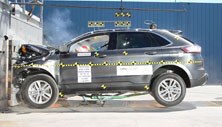
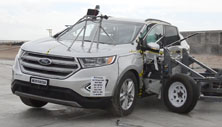
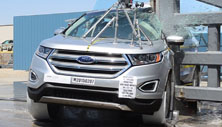
NHTSA crash tests
The agency crash-tested this model year itself. These are its own
photographs and star ratings.
Frontal crash test
Side barrier crash test
Side pole crash test
Photographs taken by NHTSA during its own New Car Assessment Program crash
tests of this model year. Public domain.
Configuration
Overall
Front
Side
Rollover
2016 Ford Edge SUV FWD
15.4% risk
2016 Ford Edge SUV AWD
15.5% risk
When owners complained
A spike years after the car went on sale usually means a part wearing
out on schedule across the whole fleet — the kind of pattern no single
owner can see from inside their own car.
Jun 2016peak 27Sep 2026
NHTSA investigations into the 2016 Ford Edge
An investigation is the step before a recall: the agency has seen enough
complaints to look into a pattern itself. An open one means it thinks
something may be wrong and nothing has been fixed yet.
From 2000 through 2017, Takata produced millions of air bag inflators using two types of phase-stabilized ammonium nitrate ("PSAN") propellant -- propellant 2004 and propellant 2004L. After prolonged exposure to high temperature cycles and humidity, inflators using propellant 2004 can degrade, causing the propellant to burn too quickly when ignited. The rapid burning can cause the inflator to rupture during deployment, potentially causing serious or even fatal injury to vehicle occupants. See 2016 Blomquist Report at www.nhtsa.gov/sites/nhtsa.gov/files/documents/expert_report-hrblomquist.pdf.C...
PE24027Opened 3 Oct 2024Closed 30 Oct 2025SERVICE BRAKES
Loss of braking caused by rear brake hose failure
On October 3, 2024, NHTSA’s Office of Defects Investigation (ODI) opened this Preliminary Evaluation to investigate instances of rear brake hose ruptures causing a sudden and unexpected loss of braking in model year (MY) 2015-2017 Ford Edge vehicles manufactured by Ford Motor Company. The complaints allege that, without warning, the vehicle lost its ability to brake causing an unanticipated increase in the vehicle’s stopping distance. The complaints also allege that, prior to the rear brake hose rupture event, the vehicle had been serviced under recall 20V-469. Recall 20V469 involved MY 2015-2...
Recalls on the 2016 Ford Edge
A complaint is one owner's allegation. A recall is the point at which
the manufacturer or a regulator agreed the defect is real and dangerous
enough to fix for free — however old the car is.
United States — NHTSA
25V572000
BACK OVER PREVENTION: SENSING SYSTEM: CAMERA
Ford Motor Company (Ford) is recalling certain 2015-2019 Lincoln MKC, Mustang, F-350 SD, F-250 SD, F-450 SD, 2015-2017 Lincoln Navigator, Expedition, 2015-2018 Edge, Transit Connect, 2016-2019 F-550 SD, Transit, 2017-2019 Econoline, and 2019 Ranger vehicles. The rearview camera may display a distorted, inverted, or blank image when the vehicle is in reverse.
Risk: A rearview camera that displays an inverted, distorted, or blank image can reduce the driver’s view behind the vehicle, increasing the risk of a crash.
25V544000
SERVICE BRAKES, HYDRAULIC:FOUNDATION COMPONENTS:HOSES, LINES/PIPING, AND FITTINGS
Ford Motor Company (Ford) is recalling certain 2016-2018 Lincoln MKX and 2015-2018 Edge vehicles. The rear brake jounce hose may rupture and leak brake fluid.
Risk: A brake fluid leak can extend the distance required to stop the vehicle, increasing the risk of a crash.
22V413000
POWER TRAIN:AUTOMATIC TRANSMISSION:GEAR POSITION INDICATION (PRNDL)
Ford Motor Company (Ford) is recalling certain 2013-2019 Escape, 2013-2018 C-Max, 2013-2016 Fusion, 2013-2021 Transit Connect, and 2015-2018 Edge vehicles. The bushing that attaches the shifter cable to the transmission may degrade or detach.
Risk: A damaged or missing bushing may prevent the vehicle from shifting into the intended gear, and cause the vehicle to move in an unexpected direction. Additionally, the vehicle may roll after the driver selects the 'Park' position. Either scenario increases the risk of a crash or injury.
20V469000
SERVICE BRAKES
Ford Motor Company (Ford) is recalling certain 2015-2018 Ford Edge and 2016-2018 Lincoln MKX vehicles. The front brake hoses may rupture prematurely.
Risk: A ruptured front brake hose will cause a brake fluid leak, lengthening the distance needed to stop the vehicle, increasing the risk of a crash.
19V632000
STEERING:ELECTRIC POWER ASSIST SYSTEM
Ford Motor Company (Ford) is recalling certain 2013-2016 Ford Fusion and Lincoln MKZ, 2015-2016 Ford Edge, and 2016 Lincoln MKX vehicles originally sold, or currently registered in Connecticut, Delaware, the District of Columbia, Illinois, Indiana, Iowa, Maine, Maryland, Massachusetts, Michigan, Minnesota, Missouri, New Hampshire, New Jersey, New York, Ohio, Pennsylvania, Rhode Island, Vermont, West Virginia, and Wisconsin. Road salt or other contaminants may corrode the electric power steering gear motor attachment bolts.
Risk: If the bolts corrode, the steering gear motor may detach from the gear housing resulting in a loss of power steering assist, requiring a greater steering effort, especially at lower speeds, and increasing the risk of a crash.
17V123000
AIR BAGS:FRONTAL:DRIVER SIDE:INFLATOR MODULE
Ford Motor Company (Ford) is recalling certain 2016-2017 Ford Edge and Lincoln MKX vehicles and 2017 Lincoln Continental vehicles. In the event of a crash, the driver's frontal air bag may not fully inflate or the air bag cushion may detach from the air bag module. As such, these vehicles fail to comply with the requirements of Federal Motor Vehicle Safety Standard (FMVSS) number 208, "Occupant Crash Protection."
Risk: During deployment, if the air bag does not fully inflate or the cushion detaches, there is an increased risk of injury in the event of a crash.
16V733000
SERVICE BRAKES, HYDRAULIC:ANTILOCK/TRACTION CONTROL/ELECTRONIC LIMITED SLIP
Ford Motor Company (Ford) is recalling certain model year 2015-2016 Ford Edge vehicles manufactured February 9, 2015, to August 12, 2016. During dealer servicing, the affected vehicles may be have been updated with incorrect Antilock Brake System (ABS) and Electronic Stability Control (ESC) software. This software can cause the ESC system to lose engine torque control, and not provide any warning lamps to warn the driver if there was an ABS or ESC system malfunction. As such, these vehicles fail to comply with the requirements of Federal Motor Vehicle Safety Standard (FMVSS) number 126, "Electronic Stability Control Systems" and number 135, "Light Vehicle Brake Systems."
Risk: If the operator is not warned of an ABS or ESC malfunction and the ESC loses engine torque control, there would be an increased risk of a crash.
Canada — Transport Canada
Canada runs its own recall programme, and its campaigns do not
always mirror the American ones.
Recall 2025449122,125 units in Canada
Visual System
Issue: On certain vehicles, there could be a problem with the connections inside the rearview camera. As a result, the rearview camera image may not display correctly or at all when the transmission is shifted into reverse. Note: For certain models, this recall also affects incomplete vehicles. Safety Risk: A rearview camera image that doesn't display could reduce a driver's ability to see behind the vehicle while backing up. This could increase the risk of a crash. Corrective Actions: Ford will notify owners by mail and advise you to take your vehicle to a dealership to inspect and, if necessary, replace the rearview camera.
Recall 202543552,547 units in Canada
Brakes
Issue: On certain vehicles, the rear brake hoses could fail and cause a progressive brake fluid leak. If this happens, there could be reduced braking. Note: This problem could cause a change in brake pedal feel and travel. Safety Risk: Reduced braking can cause extended stopping distances and increase the risk of a crash. Corrective Actions: Ford will notify owners by mail and advise you to take your vehicle to a dealership to inspect and replace or reroute the rear brake hoses, as necessary.
Recall 2022311362,062 units in Canada
Powertrain
Issue: On certain vehicles, the shift cable may detach from the transmission. This could cause the transmission not to shift gears when the shifter is moved. As a result, the transmission could be in a different gear than the gear shifter indicates. If a driver attempts to exit the vehicle while the transmission is not in Park, and the parking brake is not applied, the vehicle could move suddenly. Safety Risk: Sudden and unexpected movement of the vehicle could increase the risk of a crash. Corrective Actions: Ford will notify owners by mail and instruct you to take your vehicle to a dealership to replace the transmission shifter cable bushing and install a protective service cap. Ford advises that you should apply the parking brake each time the vehicle is parked.
Recall 202037362,876 units in Canada
Brakes
Issue: On certain vehicles, the front brake hoses could fail, causing a progressive brake fluid leak. If this happens, the driver may experience a change in brake pedal feel and travel. This can cause reduced brake performance. Note: A brake fluid leak would cause the brake warning light to turn on. Safety Risk: Reduced brake performance could cause extended stopping distances and increase the risk of a crash. Corrective Actions: Ford will notify owners by mail and instruct you to take your vehicle to a dealer to replace the front brake hoses.
Recall 20194319,906 units in Canada
Steering
Issue: On certain vehicles, the bolts that attach the electric power steering assist motor to the steering gear may corrode and break. This could cause a loss of power steering assist. This recall applies to vehicles originally sold or currently registered in areas of heavy road salt usage (Ontario, Quebec, New Brunswick, Nova Scotia, Prince Edward Island, and Newfoundland & Labrador). Safety Risk: A loss of power steering assist may result in a sudden increase in steering effort, especially at low vehicle speeds. This could increase the risk of a crash. Corrective Actions: The company will notify owners by mail and instruct you to take your vehicle to a Ford or Lincoln dealer to replace the bolts and apply a wax sealer. If one or more of the bolts are broken or missing, a new steering gear will be installed.
Recall 20171024,336 units in Canada
Airbag
Certain vehicles may fail to comply with the requirements of Canada Motor Vehicle Safety Standard (CMVSS) 208 - Occupant Protection in Frontal Impacts. Certain driver frontal airbag modules may have been assembled incorrectly. In the event of a crash warranting deployment of the driver's frontal airbag, the airbag may not completely fill, or the airbag cushion may detach from the airbag module, which would not protect the driver as expected, and could increase the risk of injury. Correction: Dealers will replace the driver's frontal airbag.
Recall 20164933 units in Canada
Brakes
Certain vehicles fail to comply with the requirements of Canada Motor Vehicle Safety Standard (CMVSS) 126 - Electronic Stability Control Systems. Vehicles that were brought to a dealer for service may have received an incorrect software update for the Antilock Brake System Stability Control system. The incorrect software disables the engine torque control of the Electronic Stability Control (ESC) system, and if a fault were to occur in the stability control system, including Antilock Brake System (ABS), Traction Control (T/C), and ESC, no warning lamp/indicator would be displayed to the driver. Additionally, no warning lamp/indicator would be displayed when traction control is disabled, or when the Electric Parking Brake (EPB) is applied. A lack of visual warning to indicate these systems are not functioning would be contrary to the requirements of the standard, and could increase the risk of a crash causing injury and/or damage to property. Correction: Dealers will reprogram the ABS module to correct the non-compliance. Until this software is available, dealers will replace the ABS module.
Reports where the owner recorded a crash, a fire, an injury or a death.
at 111,000 milesAlbuquerque, NMCrash1 injured
LATCHES/LOCKS/LINKAGES:HOOD:LATCH
The contact owns a 2016 Ford Edge. The contact stated that while driving at 15 MPH in the rain, the brake pedal was applied however, there was a delay in responding, and crashed into a Subaru Forester. There was an abnormal squeaking and squealing sound detected. The vehicle was drivable. While approaching a stoplight, there was an abnormal squealing noise, and there was an increase in stopping distance. There were no warning lights illuminated. The contact sustained a sprained neck, and medical attention was provided. There was no reported fire or air bag deployment. A police report was filed. The vehicle was taken to a brake center where it was determined there was an ABS failure related to NHTSA Campaign Number: 25V544000 (Service Brakes, Hydraulic) however the parts were not available. The hood was unable to be opened. The local dealer was not contacted. The vehicle was not diagnosed or repaired. The manufacturer was not notified. The failure mileage was approximately 111,000.
NHTSA complaint #11708769 — an unverified report by a vehicle owner.
at 111,000 milesAlbuquerque, NMCrash1 injured
SERVICE BRAKES, HYDRAULIC
The contact owns a 2016 Ford Edge. The contact stated that while driving at 15 MPH in the rain, the brake pedal was applied however, there was a delay in responding, and crashed into a Subaru Forester. There was an abnormal squeaking and squealing sound detected. The vehicle was drivable. While approaching a stoplight, there was an abnormal squealing noise, and there was an increase in stopping distance. There were no warning lights illuminated. The contact sustained a sprained neck, and medical attention was provided. There was no reported fire or air bag deployment. A police report was filed. The vehicle was taken to a brake center where it was determined there was an ABS failure related to NHTSA Campaign Number: 25V544000 (Service Brakes, Hydraulic) however the parts were not available. The hood was unable to be opened. The local dealer was not contacted. The vehicle was not diagnosed or repaired. The manufacturer was not notified. The failure mileage was approximately 111,000.
NHTSA complaint #11708769 — an unverified report by a vehicle owner.
Smiths Station, ALCrash
UNKNOWN OR OTHER
Rear view camera was distorted and didn’t show a vehicle behind me when I backed out of parking spot and made contact with another vehicle.
NHTSA complaint #11691748 — an unverified report by a vehicle owner.
Smiths Station, ALCrash
BACK OVER PREVENTION: REARVIEW SYSTEM BRAKING
Rear view camera was distorted and didn’t show a vehicle behind me when I backed out of parking spot and made contact with another vehicle.
NHTSA complaint #11691748 — an unverified report by a vehicle owner.
Estill, SCCrash1 injured
SERVICE BRAKES, HYDRAULIC
The contact owns a 2016 Ford Edge. The contact stated that while driving at an undisclosed speed in the rain, the vehicle started jerking. The contact stated that upon depressing the brake pedal, the vehicle failed to respond and crashed into a tree. The front driver's side air bag and the knee air bag deployed. The contact sustained neck and ankle injuries and was transported to the local emergency room for medical attention. A police report was filed; however, the report number was not provided to the contact. The vehicle was towed to an independent mechanic. The dealer was not contacted. The vehicle was not diagnosed or repaired. The contact received notification of NHTSA Campaign Number: 25V544000 (Service Brakes, Hydraulic), which the contact related to the failure. The manufacturer was not made aware of the failure. The failure mileage was unknown.
NHTSA complaint #11691023 — an unverified report by a vehicle owner.
Justin, TXCrash2 injured
AIR BAGS
Head on collison. Air bags did not deploy. Car was totaled.
NHTSA complaint #11632098 — an unverified report by a vehicle owner.
The most recent complaints
In the owners' own words, exactly as filed with NHTSA.
Captain Cook, HI
ENGINE
Component-Engine / Propulsion System Symptoms-Progressive coolant loss without external leaks, rough starting, engine shaking, white exhaust smoke, and illuminated Check Engine Light with cylinder misfire codes. Description of Incident- My 2016 Ford Edge equipped with the 2.0L EcoBoost engine is experiencing internal engine coolant intrusion into the combustion cylinders, perfectly matching the design defect identified in Ford Technical Service Bulletin (TSB) 19-2346. The vehicle exhibits persistent coolant loss alongside severe engine misfires. This defect poses an immediate safety hazard, as the fluid intrusion causes rough idling, stalling, and a sudden, hazardous loss of motor power while operating at driving speeds. This complaint is being filed in direct relation to the active NHTSA Defect Petition DP26008 investigating 2015–2018 Ford Edge vehicles for engine failures caused by this specific coolant intrusion flaw.
NHTSA complaint #11763871 — an unverified report by a vehicle owner.
Kansas City, MO
ENGINE
Recently purchased the vehicle, the following morning after purchased, the check engine light came on and I had it hooked to a computer scanner for it showed a cylinder 3 misfire. We also visually notice that the coolant level in the reservoir was somewhat low after sitting for several hours, so we filled the coolant reservoir to the appropriate line shown on the tank, but just between the afternoon when it was purchased , and that next morning there was no coolant that had leaked underneath the vehicle . The dealer that I purchased it from had the spark plugs, the spark plug wires and the ignition coils replaced. When I picked up the vehicle after those were replaced, I drove it for about a total of 40 miles before the check engine light came back on and upon starting, the vehicle started kind of rough like it wasn't igniting completely. Over the next day and a half upon each start whether it be a cold start or not, the vehicle started in the same way where it felt as though it was not getting a good ignition or fire but it would still start up. I took the vehicle to a Ford dealership where the technicians connected their diagnostic scanner and also did a pressure test where it reported to have coolant intrusion and would require a new motor . As I could not afford to replace it, since I just purchased the vehicle, I took it home and did not try to drive it but by the next morning, less than 24 hours, upon trying to start it, the vehicle would not start at all. The warranty that the vehicle had from the used dealership I purchased from unfortunately has a $500 max payout for repairs. It never overheated the few times I drove it, it only showed a small amount of white smoke out of the exhaust upon starting, but the coolant level has not really going down since putting the coolant in it the morning after I purchased. It currently has a little over 104,000 miles, I've had less than a week, driven it maybe a total of 100 miles, I don't have over $9,000 for a motor
NHTSA complaint #11763801 — an unverified report by a vehicle owner.
Lynchburg, VA
ENGINE
While on vacation in September of 2021the check engine light came on. it was for a number three cylinder misfire. I replaced the spark plug thinking that was the problem. In October of 2021 I was driving the car and the dashboard lit up with numerous warning lights. I pulled the car off the road and checked under the hood. There was no coolant in the reservoir. I could not restart the vehicle. Had it towed to a shop and was told that one of the cylinders had coolant in it. Had it towed from the original shop to a Ford dealer in hopes Ford would be able to help with the repairs. I was told that there was a possible class action suit against Ford for this engine problem and Ford would not help with the repair. After much back and forth with the dealer I decided to have them do the repairs at my expense. They replaced the engine block with a Ford remanufactured part. The total cost of the repair was $5004.12. I did not file this at the time because I was waiting to see if the class action suit was going to be filed for Virginia.
NHTSA complaint #11763538 — an unverified report by a vehicle owner.
at 83,000 milesBrockton, MA
ENGINE AND ENGINE COOLING
The contact owns a 2016 Ford Edge. The contact stated that coolant was entering the engine combustion chamber. The check engine light was illuminated, and the vehicle displayed DTC: P0301. The contact also referenced a scanner displaying code 4301. The contact stated that there was a sweet smell while starting the vehicle, which was consistent with coolant intrusion into the engine. The condition progressively worsened. The contact consulted with an independent mechanic. The contact was concerned that the vehicle might stall or that the engine could suffer catastrophic damage while driving on the highway. The failure mileage was approximately 83,000.
NHTSA complaint #11763423 — an unverified report by a vehicle owner.
Clinton Township, MI
ENGINE
There was coolant leaking into the cylinders creating a white smoke from the tail pipe exhaust. our safety was put at risk as the car was stalling out and would shake when started. We took it to a ford dealership and had it check out with them performing a scope test on the cylinders and they said we needed a long block replacement.
NHTSA complaint #11763330 — an unverified report by a vehicle owner.
Ludlow, KY
SERVICE BRAKES, HYDRAULIC
The contact owns a 2016 Ford Edge. The contact received notification of NHTSA Campaign Number: 25V544000 (Service Brakes, Hydraulic); however, the part to do the recall repair was not yet available. The contact stated that the manufacturer had exceeded a reasonable amount of time for the recall repair. The dealer and the manufacturer were made aware of the issue and confirmed that parts were not yet available.
NHTSA complaint #11762992 — an unverified report by a vehicle owner.
Deland, FL
ENGINE
Dealer has told me that there is a leak that could impact engine performance/life. They said it could happen in 2,000 or 20,000 miles. What I have experienced is that several times a month when I turn the engine on it has a rough idle. Sometimes it happens when I have stopped at a traffic light. So far the engine has not stopped or slowed down, as others have reported. I am concerned that the engine will slow or stop, risking my safety and the safety of those around me. I have not had any warning lights, to date. This has been going on for about the last year.
NHTSA complaint #11763041 — an unverified report by a vehicle owner.
Maple Valley, WA
SERVICE BRAKES
RE: Safety Recall MFG No. 25S87, NHTSA No. 25V544, 08/25/2025 Rear Brake Lines - Potential Failure. It has been OVER ONE YEAR and my car has not been repaired due to lack of parts. This is unacceptable - This Safety Recall is NOT being addressed in a timely manner.
NHTSA complaint #11762333 — an unverified report by a vehicle owner.
RE: Safety Recall MFG No. 25S87, NHTSA No. 25V544, 08/25/2025 Rear Brake Lines - Potential Failure. It has been OVER ONE YEAR and my car has not been repaired due to lack of parts. This is unacceptable - This Safety Recall is NOT being addressed in a timely manner.
NHTSA complaint #11762333 — an unverified report by a vehicle owner.
Atkins, IA
ENGINE
Coolant intrusion. 2.0 engine blows white exhaust.
NHTSA complaint #11761534 — an unverified report by a vehicle owner.
Summerfield, FL
POWER TRAIN
Transmission jumps from 2nd to 4th without warning and causes the vehicle to jerk into oncoming traffic
NHTSA complaint #11761251 — an unverified report by a vehicle owner.
Kennewick, WA
ENGINE
Total engine failure at 81,000 miles due to coolant intrusion. This is due to a known defect by FORD as outlined in the Technical Service Bulletin #19-2346. Engine light and codes PO316 and PO304 promoted spark plug replacement, which did not clear the codes. 1 day later, the coolant intruded into the cylinder and the engine block failed. FORD stated they would extend warranty if this happens within 7 year/85,000 miles. Since my car is a 2016 with only 81,000 miles, was perfectly maintained, and was under mileage, I hoped FORD could cover a full block replacement (as stated in the TSB). The representative denied my request since the car is 9 years old, but assigned a case number and said she’d send the report to the ‘Safety’ department for the option to further investigate if they chose.
NHTSA complaint #11761123 — an unverified report by a vehicle owner.
Spring Hill, KS
ENGINE
My 2016 Ford Edge equipped with the 2.0L EcoBoost engine experienced an internal engine coolant intrusion failure that resulted in significant engine damage and ultimately required replacement of the complete engine assembly. The coolant intrusion occurred internally within the engine, allowing coolant to enter the combustion chambers and causing the engine to malfunction. The failed engine assembly and related components are available for inspection upon request. The failure created a significant safety risk because the engine experienced a loss of power and reliability while the vehicle was being operated. Coolant intrusion resulted in engine misfires, rough running, reduced engine performance, and sudden loss of power or engine failure while driving. This presented a risk to me and other motorists, particularly if the failure occurred while traveling at highway speeds or in traffic. The problem was diagnosed and confirmed by a qualified automotive service facility, which determined that the engine had suffered from coolant intrusion and that the appropriate repair required replacement of the complete engine assembly. The vehicle was inspected by the servicing facility as part of the diagnostic and repair process. If requested, documentation of the diagnosis and engine replacement can be provided. Prior to the complete engine failure, the vehicle exhibited symptoms consistent with coolant intrusion, including engine misfires, rough engine operation, and loss of performance. Warning indicators and diagnostic trouble codes associated with the engine malfunction appeared prior to the failure. The symptoms progressively worsened until the vehicle could no longer be safely operated without replacing the engine assembly.
NHTSA complaint #11760746 — an unverified report by a vehicle owner.
Middleboro, MA
ENGINE
My 2016 Ford has EcoBoost coolant intrusion defect, The system failed to hold pressure, dropping significantly below operational thresholds. A subsequent borescope inspection confirmed that coolant is actively leaking past the block sealing surface and directly flooding the engine cylinders. The service facility has confirmed that because the structural engine block itself is defective, a simple head gasket replacement is mathematically unviable. The only permanent, safe solution is a complete engine long block replacement.. I contacted Ford and was told they are aware of this but cannot fix the issue or assist in fixing the problem.
NHTSA complaint #11758967 — an unverified report by a vehicle owner.
East Brunswick, NJ
SERVICE BRAKES, HYDRAULIC
See attached document for complaint.
NHTSA complaint #11758291 — an unverified report by a vehicle owner.
Hastings, MI
ENGINE
2.0 Ecoboost coolant intrusion. Vehicle is now undrivable and was told the current engine cannot be repaired and a whole new engine is needed.
NHTSA complaint #11757327 — an unverified report by a vehicle owner.
Medon, TN
ENGINE
Engine started having a rough idle on start up and within a few days the check engine light came on. Took to Lonnie Cobb Ford in Henderson, TN. DTC P0300 and P0302 diagnosed. Coolant leaking on to piston head. Issue involved in lawsuit Miller vs. FordMotor Ecoboost lawsuit. Safety issue due to possible engine lock up or fire. Out of warranty. Quote for $6500 on an $8000 vehicle for an engine defect Ford has been aware of for years.
NHTSA complaint #11757154 — an unverified report by a vehicle owner.
Los Banos, CA
ENGINE
My 2016 Ford Edge with the 2.0L EcoBoost engine began having rough starts, misfiring, and an intermittent check-engine light. The warning light repeatedly turns on and off, but the problem continues. On 96000, the Ford dealership diagnosed internal coolant intrusion into the engine/cylinder area and advised that the vehicle requires major engine repair or replacement estimated at approximately $10,000. This defect can cause continued misfires, reduced engine performance, overheating, stalling, or sudden loss of power while driving. I am concerned that the engine could fail or lose power in traffic without adequate warning. This appears to be a premature internal engine failure rather than normal maintenance. Ford declined my request for financial or goodwill assistance even though coolant intrusion is a documented problem affecting similar Ford EcoBoost engines. I am requesting that NHTSA investigate this defect and determine whether a safety recall is necessary.
NHTSA complaint #11756856 — an unverified report by a vehicle owner.
at 160,000 milesMineral Wells, TX
SERVICE BRAKES, HYDRAULIC
The contact owns a 2016 Ford Edge. The contact stated that the brake warning light illuminated while driving at an undisclosed speed. The contact was notified of NHTSA Campaign Number 25V544000 (Service Brakes, Hydraulic); however, the part to do the recall repair was on back order. The vehicle was taken to an independent mechanic, who replaced the brake pads and brake lines. The vehicle was then taken to a local dealer, where an unknown diagnosis and repair were performed. The brake pads and brake lines had been replaced three times, but the failure persisted. The manufacturer was not notified of the failure. The failure mileage was approximately 160,000.
NHTSA complaint #11756124 — an unverified report by a vehicle owner.
Pennington, NJ
ENGINE
"Ford Emissions Recall 24E10 addresses defective factory PCM software parameters. This software defect caused unbalanced air-fuel ratios to ruin both catalytic converters on my 2016 Ford Edge (Bank 2 at 128k miles and Bank 1 at 157,552 miles). The dealership, [XXX] of [XXX], completed the 24E10 software flash under Repair Order #XXX, but Ford Corporate's SSSC portal (Contact ID: [XXX]) officially denied the consequential hardware replacement. They claim that because the new software prevents future codes, they are not responsible for the massive hardware degradation caused by forcing my engine to run on their old defective software for 157,000 miles before a fix was available. This is an attempt by Ford to evade financial responsibility for physical components destroyed by a known factory engineering defect." INFORMATION REDACTED PURSUANT TO THE FREEDOM OF INFORMATION ACT (FOIA), 5 U.S.C. 552(B)(6)
NHTSA complaint #11755562 — an unverified report by a vehicle owner.
Cincinnati, OH
SERVICE BRAKES, HYDRAULIC
The contact owns a 2016 Ford Edge. The contact received notification of NHTSA Campaign Number: 25V544000 (Service Brakes, Hydraulic); however, the part to do the recall repair was not yet available. The local dealer was contacted. The contact stated that the manufacturer had exceeded a reasonable amount of time for the recall repair. The manufacturer was not made aware of the issue. The contact had not experience a failure.
NHTSA complaint #11755289 — an unverified report by a vehicle owner.
Ennis, TX
ENGINE
Confirmed Coolant intrusion into the cylinder. Low coolant level, white exhaust smoke, runs rough, code P0303
NHTSA complaint #11753876 — an unverified report by a vehicle owner.
Apple Valley, MN
ENGINE
The vehicle shake while idling, and a check engine light indicating code P0302 (Cylinder 2 Misfire). After looking under the hood the engine cooling system was severely low on coolant, and a loud sloshing liquid noise could be heard behind the dashboard. The vehicle was brought to an authorized Ford dealership, where technicians confirmed internal EcoBoost coolant intrusion into Cylinder 2 as documented in Ford Technical Service Bulletin TSB 22-2229. This structural design flaw creates an immediate safety hazard, as the engine is at risk of catastrophic failure and stalling while operating at highway speeds.
NHTSA complaint #11750718 — an unverified report by a vehicle owner.
at 65,000 milesOttawa, OH
SERVICE BRAKES, HYDRAULIC
The contact owns a 2016 Ford Edge. The contact received notification of NHTSA Campaign Number: 25V544000 (SERVICE BRAKES, HYDRAULIC); however, the part to do the recall repair was unavailable. The local dealer was contacted, and it was confirmed that the part was not yet available for the recall repair. The contact stated that the manufacturer had exceeded a reasonable amount of time for the recall repair. The manufacturer was made aware of the issue. The vehicle experienced the failure stated in the recall and the brake lines were replaced and the vehicle was repaired. The failure mileage was approximately 65,000.
NHTSA complaint #11750201 — an unverified report by a vehicle owner.
at 104,000 milesCincinati, OH
POWER TRAIN
The contact owns a 2016 Ford Edge. The contact stated that while driving at an undisclosed speed, there was an abnormal sound coming from the vehicle. The vehicle was taken to an independent mechanic, where it was diagnosed with bearing failure. The contact was informed that the bearing needed to be replaced. The vehicle was repaired; however, the failure reoccurred. The vehicle was towed to the dealer, where it was diagnosed with a failed torque converter and transmission failure. The contact was informed that the transmission needed to be replaced. The vehicle was in the process of being repaired. The contact stated that the failure was a known failure with the vehicle. The manufacturer was not made aware of the failure. The failure mileage was approximately 104,000.
NHTSA complaint #11750103 — an unverified report by a vehicle owner.