Owners have filed 594 complaints
about the 2023 Jeep Wrangler with NHTSA between 2022 and 2026.
The largest single group is the electrical system.
Across this model's run it ranks 19 of 33 worst.
The letter says how bad. This says what kind — whether this year drew
an unusual number of complaints, unusually dangerous
ones, or failures that arrived unusually early.
The dashed ring is 50 — the national norm. Further out is worse.
Complaint volume — 44
Against the median year of the Jeep Wrangler. 50 means typical for this
model; 100 means roughly double.
Severity — 30
5.7% of these complaints
involved a crash, fire, injury or death, against a national rate of
9.7%.
Early failure — 100
84% of failures with a mileage on record happened under
36,000 miles, against a national rate of
29%.
Odometer readings owners gave when they filed. About half of all
complaints include one.
Under 1,000 miles
710.9%
1,000 – 9,999 miles
1625.0%
10,000 – 24,999 miles
2539.1%
25,000 – 49,999 miles
914.1%
50,000 – 74,999 miles
710.9%
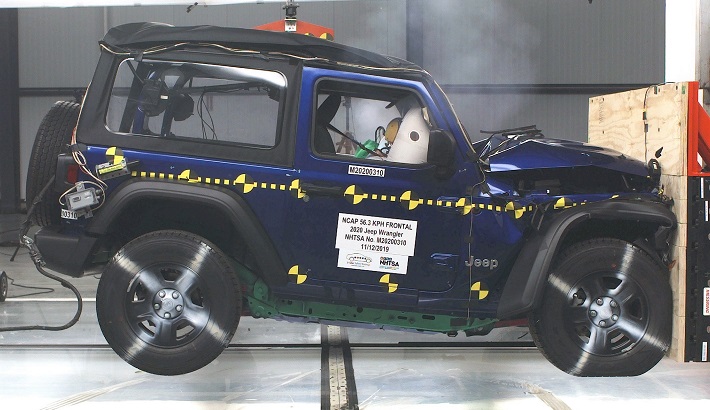
NHTSA crash tests
The agency crash-tested this model year itself. These are its own
photographs and star ratings.
Frontal crash test
Photographs taken by NHTSA during its own New Car Assessment Program crash
tests of this model year. Public domain.
Configuration
Overall
Front
Side
Rollover
2023 Jeep Wrangler SUV 4WD
—
—
27.9% risk
When owners complained
A spike years after the car went on sale usually means a part wearing
out on schedule across the whole fleet — the kind of pattern no single
owner can see from inside their own car.
Nov 2022peak 47Sep 2026
NHTSA investigations into the 2023 Jeep Wrangler
An investigation is the step before a recall: the agency has seen enough
complaints to look into a pattern itself. An open one means it thinks
something may be wrong and nothing has been fixed yet.
2
investigations are
still open.
PE24024Opened 6 Sep 2024Still openSTEERING:HYDRAULIC POWER ASSIST:PUMP
Underhood fires
The Office of Defects Investigation (ODI) has received 9 Vehicle Owner's Questionnaire (VOQ) reports, 1 Death and Injury report, and multiple field reports alleging incidents of engine compartment fires in model year (MY) 2021-2023 Jeep Wrangler and Gladiator vehicles. The majority of the reports describe a fire occurring while the ignition in the vehicle was in an ‘OFF’ state with a suspected origin at the passenger front side of the engine compartment. An ignition ‘OFF’ vehicle fire can result in an increased risk of occupant injury, injury to persons outside the vehicle, and property damage...
RQ24012Opened 5 Jul 2024Still openELECTRICAL SYSTEM
Loss of Motive Power
The Office of Defects Investigation (ODI) has identified 68 Vehicle Owner Questionnaire (VOQ) reports for model years (MY) 2021 through 2024 Jeep Wrangler 4xe vehicles alleging a loss of motive power. Recall 22V-865 was issued by the manufacturer to address an engine shutdown condition in certain MY 2021-2023 Wrangler 4xe vehicles. The complaints noted here contain both post recall remedy failures and failures in vehicles not included within the scope of 22V-865. An analysis comparing complaints received before the issuance of recall 22V-865 and complaints outside the scope of the recall has b...
Recalls on the 2023 Jeep Wrangler
A complaint is one owner's allegation. A recall is the point at which
the manufacturer or a regulator agreed the defect is real and dangerous
enough to fix for free — however old the car is.
United States — NHTSA
26V363000
STEERING:HYDRAULIC POWER ASSIST:PUMP
Chrysler (FCA US, LLC) is recalling certain 2021-2025 Jeep Wrangler, Wrangler 4XE, and Jeep Gladiator vehicles. The electric hydraulic power steering pump wiring may overheat and cause a vehicle fire, even when the vehicle is parked with the ignition in the "Off" position.
Risk: A vehicle fire increases the risk of injury.
Chrysler (FCA US, LLC) is recalling certain 2020-2025 Jeep Wrangler 4Xe and 2022-2026 Grand Cherokee 4Xe vehicles. The high voltage battery may fail internally and lead to a vehicle fire while parked or driving.
Risk: A vehicle fire can increase the risk of injury.
24V676000
BACK OVER PREVENTION: SENSING SYSTEM: CAMERA
Chrysler (FCA US, LLC) is recalling certain 2018-2024 Jeep Wrangler vehicles. The wiring harness for the rearview camera and the center brake light may short circuit, which can disable the rearview camera image and center brake light. As such, these vehicles fail to comply with the requirements of Federal Motor Vehicle Safety Standard numbers 111, "Rear Visibility" and 108, "Lamps, Reflective Devices, and Associated Equipment."
Risk: A rearview camera image that does not display decreases the driver's visibility, increasing the risk of a crash. Additionally, a center brake light that fails to illuminate can fail to indicate to other drivers that the vehicle is slowing down, increasing the risk of a crash.
24V652000
ELECTRICAL SYSTEM: INSTRUMENT CLUSTER/PANEL
Chrysler (FCA US, LLC) is recalling certain 2020-2024 Jeep Gladiator and 2018-2024 Jeep Wrangler vehicles. The instrument panel cluster may experience an internal short circuit and fail. As such, these vehicles fail to comply with the requirements of Federal Motor Vehicle Safety Standard number 101, "Controls and Displays."
Risk: An instrument panel that fails to display critical safety information, such as the speedometer or warning lights, can increase the risk of a crash.
24V199000
AIR BAGS:FRONTAL:DRIVER CLOCKSPRING/SPIRAL CASSETTE
Chrysler (FCA US, LLC) (Stellantis) is recalling certain 2023-2024 Ram 1500, Jeep Wrangler, Jeep Wagoneer, Jeep Grand Wagoneer, Chrysler Pacifica, Ram 3500, Ram 3500 cab chassis, Ram 2500, Ram 4500 cab chassis, Ram 5500 cab chassis, 2023 Jeep Gladiator, Jeep Grand Cherokee, Jeep Grand Cherokee L, Ram 3500 Cab Chassis with a GVWR less than 10,000 lbs., and Chrysler Voyager vehicles. The steering column control module may not be welded properly, which can prevent the driver's air bag from deploying in a crash. As such, these vehicles fail to comply with the requirements of Federal Motor Vehicle Safety Standard number 208, "Occupant Crash Protection."
Risk: An air bag that does not deploy in a crash can increase the risk of injury.
24V111000
VISIBILITY:DEFROSTER/DEFOGGER/HVAC SYSTEM
Chrysler (FCA US, LLC) is recalling certain 2021-2024 Jeep Wrangler and 2022-2024 Jeep Grand Cherokee vehicles. A hybrid control processor (HCP) software error may cause the defrosting and defogging system to be inoperative. As such, these vehicles fail to comply with the requirements of Federal Motor Vehicle Safety Standard number 103, "Windshield Defrosting and Defogging Systems."
Risk: An inoperative windshield defrosting and defogging system may decrease the driver's visibility, increasing the risk of a crash.
Chrysler (FCA US, LLC) is recalling certain 2021-2023 Jeep Wrangler Plug-In Hybrid Electric (PHEV) vehicles. The high voltage battery may fail internally and lead to a vehicle fire while parked or driving.
Risk: A vehicle fire while parked or driving can increase the risk of injury.
23V641000
POWER TRAIN:MANUAL TRANSMISSION
Chrysler (FCA US), LLC is recalling certain 2022-2023 Jeep Wrangler and Gladiator vehicles equipped with a manual transmission. The rearview camera may fail to display the rearview image and the reverse lights may not illuminate when the vehicle is placed in reverse. As such, these vehicles fail to comply with the requirements of Federal Motor Vehicle Safety Standard numbers 111, "Rear Visibility" and 108, "Lamps, Reflective Devices, and Associated Equipment."
Risk: A disabled rearview image can decrease the driver's visibility of the rear view, and disabled reverse lights may not alert others that the vehicle is reversing, increasing the risk of injury or crash.
Canada — Transport Canada
Canada runs its own recall programme, and its campaigns do not
always mirror the American ones.
Recall 2026271106,258 units in Canada
Steering
Issue: On certain vehicles, the connection for the electric hydraulic power steering pump (EHPSP) could become loose. If this happens, the EHPSP connection could overheat and melt. Safety Risk: Wiring that overheats and melts can create a fire risk, even while the vehicle is parked and turned off. Corrective Actions: To reduce the safety risk, FCA recommends that you should park your vehicle outside and away from other vehicles or buildings until the recall repairs are completed. FCA Canada will notify owners in writing and advise you to take your vehicle to a dealership to inspect and, if necessary, replace the EHPSP and the wiring.
Recall 202559520,753 units in Canada
High Voltage
Issue: On certain vehicles, the recall repairs completed by an FCA dealer during recall 95B (Transport Canada recall no. 2024-566) may not be effective. As a result, another repair is required. On certain vehicles, there could be a problem inside the high-voltage battery that can cause a fire, even while parked with the ignition off. Note: This recall only affects 4xe plug-in hybrid (PHEV) models. This recall replaces Transport Canada recall no. 2024-566. Safety Risk: The vehicle could catch fire, even while parked and turned off. Corrective Actions: To reduce the safety risk, FCA advises not to charge your vehicle, and to park it outdoors and away from other vehicles or structures until the recall repairs have been completed. FCA Canada will notify owners in writing and advise you to take your vehicle to a dealership to update the high-voltage battery pack software. If necessary, the battery pack will be replaced.
Recall 202456614,038 units in Canada
High Voltage
Issue: On certain vehicles, the recall repairs completed by an FCA dealer during recall B9A (Transport Canada recall no. 2023-627) may not be effective. As a result, a second repair is required. On certain vehicles, there could be a problem inside the high-voltage battery that can cause a fire, even while parked with the ignition off. Note: This recall only affects 4xe plug-in hybrid (PHEV) models. This recall replaces Transport Canada recall no. 2023-627. Safety Risk: The vehicle could catch fire, even while parked and turned off. Corrective Actions: To reduce the safety risk, FCA advises not to charge your vehicle, and to park it outdoors and away from other vehicles or structures until the recall repairs have been completed. FCA Canada will notify owners by mail and advise you to take your vehicle to a dealership to update the high-voltage battery pack software. If necessary, the battery pack will be replaced.
Recall 20245041,613 units in Canada
Lights And Instruments
Issue: On certain vehicles, the instrument panel cluster could stop working. As a result, warnings, tell-tales and gauges may not display. Note: This recall only affects vehicles equipped with a 3.5" instrument cluster panel. Safety Risk: Warnings, tell-tales and gauges that don't display could increase the risk of a crash. Corrective Actions: FCA Canada will notify owners by mail and advise you to take your vehicle to a dealership to replace the instrument panel cluster.
Recall 20241703,417 units in Canada
Airbag
Issue: On certain vehicles, the steering column control module may not have been manufactured properly. As a result, the driver-front airbag may not inflate in a crash. Note: This problem would cause the airbag warning light to turn on. Safety Risk: An airbag that is turned off could increase the risk of injury in a crash. Corrective Actions: FCA Canada will notify owners by mail and advise you to take your vehicle to a dealership to inspect and, if necessary, replace the steering column control module.
Recall 202409816,039 units in Canada
Heater And Defroster
Issue: On certain vehicles, a software problem could cause the windshield defrost system not to work properly. As a result, the vehicles don't meet the requirements of Canadian regulations. Note: This recall only affects plug-in hybrid (PHEV) models. Safety Risk: A windshield defroster that doesn't work may cause reduced visibility and increase the risk of a crash. Corrective Actions: FCA Canada will notify owners by mail and advise you to take your vehicle to a dealership to update the hybrid control processor (HCP) software.
Recall 20236273,856 units in Canada
High Voltage
Issue: On certain Wrangler 4xe plug-in hybrid electric vehicles (PHEV), there could be a problem inside the high-voltage battery that can cause a fire, even while parked with the ignition off. Safety Risk: The vehicle could catch fire, even while parked and turned off. Corrective Actions: FCA Canada will notify owners by mail and advise you to take your vehicle to a dealership to update the high-voltage battery pack software. If necessary, the battery pack will be replaced. FCA advises not to charge your vehicle, and to park it outdoors and away from other vehicles or structures until the recall repairs have been completed.
Recall 20235141,051 units in Canada
Lights And Instruments
Issue: On certain vehicles equipped with a manual transmission, a problem with the gear sensor (AGS) could cause the rearview camera not to work and the backup lamps not to turn on when backing up. Safety Risk: A rearview camera image that doesn't display could reduce a driver's ability to see behind the vehicle while backing up. Additionally, backup lamps that don't turn on could cause a person not to recognize that the vehicle is backing. Both issues could increase the risk of a crash. Corrective Actions: FCA Canada will notify owners by mail and advise you to take your vehicle to a dealership to replace the all gear sensor (AGS).
Reports where the owner recorded a crash, a fire, an injury or a death.
at 17,000 milesBuffalo, NYCrash2 injured
AIR BAGS
The contact owned a 2023 Jeep Wrangler. The contact stated that while her husband was driving through an intersection at 40 MPH, another driver ran a stop light and crashed into the front driver's side of the vehicle. The other driver's vehicle went underneath the contact's vehicle as the contact's back tires drove over the other driver's engine. The other driver admitted fault due to distracted driving. The contact stated that no air bags deployed inside the vehicle; however, the other vehicle did have the air bags deploy. The contact and her husband were seen by paramedics at the scene of the accident. The contact later sought treatment from her doctor, where an MRI was performed, which showed that the contact had suffered a concussion. The MRI also showed that the contact had suffered a traumatic brain injury, as white matter changes were found in her brain. In addition, the contact was informed that parts of her vertebrae were also damaged, which required surgery. The surgery involved a bone fusion of bone C5 to C6 and a disc replacement of bone C4 to C5. The contact mentioned she was a registered nurse for 25 years, and due to the severity of her injuries, she can no longer return to her profession. The contact's husband was also treated by his doctor for a dislocated right wrist. The injuries of the other driver were unknown if any; however her father, who was a police officer, picked her up from the scene of the crash. A police report was filed. As a result of the accident, the vehicle was totaled and was towed to an independent wrecking yard. The dealer nor the manufacturer had yet been notified of the failure. The vehicle was destroyed. The failure mileage was approximately 17,000.
NHTSA complaint #11711430 — an unverified report by a vehicle owner.
Wexford, PACrash
SERVICE BRAKES
Over the past two days, the vehicle has intermittently displayed an Electronic Stability Control (ESC) system error message while driving. At the same time, the brake pedal becomes extremely hard to press, as if the brake booster or power assist is not functioning. When this occurs, it requires significantly increased force to slow or stop the vehicle, creating a serious safety hazard. The issue appears randomly and then resolves on its own. The vehicle starts normally, but the brake assist failure and ESC warning recur intermittently without warning. No modifications have been made to the braking system. I lightly tapped my house due to the sudden loss of braking power. No accident with another vehicle or person.
NHTSA complaint #11711348 — an unverified report by a vehicle owner.
Jefferson, GAFire
ELECTRICAL SYSTEM
On October 25th, 2025 my husband and I were driving home on the freeway. All of a sudden, without any warning notice or check engine light, my hybrid 2023 Jeep caught on fire as we were in it driving down the freeway. The fire started under the hood and under us. Flames were coming up the sides of the Jeep as we drove and were getting bigger then coming in the vents and under the hood. My husband pulled the Jeep over to the shoulder and we quickly got out and away from the Jeep and called 911 for help. Cars were still driving down the freeway as the Jeep was engulfed in flames. Our safety was put at high risk since we were driving on the freeway at highway speeds and the Jeep caught on fire without any warning and my husband and I were sitting inside the Jeep traveling while it was actively on fire and getting worse. We were located right by the fire as we were driving. It was under us, in front of us and growing around us. Others were put at risk because there was a large fire on the side of the freeway as other vehicles were driving by. A semi truck almost hit the median in the freeway when it probably noticed what was going on. Further, vehicles were driving in the right hand lane right beside the active fire. My Jeep was sparking, throwing flames and some things exploded. Jeep hybrids have had problems and my Jeep has had many recalls and problems. Stellantis was involved with the last few dealership service visits. The Jeep was not charging so a new charging system was put in it at the dealership. The Jeep had a red turtle come on as I was driving and it drastically slowed my speed down suddenly. I pulled over and then my Jeep turned off and would not start again for hours. The dealership, with Stellantis involved, put in a new rechargeable battery. These were some of the things done recently prior to my Jeep catching on fire en route in addition to many recalls/updates. There were no warning signs at all prior to his Jeep fire.
NHTSA complaint #11697246 — an unverified report by a vehicle owner.
Jefferson, GAFire
ENGINE
On October 25th, 2025 my husband and I were driving home on the freeway. All of a sudden, without any warning notice or check engine light, my hybrid 2023 Jeep caught on fire as we were in it driving down the freeway. The fire started under the hood and under us. Flames were coming up the sides of the Jeep as we drove and were getting bigger then coming in the vents and under the hood. My husband pulled the Jeep over to the shoulder and we quickly got out and away from the Jeep and called 911 for help. Cars were still driving down the freeway as the Jeep was engulfed in flames. Our safety was put at high risk since we were driving on the freeway at highway speeds and the Jeep caught on fire without any warning and my husband and I were sitting inside the Jeep traveling while it was actively on fire and getting worse. We were located right by the fire as we were driving. It was under us, in front of us and growing around us. Others were put at risk because there was a large fire on the side of the freeway as other vehicles were driving by. A semi truck almost hit the median in the freeway when it probably noticed what was going on. Further, vehicles were driving in the right hand lane right beside the active fire. My Jeep was sparking, throwing flames and some things exploded. Jeep hybrids have had problems and my Jeep has had many recalls and problems. Stellantis was involved with the last few dealership service visits. The Jeep was not charging so a new charging system was put in it at the dealership. The Jeep had a red turtle come on as I was driving and it drastically slowed my speed down suddenly. I pulled over and then my Jeep turned off and would not start again for hours. The dealership, with Stellantis involved, put in a new rechargeable battery. These were some of the things done recently prior to my Jeep catching on fire en route in addition to many recalls/updates. There were no warning signs at all prior to his Jeep fire.
NHTSA complaint #11697246 — an unverified report by a vehicle owner.
Jefferson, GAFire
FUEL/PROPULSION SYSTEM
On October 25th, 2025 my husband and I were driving home on the freeway. All of a sudden, without any warning notice or check engine light, my hybrid 2023 Jeep caught on fire as we were in it driving down the freeway. The fire started under the hood and under us. Flames were coming up the sides of the Jeep as we drove and were getting bigger then coming in the vents and under the hood. My husband pulled the Jeep over to the shoulder and we quickly got out and away from the Jeep and called 911 for help. Cars were still driving down the freeway as the Jeep was engulfed in flames. Our safety was put at high risk since we were driving on the freeway at highway speeds and the Jeep caught on fire without any warning and my husband and I were sitting inside the Jeep traveling while it was actively on fire and getting worse. We were located right by the fire as we were driving. It was under us, in front of us and growing around us. Others were put at risk because there was a large fire on the side of the freeway as other vehicles were driving by. A semi truck almost hit the median in the freeway when it probably noticed what was going on. Further, vehicles were driving in the right hand lane right beside the active fire. My Jeep was sparking, throwing flames and some things exploded. Jeep hybrids have had problems and my Jeep has had many recalls and problems. Stellantis was involved with the last few dealership service visits. The Jeep was not charging so a new charging system was put in it at the dealership. The Jeep had a red turtle come on as I was driving and it drastically slowed my speed down suddenly. I pulled over and then my Jeep turned off and would not start again for hours. The dealership, with Stellantis involved, put in a new rechargeable battery. These were some of the things done recently prior to my Jeep catching on fire en route in addition to many recalls/updates. There were no warning signs at all prior to his Jeep fire.
NHTSA complaint #11697246 — an unverified report by a vehicle owner.
Brockton, MAFire
POWER TRAIN
jeep caught on fire while it was parked in the driveway there as a ecall on the battery as it s a 4xe i had an appointment with the jeep dealer on the 16th of december and they cancelled it few days before the scheduled appointment they said they didnt have any loaners as it was a 2 day job they would call to reschedule they did not and it blew up on the 27th of december
NHTSA complaint #11635646 — an unverified report by a vehicle owner.
The most recent complaints
In the owners' own words, exactly as filed with NHTSA.
Spanaway, WA. 98387, WA
ELECTRICAL SYSTEM
Manufacturer Recall Number68C NHTSA Recall Number25V-741 Recall StatusRecall Incomplete Cannot charge and "recommended" to not charge, or park by my own house!! waiting for solution for over a year now. Its unsafe and cannot even get good trade in value. Help me solve this or buy it back. pay it off. something! Its unsafe for my kids and family and property. It needs to get fixed asap
NHTSA complaint #11764089 — an unverified report by a vehicle owner.
Spanaway, WA. 98387, WA
ENGINE
Manufacturer Recall Number68C NHTSA Recall Number25V-741 Recall StatusRecall Incomplete Cannot charge and "recommended" to not charge, or park by my own house!! waiting for solution for over a year now. Its unsafe and cannot even get good trade in value. Help me solve this or buy it back. pay it off. something! Its unsafe for my kids and family and property. It needs to get fixed asap
NHTSA complaint #11764089 — an unverified report by a vehicle owner.
Maryville, TN
POWER TRAIN
After the 68c recall the power of the electric drive is limited. Frequent power loss occurs on highway driving during acceleration (merging onto highway or passing other cars). Despite the battery being charged up to 50% there is only 25% power available. The car is a plug in hybrid vehicle. The internal combustion engine starts in these cases with several seconds delay. During that time the car does not accelerate sufficiently to safely merge onto a highway or pass other cars. The power loss happens without warning during critical drive situations like merging onto a highway or passing other cars. The driver expects a continuous level of power by the car, not a sudden power loss. This is reported by countless other drivers on all social media platforms as a consequence of the 68C recall that affects 350 000 Jeep Wrangler 4xe and Grand Cherokee 4xe. Jeep does not respond to customer complaints or requests for clarification.
NHTSA complaint #11763913 — an unverified report by a vehicle owner.
Willowbrook, IL
UNKNOWN OR OTHER
Vehicle went into “limp mode” as I was entering an intersection. Pressed accelerator to the floor and vehicle would only sputter and crawl slowly. Vehicle towed to dealership. My safety and the safety of others was put at risk as the vehicle, without warning, essentially stalled while driving. If there were other vehicles on the roadway, this could have easily caused an an accident with injuries or worse. Yes the problem was comfirmed by the dealership. Yes the vehicle has been inspected by the dealer and manufacturer engineer. Dealership reports high voltage battery needs replacement. Dealership states that they cannot guarantee this won’t happen again even after battery is replaced. Check engine light was illuminated.
NHTSA complaint #11761713 — an unverified report by a vehicle owner.
Willowbrook, IL
ELECTRICAL SYSTEM
Vehicle went into “limp mode” as I was entering an intersection. Pressed accelerator to the floor and vehicle would only sputter and crawl slowly. Vehicle towed to dealership. My safety and the safety of others was put at risk as the vehicle, without warning, essentially stalled while driving. If there were other vehicles on the roadway, this could have easily caused an an accident with injuries or worse. Yes the problem was comfirmed by the dealership. Yes the vehicle has been inspected by the dealer and manufacturer engineer. Dealership reports high voltage battery needs replacement. Dealership states that they cannot guarantee this won’t happen again even after battery is replaced. Check engine light was illuminated.
NHTSA complaint #11761713 — an unverified report by a vehicle owner.
Willowbrook, IL
ENGINE
Vehicle went into “limp mode” as I was entering an intersection. Pressed accelerator to the floor and vehicle would only sputter and crawl slowly. Vehicle towed to dealership. My safety and the safety of others was put at risk as the vehicle, without warning, essentially stalled while driving. If there were other vehicles on the roadway, this could have easily caused an an accident with injuries or worse. Yes the problem was comfirmed by the dealership. Yes the vehicle has been inspected by the dealer and manufacturer engineer. Dealership reports high voltage battery needs replacement. Dealership states that they cannot guarantee this won’t happen again even after battery is replaced. Check engine light was illuminated.
NHTSA complaint #11761713 — an unverified report by a vehicle owner.
Torrance, CA
POWER TRAIN
I own a 2023 Jeep Wrangler 4-Door Sahara 4xe (VIN [XXX], plug-in hybrid). Since new, this vehicle has had repeated electrical and high-voltage (HV) hybrid battery system failures. About eight months after purchase, at approximately 6,590 miles, the vehicle lost power and would not restart in a parking lot ("Service Charging System" warning) and had to be towed to the dealer (Repair Order #[XXX], 10/18/2023–10/20/2023); a 12V battery failure was diagnosed. On February 9–10, 2026, the dealer performed Recall Campaign 68C (JL/WL PHEV HV Battery) on this vehicle — a software/module update to the BPCM, HCP, AHCP, PCM, TCM, and IDCM, plus an HV battery diagnostic analysis (Repair Order #[XXX]). On [XXX], at approximately 22,692 miles, the check engine light illuminated and the dealer diagnosed a hybrid (HV) battery failure. The manufacturer (Stellantis/FCA US LLC) subsequently opened a warranty case (#[XXX]) and a lemon-law repurchase case (#[XXX]), confirming the vehicle could not be repaired and offering repurchase or $15,000 cash compensation. As of this filing, the vehicle remains at the dealership, out of service, well past the dealer's own promised repair completion date. Across its ownership, this vehicle has been out of service for HV-battery- and electrical-system-related repairs for a documented cumulative total of approximately 50 days. I am filing this report because a vehicle losing propulsion/electrical power unexpectedly, and a manufacturer needing to run an HV battery software recall campaign on this same vehicle only six months before a full HV battery failure, both raise safety concerns beyond an ordinary warranty repair, and I want this pattern on record in case other owners of this model are experiencing the same failures. INFORMATION REDACTED PURSUANT TO THE FREEDOM OF INFORMATION ACT (FOIA), 5 U.S.C. 552(B)(6)
NHTSA complaint #11758933 — an unverified report by a vehicle owner.
Torrance, CA
ELECTRICAL SYSTEM
I own a 2023 Jeep Wrangler 4-Door Sahara 4xe (VIN [XXX], plug-in hybrid). Since new, this vehicle has had repeated electrical and high-voltage (HV) hybrid battery system failures. About eight months after purchase, at approximately 6,590 miles, the vehicle lost power and would not restart in a parking lot ("Service Charging System" warning) and had to be towed to the dealer (Repair Order #[XXX], 10/18/2023–10/20/2023); a 12V battery failure was diagnosed. On February 9–10, 2026, the dealer performed Recall Campaign 68C (JL/WL PHEV HV Battery) on this vehicle — a software/module update to the BPCM, HCP, AHCP, PCM, TCM, and IDCM, plus an HV battery diagnostic analysis (Repair Order #[XXX]). On [XXX], at approximately 22,692 miles, the check engine light illuminated and the dealer diagnosed a hybrid (HV) battery failure. The manufacturer (Stellantis/FCA US LLC) subsequently opened a warranty case (#[XXX]) and a lemon-law repurchase case (#[XXX]), confirming the vehicle could not be repaired and offering repurchase or $15,000 cash compensation. As of this filing, the vehicle remains at the dealership, out of service, well past the dealer's own promised repair completion date. Across its ownership, this vehicle has been out of service for HV-battery- and electrical-system-related repairs for a documented cumulative total of approximately 50 days. I am filing this report because a vehicle losing propulsion/electrical power unexpectedly, and a manufacturer needing to run an HV battery software recall campaign on this same vehicle only six months before a full HV battery failure, both raise safety concerns beyond an ordinary warranty repair, and I want this pattern on record in case other owners of this model are experiencing the same failures. INFORMATION REDACTED PURSUANT TO THE FREEDOM OF INFORMATION ACT (FOIA), 5 U.S.C. 552(B)(6)
NHTSA complaint #11758933 — an unverified report by a vehicle owner.
Walnutport, PA
ELECTRICAL SYSTEM
Vehicle left me stranded in the middle of an intersection XXX due to high voltage battery failure. Vehicle was totally inoperable. This is the second time the battery has failed. First battery replacement was XXX. Also serviced XXX for battery issues. Vehicle had to be towed to the dealership, date unknown when battery will arrive for replacement. I'm now left with a vehicle that will have zero value for resale. I do not feel safe driving this vehicle and cannot consider driving the Jeep for a long distance. I tried to chat one of the agents associated with NHTSA named [XXX], she was very rude. I hope you can understand this situation is extremely upsetting. Thank you. INFORMATION REDACTED PURSUANT TO THE FREEDOM OF INFORMATION ACT (FOIA), 5 U.S.C. 552(B)(6)
NHTSA complaint #11758155 — an unverified report by a vehicle owner.
Ambler, PA
ELECTRICAL SYSTEM
This vehicle is subject to two open NHTSA fire-risk recalls. The remedies provided so far have not corrected the underlying defects. Recall 25V-741 (Safety Recall 95B/68C), high-voltage battery fire risk: On 1/9-20/2025, dealer reprogrammed BPCM and TCM software only (Invoice #52682); no parts replaced; mileage 18,680. On 1/6-7/2026 - one year later - the dealer performed a SECOND remedy for the SAME recall: reprogrammed BPCM, AHCP/HCP, and PCM software only (Invoice #61639); no parts replaced; mileage 31,553-31,561. Reprogramming the same modules twice within 12 months for the same fire-risk recall, with no battery hardware ever replaced, indicates the first remedy failed to correct the defect. The recall notice describes battery pack replacement as a possible remedy "if needed," but this has never been performed. Recall 26V363000 (issued 6/4/2026), EPS pump wiring fire risk: On 7/10/2026, dealer inspected the power steering pump harness connector only (Invoice #66268, "Safety Recall 21D"); no parts replaced; mileage 36,871-36,874. Across 3 remedy visits spanning both recalls, only software reprogramming or connector inspection was performed - zero hardware parts replaced. This pattern indicates the fire-risk defects remain uncorrected. Requesting NHTSA review the adequacy of these recall remedies.
NHTSA complaint #11757896 — an unverified report by a vehicle owner.
Ambler, PA
ENGINE
This vehicle is subject to two open NHTSA fire-risk recalls. The remedies provided so far have not corrected the underlying defects. Recall 25V-741 (Safety Recall 95B/68C), high-voltage battery fire risk: On 1/9-20/2025, dealer reprogrammed BPCM and TCM software only (Invoice #52682); no parts replaced; mileage 18,680. On 1/6-7/2026 - one year later - the dealer performed a SECOND remedy for the SAME recall: reprogrammed BPCM, AHCP/HCP, and PCM software only (Invoice #61639); no parts replaced; mileage 31,553-31,561. Reprogramming the same modules twice within 12 months for the same fire-risk recall, with no battery hardware ever replaced, indicates the first remedy failed to correct the defect. The recall notice describes battery pack replacement as a possible remedy "if needed," but this has never been performed. Recall 26V363000 (issued 6/4/2026), EPS pump wiring fire risk: On 7/10/2026, dealer inspected the power steering pump harness connector only (Invoice #66268, "Safety Recall 21D"); no parts replaced; mileage 36,871-36,874. Across 3 remedy visits spanning both recalls, only software reprogramming or connector inspection was performed - zero hardware parts replaced. This pattern indicates the fire-risk defects remain uncorrected. Requesting NHTSA review the adequacy of these recall remedies.
NHTSA complaint #11757896 — an unverified report by a vehicle owner.
Cushing, OK
ELECTRICAL SYSTEM
Battery pack replacement twice and engine replacement this jeep had problems right after I got it new been in the shop 12 times over and over again they can not get it right
NHTSA complaint #11757798 — an unverified report by a vehicle owner.
Cushing, OK
ENGINE
Battery pack replacement twice and engine replacement this jeep had problems right after I got it new been in the shop 12 times over and over again they can not get it right
NHTSA complaint #11757798 — an unverified report by a vehicle owner.
North Little Rock, AR
ENGINE
My 2023 Jeep Wrangler 4xe High Altitude received FCA Recall 68C. Since the recall was completed, the vehicle has experienced repeated and unpredictable reductions in available propulsion during normal driving. The problem is most noticeable when accelerating to merge onto highways, enter traffic, or pass slower vehicles. During these situations, I depress the accelerator expecting normal acceleration, but the vehicle frequently provides significantly reduced power. There is a noticeable delay before the gasoline engine produces sufficient propulsion, leaving the vehicle unable to accelerate as expected for several seconds. Based on my experience, the condition is significantly worse during hot weather. As outside temperatures increase, the hesitation and reduction in available propulsion appear to occur more frequently and are more pronounced. This has caused me to lose confidence in the vehicle's ability to accelerate when needed. This condition creates a serious safety hazard because surrounding traffic continues at highway speeds while my vehicle is unable to accelerate as commanded. In [XXX], this hazard is particularly acute because many interstate and highway entrance ramps are relatively short, requiring drivers to accelerate quickly to merge safely into traffic traveling at highway speeds. When the vehicle unexpectedly limits propulsion or delays engaging the gasoline engine, there may not be sufficient distance to reach the speed necessary to merge safely, increasing the risk of a collision. The same issue also affects attempts to pass slower vehicles on two-lane highways, where timely acceleration is essential for safe operation. The vehicle does not display diagnostic trouble codes or warning messages when this occurs. Because no diagnostic codes are stored, I have not taken the vehicle to the dealer, as other owners have reported that dealerships are unable to identify or repair the condition in the absence of fault codes. The lack of diagnostic codes INFORMATION REDACTED PURSUANT TO THE FREEDOM OF IN
NHTSA complaint #11755207 — an unverified report by a vehicle owner.
North Little Rock, AR
FUEL/PROPULSION SYSTEM
My 2023 Jeep Wrangler 4xe High Altitude received FCA Recall 68C. Since the recall was completed, the vehicle has experienced repeated and unpredictable reductions in available propulsion during normal driving. The problem is most noticeable when accelerating to merge onto highways, enter traffic, or pass slower vehicles. During these situations, I depress the accelerator expecting normal acceleration, but the vehicle frequently provides significantly reduced power. There is a noticeable delay before the gasoline engine produces sufficient propulsion, leaving the vehicle unable to accelerate as expected for several seconds. Based on my experience, the condition is significantly worse during hot weather. As outside temperatures increase, the hesitation and reduction in available propulsion appear to occur more frequently and are more pronounced. This has caused me to lose confidence in the vehicle's ability to accelerate when needed. This condition creates a serious safety hazard because surrounding traffic continues at highway speeds while my vehicle is unable to accelerate as commanded. In [XXX], this hazard is particularly acute because many interstate and highway entrance ramps are relatively short, requiring drivers to accelerate quickly to merge safely into traffic traveling at highway speeds. When the vehicle unexpectedly limits propulsion or delays engaging the gasoline engine, there may not be sufficient distance to reach the speed necessary to merge safely, increasing the risk of a collision. The same issue also affects attempts to pass slower vehicles on two-lane highways, where timely acceleration is essential for safe operation. The vehicle does not display diagnostic trouble codes or warning messages when this occurs. Because no diagnostic codes are stored, I have not taken the vehicle to the dealer, as other owners have reported that dealerships are unable to identify or repair the condition in the absence of fault codes. The lack of diagnostic codes INFORMATION REDACTED PURSUANT TO THE FREEDOM OF IN
NHTSA complaint #11755207 — an unverified report by a vehicle owner.
Noblesville, IN
FUEL/PROPULSION SYSTEM
Supplemental Safety Complaint — Post-68C Recall Throttle Non-Response and Loss of Drive Power — Case 11753417. Supplemental incident report referencing prior NHTSA complaint case number 11753417. August 2, 2026. 75°F ambient temperature, low humidity. Vehicle operated normal for approximately 15 electric miles at 40-55 mph, then with 7 miles remaining EV range, electric drive mode exhibited violent, random transitions to ICE engagement. Critical safety concern: pressing accelerator produced zero throttle response for 1-2 seconds during transitions at several intervals. Driver (spouse) felt unsafe. **This incident demonstrates the post-68C software behavior is triggered by both thermal conditions AND low battery state of charge — not temperature alone as previously documented. A throttle dead zone of 1-2 seconds during normal driving constitutes an unreasonable safety risk under federal standards, particularly during merging and intersection navigation. Requesting NHTSA investigate whether the 68C recall remedy introduced unaddressed safety defects affecting throttle response across the 4xe population.
NHTSA complaint #11754319 — an unverified report by a vehicle owner.
Fayetteville, PA
ELECTRICAL SYSTEM
After Recall 68C was performed, the vehicle lost meaningful electric-only operation. This is not FORM. The gasoline engine now intervenes during routine Electric-mode driving with adequate charge. The dealer/manufacturer has not restored the vehicle’s advertised PHEV functionality. Visited dealer to document, and dealer did not charge vehicle and test to see. They instead scanned for codes and said no codes returned.
NHTSA complaint #11754234 — an unverified report by a vehicle owner.
Noblesville, IN
FUEL/PROPULSION SYSTEM
Following the 68C recall remedy, my vehicle's electric drive mode exhibits intermittent and unsafe power loss during normal operation. Symptoms include sudden RPM spikes, abrupt ICE engagement, loss of drive power with a delay before the gas engine catches, and electric mode becoming temporarily unavailable — occurring unpredictably during stop-and-go traffic, merging, and intersection navigation. I have documented a consistent thermal threshold trigger: symptoms reliably emerge after 10-20 minutes of electric mode operation in ambient temperatures above approximately 80°F, and onset is faster when the battery is warm from prior use. No fault codes are generated because the power limiting appears to be intentional software behavior implemented via the 68C recall remedy — not a malfunction. As a result, dealers scan the vehicle, find no codes, and characterize the behavior as normal operation. Stellantis marketed this vehicle on its electric drive capability. Following the 68C recall, a software update appears to have throttled that capability to protect the battery pack from thermal overload — likely because the cooling system cannot maintain safe battery temperatures under sustained electric load. Jeep now calls this reduced capability "normal operation," effectively de-featuring the vehicle via recall remedy while introducing a new safety risk: unexpected power loss during merging and intersection navigation with a dangerous delay before ICE engagement. I have an open FCA Customer Care case on this issue. The dealer has declined to road-test the vehicle until symptoms are actively occurring. I am requesting NHTSA investigate whether the 68C recall remedy introduced an unaddressed safety defect affecting all 4xe vehicles in this population. Videos of symptoms available via YouTube: [XXX] [XXX] [XXX] INFORMATION REDACTED PURSUANT TO THE FREEDOM OF INFORMATION ACT (FOIA), 5 U.S.C. 552(B)(6)
NHTSA complaint #11753417 — an unverified report by a vehicle owner.
Peabody, MA
STEERING
On numerous instances now, while travelling at highway speeds a small bump or uneven surface will cause the vehicle to experience the "Jeep Death Wobble" and will violently shake the entire vehicle out of control unless a rapid deceleration and / or stoppage occurs. I have brought it to a dealer who indicates that they were not able to reproduce the "Shimmy" (they also were unable to perform my safety recalls spite have the vehicle for several days in a row). There is a clear shake, wobble, shimmy, or whatever that is easily reproducible at highway speeds of 50 mph or greater.
NHTSA complaint #11751433 — an unverified report by a vehicle owner.
Brentwood, TN
UNKNOWN OR OTHER
I leased this vehicle in April 2023. I have only put 23,000 miles on it and have only had it serviced by the dealership. Months after the start of my lease I experienced the Jeep Death Wobble at speeds in excess of 70 mph with my newborn son in the car. Never having even heard of it, I am extremely lucky that I maintained composure and did not crash. I took the car to the dealership who claimed they repaired in accordingly under my warranty. Since then the death wobble has returned 3 additional times for a total of 4 times in 3 years (the most recent being 6 months ago) with again only 23,000 miles on the car. Each time I have taken the car to the dealership and they have claimed to have repaired the issue. For the past 3 years, I have been plagued with sheer anxiety every time my vehicle goes over 55 mph, never knowing when the wobble will return but always assuming correctly that it will and it has. This is a known issue that I believe has not been able to be directly attributed to crashed because the outcome relies significantly on the drivers reaction to the problem. Had I not remained calm or made any sudden movements with my car each time that this happened, it easily could have been 4 crashes. Multiply that by how many people I know who have or are experiencing this issue and its crazy that Jeep is allowed to continue operating like this.
NHTSA complaint #11749411 — an unverified report by a vehicle owner.
Newark, NJ
STEERING
The contact owns a 2023 Jeep Wrangler. The contact received notification of NHTSA Campaign Number: 26V363000 (Steering); however, the part to complete the recall repair was not yet available. Neither the dealer nor the manufacturer was contacted. The contact stated that the manufacturer had exceeded a reasonable amount of time for the recall repair. The contact had not experienced a failure.
NHTSA complaint #11749028 — an unverified report by a vehicle owner.
North Liberty, IA
UNKNOWN OR OTHER
My oil plug fell out of my jeep. Within minutes all of the oil had splattered underneath and the back of the jeep. The oil lamp went on in my jeep. From the time the oil warning came on to the seizure of the engine was a couple minutes. The jeep went into protection mode or would not allow me to go over 25 minutes. I saw the engine light come on and went straight to Mobil1, the closest place to get oil and they explained there was oil everywhere and no oil plug. I always got oil changes at the jeep dealership and they were the last to service. They were about to close so i tried to get an oil change. There also had been a slow leak in my driveway that i thought was just coolent but after taking a closer look, I believe it was an oil leak.
NHTSA complaint #11748356 — an unverified report by a vehicle owner.
North Liberty, IA
ENGINE
My oil plug fell out of my jeep. Within minutes all of the oil had splattered underneath and the back of the jeep. The oil lamp went on in my jeep. From the time the oil warning came on to the seizure of the engine was a couple minutes. The jeep went into protection mode or would not allow me to go over 25 minutes. I saw the engine light come on and went straight to Mobil1, the closest place to get oil and they explained there was oil everywhere and no oil plug. I always got oil changes at the jeep dealership and they were the last to service. They were about to close so i tried to get an oil change. There also had been a slow leak in my driveway that i thought was just coolent but after taking a closer look, I believe it was an oil leak.
NHTSA complaint #11748356 — an unverified report by a vehicle owner.
Knightdale, NC
ELECTRICAL SYSTEM
Nothing has happened. They dont know when they can fix this issue and its a fire issue. The solution now is to park away from buildings, but car theft is high, and break-ins happen all around here, so that in itself is an issue. Should be at a dealer lot waiting for a fix and a loaner should be provided by Jeep.
NHTSA complaint #11747396 — an unverified report by a vehicle owner.
Ridgway, CO
POWER TRAIN
While driving, my 2023 Jeep Wrangler 4xe suddenly loses drive power without warning. The car is a plug in hybrid vehicle. The vehicle routinely displays 'Electric Temporarily Unavailable'. When it happens, I press the accelerator and the vehicle does not respond; there is a delay of several seconds with little or no power before the gas engine engages. This is a serious safety hazard — the loss of power is sudden and unpredictable, and the delay leaves me unable to accelerate when merging or pulling into traffic. The condition is reproducible and began after the 68C recall software update. The driver expects a continuous level of power by the car, not a sudden power loss. This is reported by countless other drivers on all social media platforms as a consequence of the 68C recall that affects 350,000 Jeep Wrangler 4xe and Grand Cherokee 4xe. I have taken the vehicle to the dealer multiple times; each visit results in 'no codes found' and 'operating as designed,' and it has not been repaired. Jeep does not respond to customer complaints or requests for clarification.
NHTSA complaint #11746998 — an unverified report by a vehicle owner.